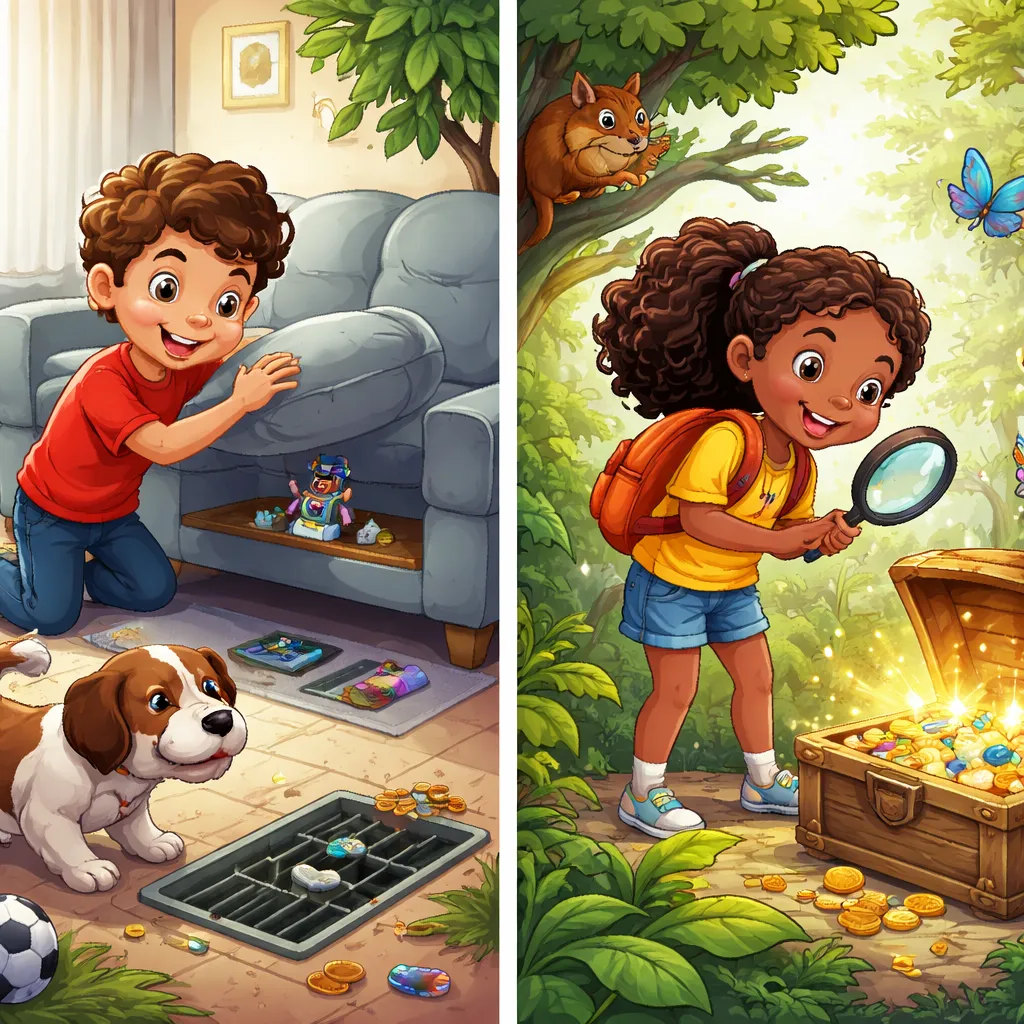

Hey there, word explorer! Have you ever looked for your missing shoe? Or have you ever learned a cool new fact about space? How do you talk about that? Do you find your shoe? Or do you discover a new fact? They both seem to mean coming across something. But are they the same? They are like two different kinds of treasure. One is finding a coin you dropped. One is uncovering a buried chest full of gold! Let's find out! Today, we explore the word friends "find" and "discover". Knowing their secret is a superpower. It makes you a great explorer of the everyday and the extraordinary. Let's start our search!
First, let's be Search Detectives. Listen at home. Here are two sentences. "I need to find my other clean sock for school." "Scientists discover new types of deep-sea creatures every year." They both talk about coming across something. A sock. New creatures. Do they sound the same? One feels like a simple, everyday search. One feels like a big, important revelation. Can you sense it? Great observation! Now, let's look at the map.
Adventure! Inside the World of Coming Across Things
Welcome to the world of coming across things! "Find" and "discover" are two different treasure maps. Think of "find" as a simple map to your lost toy. You know what you're looking for. Think of "discover" as an ancient, mysterious map to a lost city. You don't know what you'll see! Both are about locating. But they locate in different ways. Let's learn about each map.
The Simple Toy Map vs. The Ancient City Map Think about the word "find". "Find" feels like a simple map to a lost toy. It is the everyday word. It means to locate something by searching or by chance. You are looking for something known. I find my keys. Can you find the answer? It is common and practical. Now, think about "discover". "Discover" feels like an ancient map to a lost city. It means to find something for the first time, or to learn something new and unknown. It is about the new and significant. Columbus discovered America. I discovered I love guitar. "Find" is the toy map. "Discover" is the ancient map. One is for the known. The other is for the unknown.
Locating Something vs. Revealing Something New Let's compare their results. "Find" is about the act of locating. The thing may or may not be new. Did you find your homework? I found a penny. It is a simple result. "Discover" is about the act of revealing or learning. The thing is new, surprising, or important. The doctor discovered the cause. She discovered a talent. "Find" answers "where is it?" "Discover" answers "what is this new thing?" One is about recovery. The other is about revelation.
Their Special Word Partners and Common Uses Words have best friends. "Find" loves to team up with everyday lost items. Find out. Find a way. Find it in your heart. It is used in many common phrases. "Discover" has its own special teams. It often pairs with words about science, secrets, and newness. Discover the truth. Discover for yourself. A new discovery. Note: We say "find a mistake". We say "discover a cure". They are different.
Let's visit a school scene. You lose your eraser. You look in your desk and find it under a book. This is a simple act of locating a known object. Now, in science class, you do an experiment. You see a surprising reaction. You discover that mixing vinegar and baking soda makes a gas. This is learning something new and notable. Using "discover" for the eraser is too dramatic. Using "find" for the experiment is okay, but "discover" better captures the new learning.
Now, let's go to the playground. You find a pretty, normal rock. You pick it up. Later, you take it home and look closely. You see a tiny fossil in it! You have discovered a fossil! The word "find" paints the simple act of picking up the rock. The word "discover" paints the exciting moment of seeing the fossil for the first time.
Our Little Discovery So, what did we find? "Find" and "discover" are both about coming across something. But they have a big difference in importance. "Find" is the common word for locating something, whether it's lost or just there. "Discover" means to find something for the first time, or to learn something new and significant that was unknown. You find your phone. You discover a new planet. Knowing this helps you share your exciting finds perfectly.
Challenge! Become an Explorer Word Champion
Ready for a fun test? Let's try your new skills!
"The Best Choice" Challenge Let's imagine a nature scene. A squirrel is gathering nuts. It buried one last fall. Now, it uses its memory to find the exact spot and dig it up. This is locating a known, hidden item. Now, imagine an explorer in a rainforest. She sees a tiny, bright frog she has never seen before. She has just discovered a new species! This is finding something completely new and unknown to science. "Find" wins for the squirrel's hidden nut. "Discover" is the champion for the explorer's new frog.
"My Sentence Show" Your turn to create! Here is your scene: Cleaning out an old box in the attic. Can you make two sentences? Use "find" in one. Use "discover" in the other. Try it! Here is an example: "I hope I find my old trading cards in this box." This is about locating known items. "I might discover a photo of my great-grandparents I've never seen before!" This is about coming across something new and significant. Your sentences will show two levels of finding!
"Eagle Eyes" Search Look at this sentence. Can you find the word that could be better? Let's check a home context. "I discovered my pencil on the kitchen counter where I left it this morning." Hmm. The pencil was left there on purpose, so it's not a new or unknown thing. The word "found" is the simple, correct choice for locating a misplaced item. "I found my pencil on the kitchen counter where I left it this morning." "Discovered" makes it sound like a major event, which it isn't. Did you spot it? Excellent word work!
Harvest and Action! Turn Knowledge Into Your Superpower
Great exploring! We started thinking "find" and "discover" were the same. Now we know they are two different treasure maps. We can use the simple map of "find" for everyday searches. We can use the ancient map of "discover" for new and amazing things. You can now talk about your searches and revelations with perfect accuracy. This is a great skill for a curious mind.
What you can learn from this article: You can now feel that "find" is the common, everyday word for locating something, whether you were looking for it or not. You can feel that "discover" is a more exciting word for finding or learning something for the first time, especially something new, important, or previously unknown. You know that you "find" a seat in a movie theater, but an archaeologist might "discover" an ancient tomb. You learned to match the word to the importance: "find" for simple location, "discover" for new revelation.
Life practice application: Try your new skill today! Look for something you lost. When you see it, say "I found it!" Read a science book. Talk about one thing scientists discovered. Be an explorer in your own backyard. What can you discover? You are now a master of explorer words! Keep finding and discovering wonderful things.