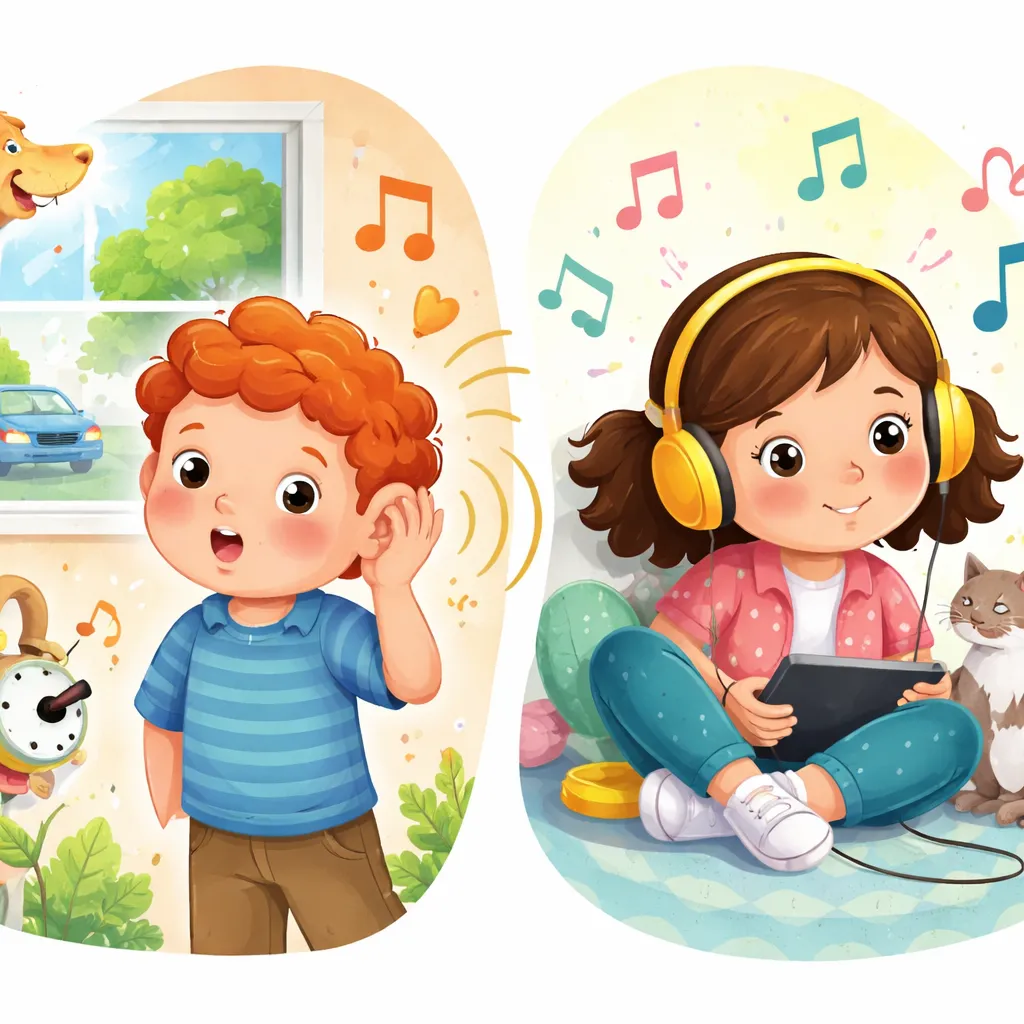

Hey there, sound explorer! Have you ever been in a noisy room? Sounds are everywhere. You hear the chatter. Then, a friend calls your name. You listen to what they say. How are these different? They both use your ears. But are they the same? They are like two different ways to use a microphone. One records all sounds. One focuses on one voice. Let's find out! Today, we explore the word friends "hear" and "listen". Knowing their secret is a superpower. It makes you a great friend and learner. Let's start our sound adventure!
First, let's be Sound Detectives. Listen at home. Here are two sentences. "I can hear the rain on the roof." "Please listen to my instructions carefully." They both involve your ears. Rain. Instructions. Do they sound the same? One feels like a sound that just arrives. One feels like you are trying to understand. Can you sense it? Great observation! Now, let's tune in with our word hearing aid.
Adventure! Into the World of Sound
Welcome to the world of sound! "Hear" and "listen" are two different microphones. Think of "hear" as an open window. Sounds just come in. You don't try. Think of "listen" as a pair of special headphones. You choose to focus on one sound. Both are about your ears. But they work in different ways. Let's learn about each one.
The Open Window vs. The Headphones Think about the word "hear". "Hear" feels like an open window. Sounds enter your ears without you trying. It is a physical sense. I hear a dog barking. Can you hear that? It is passive. The sound happens, and your ears catch it. Now, think about "listen". "Listen" feels like putting on headphones. You choose to pay attention to a sound. You want to understand it. Listen to this song. Listen to your teacher. "Hear" is the open window. "Listen" is the focused headphones. One is automatic. The other is a choice.
The Automatic Sense vs. The Active Choice Let's compare their action. "Hear" is an automatic sense. It just happens. You hear thousands of sounds every day. The wind, a door closing, a TV in another room. You don't think about them. "Listen" is an active choice. You decide to pay attention. You listen to a story. You listen for your mom's car. "Hear" is for all sounds. "Listen" is for important sounds. One is receiving. The other is receiving and thinking.
Their Special Word Partners and Common Uses Words have best friends. "Hear" loves to team up in common phrases about sounds and news. Hear a noise. Hear from someone. I've heard that before. It is used for receiving information. "Listen" has its own special teams. It always needs a friend like "to" or "for". Listen to me. Listen for the bell. It is about paying attention. Note: We say "I hear you" (I understand). We say "Listen up!" (pay attention). They are different.
Let's visit a school scene. In the cafeteria, you hear a mix of laughter, chairs, and talking. This is the open window. Sounds are everywhere. Then, your friend starts telling a joke. You listen to the joke so you can laugh. This is putting on your headphones. Using "listen" for the general noise is not right. Using "hear" for the joke is okay, but "listen" shows you are paying attention to understand.
Now, let's go to the playground. You hear birds, kids shouting, and a distant ice cream truck. Your ears catch it all. Your coach blows a whistle. You stop and listen for the next instruction. The word "hear" paints the background noise. The word "listen" paints the focused attention on the coach.
Our Little Discovery So, what did we find? "Hear" and "listen" are both about sound. But they are very different. "Hear" is the automatic, physical ability to receive sound. It is passive. "Listen" is the active, mental choice to pay attention to a sound. It is focused. You hear music playing. You listen to the lyrics. Knowing this makes you a better communicator.
Challenge! Become a Sound Word Champion
Ready for a fun test? Let's try your new skills!
"The Best Choice" Challenge Let's imagine a nature scene. A deer is grazing in a forest. Its ears are open. The deer can hear many forest sounds. This is its automatic sense. Then, the deer hears a crack of a twig. It stops and listens carefully to figure out if there is danger. "Hear" wins for the general sounds. "Listen" is the champion for the deer's focused attention on the crack.
"My Sentence Show" Your turn to create! Here is your scene: Doing homework in your room. Can you make two sentences? Use "hear" in one. Use "listen" in the other. Try it! Here is an example: "I can hear my sister playing piano in the next room." This is a sound that enters your ears. "I need to listen to this audio book for my report." This is paying attention to understand. Your sentences will show two ways of using your ears!
"Eagle Eyes" Search Look at this sentence. Can you find the word that could be better? Let's check a home context. "I was listening to the background music while I read, so I didn't hear my mom calling me for dinner." Hmm. The phrase "listening to the background music" suggests active attention. The problem is that the music was in the background, so you were probably just "hearing" it. A better choice: "I was hearing the background music while I read, so I didn't listen for my mom calling me." But actually, the original is common. Let's think: if you were focused on reading, you were not actively "listening" to the music. So: "I was hearing the background music... I didn't hear my mom..." Wait, the point is that the music prevented you from noticing your mom's call. The word "listen" is about attention. A better version: "I had music on, so I didn't hear my mom calling." But for our lesson, let's correct the use of "listen". The word "hear" is better for passive sound. "I was hearing the background music... I didn't hear my mom..." That works. Did you spot it? Excellent word work!
Harvest and Action! Turn Knowledge Into Your Superpower
Great exploring! We started thinking "hear" and "listen" were similar. Now we know they are different stages of sound. We can use the open window of "hear". We can use the headphones of "listen". You can now describe your hearing experiences with perfect accuracy. This is a great skill for friendship and learning.
What you can learn from this article: You can now feel that "hear" is the automatic, physical ability to receive sound with your ears, without trying. You can feel that "listen" is the active choice to pay attention to a sound and try to understand it. You know that you "hear" a car go by, but you "listen to" a friend's secret. You learned to match the word to your intention: "hear" for passive sound, "listen" for active attention.
Life practice application: Try your new skill today! Sit quietly for one minute. What do you hear? Now, choose one sound and listen to it carefully. Tell a friend one thing you hear right now. Then, listen to their answer. Be a great friend by choosing to listen. You are now a master of sound words! Keep your ears and mind open to the wonderful world of sound.