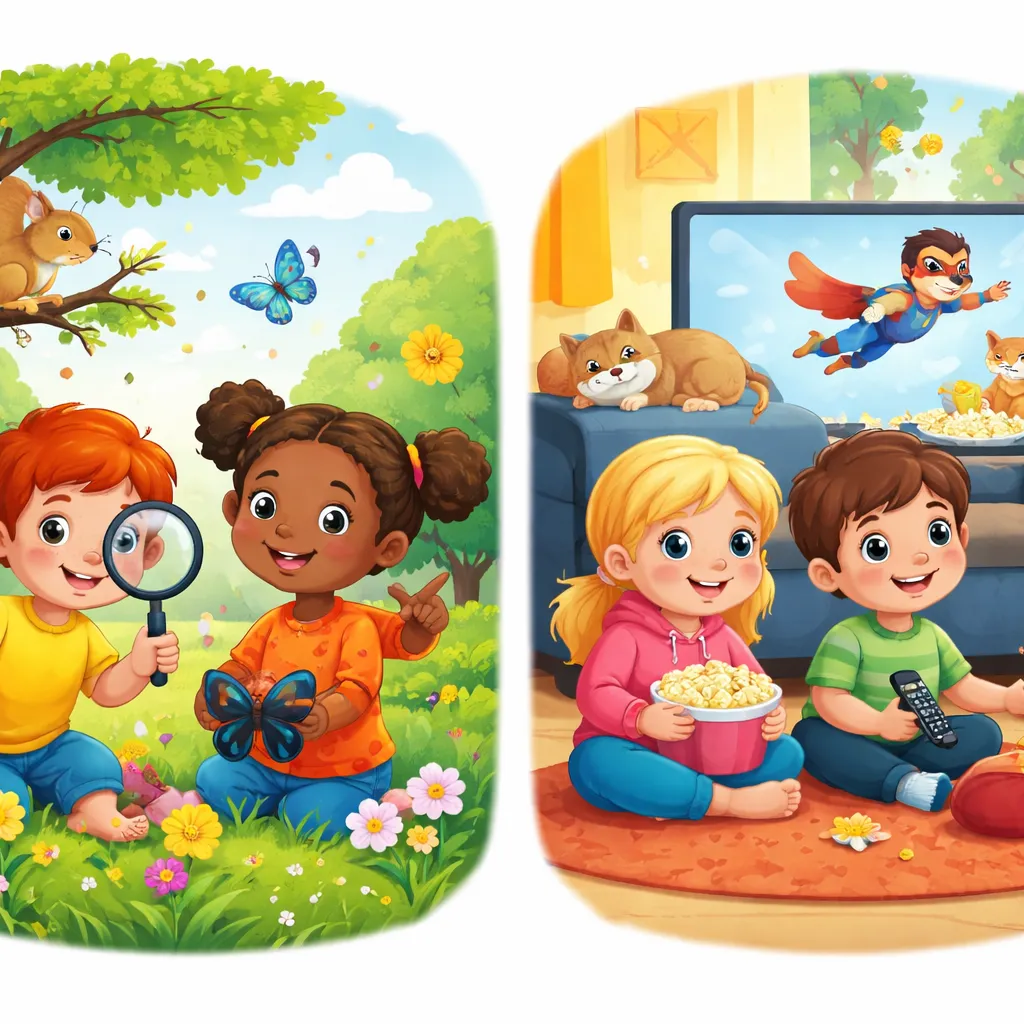

Hey there, word explorer! Have you ever glanced at a clock? Or stared at a movie screen? How do you describe that? Do you look at the clock? Or do you watch the movie? They both seem to mean using your eyes. But are they the same? They are like two different ways to use a camera. One is a quick snapshot. One is a long video. Let's find out! Today, we explore the word friends "look" and "watch". Knowing their secret is a superpower. It makes your stories and instructions super clear. Let's start our visual adventure!
First, let's be Observation Scientists. Listen at home. Here are two sentences. "Look at this picture I drew!" "Let's watch a cartoon together." They both talk about using your eyes. A picture. A cartoon. Do they sound the same? One feels like a quick, single action. One feels like a longer, focused activity. Can you sense it? Great observation! Now, let's look closer with our word microscope.
Adventure! Inside the World of Seeing
Welcome to the world of seeing! "Look" and "watch" are two different camera modes. Think of "look" as taking a quick photo. It is a short, intentional act of seeing. Think of "watch" as recording a video. It is paying attention to something over time, often to see what happens. Both use your eyes. But they use them in different ways. Let's learn about each mode.
The Quick Photo vs. The Long Video Think about the word "look". "Look" feels like taking a quick photo. You direct your eyes to something for a moment. You want to see what it is. Look at that bird. Look both ways before crossing. It is a short, intentional glance. Now, think about "watch". "Watch" feels like recording a long video. You focus your eyes on something for a period of time, usually because it is moving or changing. Watch the road while I drive. We watch the sunset. "Look" is the snapshot. "Watch" is the live stream. One is a moment. The other is a process.
The Short Glance vs. The Focused Attention Let's compare their duration. "Look" is often a brief action. You look, and then you stop. It can also be a general command to pay attention. Hey, look! It can be followed by "at". Look at me. "Watch" implies a longer period of focused attention. You watch something to see an event or change. Watch the pot so it doesn't boil over. I like to watch basketball. "Look" is for a static thing. "Watch" is for action. One is quick. The other is continuous.
Their Special Word Partners and Common Uses Words have best friends. "Look" loves to team up with prepositions and quick actions. Look out! Look for your keys. Look up the word. It is also used for appearances. You look tired. "Watch" has its own special teams. It often pairs with nouns about events, performances, and moving things. Watch TV. Watch a game. Watch out! (be careful). Note: We say "look after" (take care of). We say "watch over" (guard). They are different teams.
Let's visit a school scene. Your teacher holds up a map. She says, "Everyone, look at this country on the map." This is a quick, intentional act to see the country. Now, in science class, you have an experiment. The teacher says, "Watch carefully as the chemicals mix and change color." This asks for focused attention over time to see a change. Using "watch" for the map is possible, but "look" is more common for a static image. Using "look" for the experiment is okay, but "watch" better captures the need to observe the process.
Now, let's go to the playground. You point and say, "Look at that cool cloud!" You want your friend to see it quickly. Later, you sit on a bench and watch your friends play a whole soccer match. You are following the action. The word "look" paints the quick pointing. The word "watch" paints the focused viewing of the game.
Our Little Discovery So, what did we find? "Look" and "watch" are both about using your eyes. But they are used for different purposes. "Look" is about directing your eyes to something, often for a short time, to see what is there. "Watch" is about keeping your eyes on something over time, usually because it is moving or changing. You look at a painting. You watch a race. Knowing this helps you describe how you see the world.
Challenge! Become an Observation Champion
Ready for a fun test? Let's try your new skills!
"The Best Choice" Challenge Let's imagine a nature scene. You are in a forest. A friend whispers, "Quick, look at that deer!" You turn your head for a quick glimpse. The deer is still. You look at it. Now, the deer starts to run gracefully through the trees. You watch it until it disappears. "Look" wins for the quick glimpse. "Watch" is the champion for following the moving deer.
"My Sentence Show" Your turn to create! Here is your scene: Waiting at a bus stop with a parent. Can you make two sentences? Use "look" in one. Use "watch" in the other. Try it! Here is an example: "I look at the bus schedule to see the time." This is a quick act to get information. "We watch the road to see if the bus is coming." This is paying attention over time to a changing scene. Your sentences will show two ways of seeing!
"Eagle Eyes" Search Look at this sentence. Can you find the word that could be better? Let's check a home context. "I watched the beautiful painting on the wall for just a second as I walked by." Hmm. A painting is static. The phrase "for just a second" suggests a very short glance. The word "looked at" is a better fit. "I looked at the beautiful painting on the wall for just a second as I walked by." "Watched" implies longer attention to something changing. Did you spot it? Excellent word work!
Harvest and Action! Turn Knowledge Into Your Superpower
Great exploring! We started thinking "look" and "watch" were the same. Now we know they are two different camera modes. We can take the quick photo of "look". We can record the long video of "watch". You can now describe your observations with perfect accuracy. This is a great skill for stories and daily life.
What you can learn from this article: You can now feel that "look" is about directing your eyes to something for a short time, often to see what is there. You can feel that "watch" is about keeping your eyes on something over time, usually to see movement or change. You know that you "look" at a photo, but you "watch" a movie. You learned to match the word to how you are seeing: "look" for a glance, "watch" for focused attention.
Life practice application: Try your new skill today! Point to something and tell a friend to look. Sit and watch a bird for a minute. Listen to how teachers and parents use these words. Read a comic. Does a character look or watch? You are now a master of seeing words! Keep exploring the wonderful world with your eyes wide open.