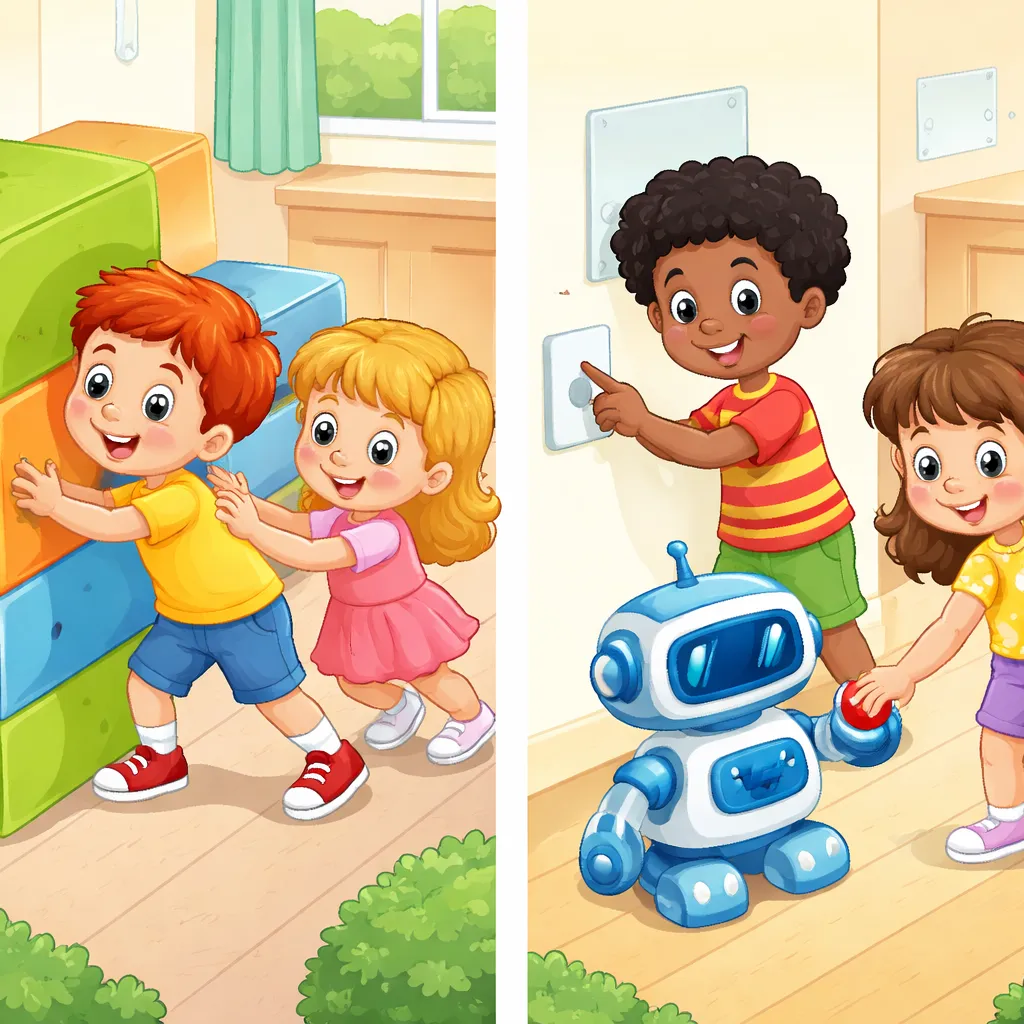

Hello, word explorer! Have you ever moved a swing to get it going? Or put a sticker on a page? How do you talk about that? Do you push the swing? Or do you press the sticker down? They both seem to mean using force with your hands. But are they the same? They are like two different kinds of touch. One is a playful shove to move something away. One is a gentle touch to put something in place. Let's find out! Today, we explore the word friends "push" and "press". Knowing their secret is a superpower. It makes you a master of using your hands. Let's start our touch adventure!
First, let's be Touch Detectives. Listen at home. Here are two sentences. "I need to push the heavy shopping cart down the grocery store aisle." "You must press the button firmly to start the washing machine." They both talk about using force. A shopping cart. A button. Do they sound the same? One feels like moving something forward. One feels like applying force to a spot. Can you sense it? Great observation! Now, let's look at the action.
Adventure! Inside the World of Using Force
Welcome to the world of using force! "Push" and "press" are two different touches. Think of "push" as a playful, moving shove. You use it to move something away from you or forward. Think of "press" as a gentle, stationary touch. You use it to apply pressure on one spot. Both are about force. But they apply it in different ways. Let's learn about each touch.
The Moving Shove vs. The Stationary Touch Think about the word "push". "Push" feels like a moving shove. It means to use force to move something away from you or forward. The goal is movement. Push the door open. The child pushed the toy car. It is about moving an object. Now, think about "press". "Press" feels like a stationary touch. It means to apply steady force against something, often without the main goal of moving it. You press a shirt. Press the buzzer. I pressed my ear to the door. "Push" is the moving shove. "Press" is the stationary touch. One is for motion. The other is for pressure.
Moving an Object vs. Applying Pressure to a Spot Let's compare their goals. "Push" is about moving an object from one place to another. The object moves. You push a swing, push someone on a bike, or push a thought from your mind. "Press" is about applying force to a specific point. The object might not move. You press a key on a piano, press a stamp onto an envelope, or press for an answer. "Push" moves things. "Press" activates or flattens things. One is dynamic. The other is often static.
Their Special Word Partners and Common Uses Words have best friends. "Push" loves to team up with movement and effort. Push through. Push your luck. Push forward. It is about effort. "Press" has its own special teams about pressure and urgency. Press charges. Press conference. Stop the press! Note: We say "push a button" (common). We say "press a button" (more precise for a touch). They are often interchangeable for buttons, but not always.
Let's visit a school scene. The fire door is heavy. You need to push it open to get out. This requires force to move the door. On the interactive whiteboard, you gently press an icon with your finger to open an app. This is a touch on a spot. Using "press" for the heavy door is too soft. Using "push" for the touchscreen is okay, but "press" is the more common and gentle word for screens.
Now, let's go to the playground. You push your friend on the swing to make them go high. This is applying force to create movement. You find a leaf. You press it between the pages of a book to flatten it. This is applying steady pressure to a spot. The word "push" paints the action of moving the swing. The word "press" paints the action of flattening the leaf.
Our Little Discovery So, what did we find? "Push" and "press" are both about applying force. But they have different purposes. "Push" means to use force to move something away from you or forward. The goal is movement. "Press" means to apply steady force against something, often in one place. The goal is pressure, activation, or flattening. You push a stroller. You press a doorbell. Knowing this helps you describe your actions perfectly.
Challenge! Become a Force Word Champion
Ready for a fun test? Let's try your new skills!
"The Best Choice" Challenge Let's imagine a nature scene. A dung beetle finds a ball of dung. It uses its back legs to push the ball across the ground to its home. This is about moving an object. Now, watch a bird building a nest. It uses its body to press twigs and mud into the shape of a cup. This is about applying pressure to form something. "Push" wins for the beetle's rolling motion. "Press" is the champion for the bird's shaping action.
"My Sentence Show" Your turn to create! Here is your scene: Using a new tube of toothpaste. Can you make two sentences? Use "push" in one. Use "press" in the other. Try it! Here is an example: "I push the tube from the bottom to move the paste to the top." This is about moving the contents. "Then I gently press the tube to squeeze a small amount onto my brush." This is about applying pressure to release it. Your sentences will show two actions!
"Eagle Eyes" Search Look at this sentence. Can you find the word that could be better? Let's check a home context. "I pressed the grocery cart with all my might because its wheel was stuck." Hmm. The goal was to move the stuck cart. The word "pushed" is the correct choice for using force to move an object. "I pushed the grocery cart with all my might because its wheel was stuck." "Pressed" suggests applying pressure in one spot, not trying to move it. Did you spot it? Excellent word work!
Harvest and Action! Turn Knowledge Into Your Superpower
Great exploring! We started thinking "push" and "press" were the same. Now we know they are two different touches. We can use the moving shove of "push". We can use the stationary touch of "press". You can now describe how you use force with perfect accuracy. This is a great skill for games and gadgets.
What you can learn from this article: You can now feel that "push" is about using force to move something away from you or forward, like pushing a door or pushing a friend on a swing. You can feel that "press" is about applying steady force against something, often in one spot, like pressing a button or pressing a flower in a book. You know that you "push" to move things and "press" to activate or flatten things. You learned to match the word to the goal: "push" for movement, "press" for pressure.
Life practice application: Try your new skill today! When you move a chair, do you push it? When you use a touchscreen, do you press it? Notice the difference. Tell a friend how to push a bike pedal and how to press a piano key. You are now a master of force words! Keep exploring how your hands interact with the world.