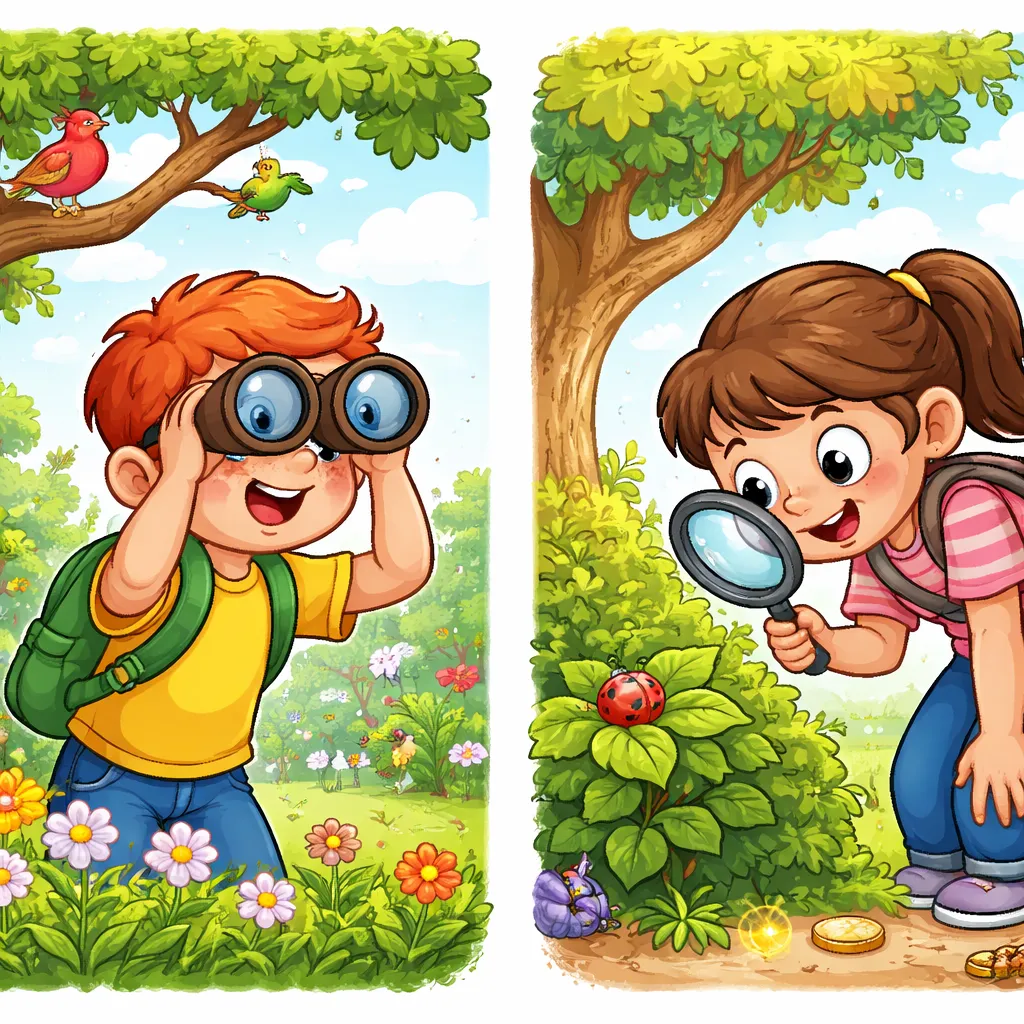

Hello, word explorer! Have you ever walked into a room? Your eyes work. You see the furniture. Then, you notice a new poster on the wall. How are these different? They both use your eyes. But are they the same? They are like two different levels of a video game. One is the basic level. One is the bonus level. Let's find out! Today, we explore the word friends "see" and "notice". Knowing their secret is a superpower. It makes you a better observer. Let's start our eye-opening adventure!
First, let's be Perception Detectives. Listen at home. Here are two sentences. "I can see the tall tree outside my window." "I just noticed a small bird's nest in that tree." They both involve your eyes. A tree. A nest. Do they sound the same? One feels like a simple fact. One feels like a discovery. Can you sense it? Great observation! Now, let's look closer with our word perception goggles.
Adventure! Inside the World of Perception
Welcome to the world of perception! "See" and "notice" are two different tools. Think of "see" as a basic camera. It simply takes a picture. Everything in view is captured. Think of "notice" as a camera with a special zoom lens. It focuses on one important detail. Both are about vision. But they work at different levels. Let's learn about each tool.
The Basic Camera vs. The Zoom Lens Think about the word "see". "See" feels like a basic camera. It is about the ability to use your eyes. It is a physical fact. I see the sky. Do you see that sign? It is passive. Your eyes just receive the image. Now, think about "notice". "Notice" feels like a zoom lens. It is about paying attention. It is an active mental step. I noticed you got a haircut. Did you notice the time? "See" is the basic picture. "Notice" is the focused detail. One is automatic. The other is thoughtful.
The Automatic Sense vs. The Active Attention Let's compare their action. "See" is an automatic sense. It just happens if your eyes are open. You see millions of things every day. You don't think about all of them. "Notice" requires your brain to pay attention. It means you become aware of something specific. You notice a friend's sad expression. You notice a spelling mistake. "See" is for everything. "Notice" is for something special. One is input. The other is processing.
Their Special Word Partners and Common Uses Words have best friends. "See" loves to team up in many common phrases. See you later. I see what you mean. Let me see. It is used for understanding and meeting. "Notice" has its own special teams. It often pairs with words about attention and signs. Take notice. Notice board. At short notice. It is used for warnings and observations. Note: We say "I see a bird" (vision). We say "I notice you're quiet" (observation). They are different.
Let's visit a school scene. In the hallway, you see many students. This is the basic picture your eyes take. Then, you notice that one student is wearing mismatched socks. Your brain focuses on that fun detail. Using "notice" for the whole crowd is too strong. Using "see" for the socks is okay, but "notice" highlights your active observation.
Now, let's go to the playground. You see the swings, the slide, and the sandbox. Your eyes take it all in. Suddenly, you notice a shiny coin in the sand. Your attention zooms in on that one thing. The word "see" paints the big picture. The word "notice" paints the moment of discovery.
Our Little Discovery So, what did we find? "See" and "notice" are both about using your eyes. But they are very different. "See" is the basic ability to use your sight. It is passive. "Notice" is the act of paying attention to a specific detail. It is active. You see a crowd. You notice a friend in the crowd. Knowing this makes you a word expert and a great observer.
Challenge! Become a Perception Champion
Ready for a fun test? Let's try your new skills!
"The Best Choice" Challenge Let's imagine a nature scene. An owl sits on a branch at night. Its big eyes work well. The owl can see the whole dark forest. This is its basic ability. Then, the owl notices a tiny mouse moving in the grass below. Its brain focuses on that movement. "See" wins for the owl's general vision. "Notice" is the champion for the owl's focused attention on the mouse.
"My Sentence Show" Your turn to create! Here is your scene: Eating breakfast at the kitchen table. Can you make two sentences? Use "see" in one. Use "notice" in the other. Try it! Here is an example: "I can see my cereal bowl and juice glass." This is the basic view. "I notice that my brother left the milk carton out." This is a specific observation. Your sentences will show two levels of seeing!
"Eagle Eyes" Search Look at this sentence. Can you find the word that could be better? Let's check a school context. "I saw the teacher's instructions on the board, but I didn't understand them until she explained." Hmm. The word "saw" is about the physical act. The problem here is about understanding, not vision. A better word might be "read". But for our lesson, the word "notice" doesn't fit either. The sentence is okay with "saw", but let's change it to fit our lesson. Let's say: "I saw the note on my desk, but I didn't notice it was for me until later." The mistake is that "saw" is just the physical act, but the point is about not paying attention. The word "notice" fits the idea of becoming aware. Did you spot it? Excellent word work!
Harvest and Action! Turn Knowledge Into Your Superpower
Great exploring! We started thinking "see" and "notice" were similar. Now we know they are different stages of perception. We can use the basic camera of "see". We can use the zoom lens of "notice". You can now describe your observations with perfect accuracy. This is a great thinking skill.
What you can learn from this article: You can now feel that "see" is the basic, automatic ability to use your eyes and take in visual information. You can feel that "notice" is the active step of paying attention and becoming aware of a specific detail. You know that you "see" a room, but you "notice" a change in the room. You learned to match the word to your mental process: "see" for vision, "notice" for attention.
Life practice application: Try your new skill today! Look around. What do you see? Now, what do you notice? Tell a family member one thing you see right now. Then, tell them one new thing you just noticed. Play a "I notice" game with a friend. You are now a master of perception words! Keep your eyes and mind open to the wonderful world.