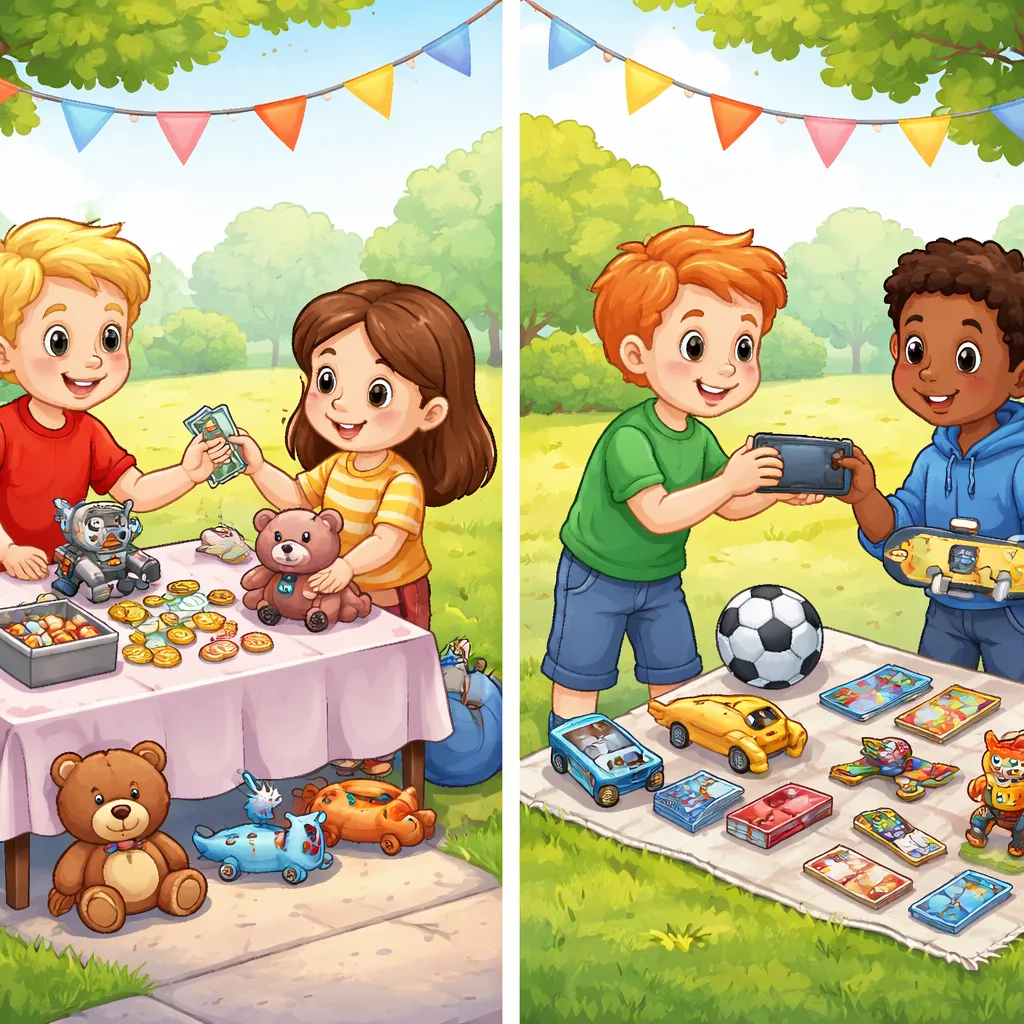

Hello, word explorer! Have you ever had a lemonade stand? Or swapped a toy with a friend? How do you talk about that? Do you sell lemonade for money? Or do you trade your toy for a different one? They both seem to be about giving something to get something else. But are they the same? They are like two different games. One is a simple shop game. One is a tricky swap game. Let's find out! Today, we explore the word friends "sell" and "trade". Knowing their secret is a superpower. It helps you understand how the world exchanges things. Let's start our market adventure!
First, let's be Exchange Detectives. Listen at home. Here are two sentences. "I will sell my old video games online to earn some cash." "My brother and I decided to trade sandwiches at lunch; he got my apple, and I got his cookie." They both involve an exchange. Video games for cash. Sandwiches for other food. Do they sound the same? One feels like getting money. One feels like swapping items directly. Can you sense it? Great observation! Now, let's look at the exchange.
Adventure! Inside the World of Exchanging
Welcome to the world of exchanging! "Sell" and "trade" are two different market stalls. Think of "sell" as a simple lemonade stand. You give lemonade and receive money. Think of "trade" as a bustling swap meet table. You give your comic book and receive a puzzle. Both are about giving to get. But what you get is different. Let's learn about each stall.
The Lemonade Stand vs. The Swap Meet Table Think about the word "sell". "Sell" feels like a lemonade stand. It means to give something to someone in exchange for money. The focus is on getting money. I want to sell my bike. Stores sell clothes. Money is the main goal. Now, think about "trade". "Trade" feels like a swap meet table. It means to exchange one thing for another thing. Often, no money is involved. Let's trade stickers. Countries trade goods. "Sell" is the lemonade stand. "Trade" is the swap meet. One is for money. The other is for other goods.
Money for Goods vs. Goods for Goods Let's compare their exchange. "Sell" is a one-way transaction for money. You are the seller. The other person is the buyer. The buyer gives you money. You sell them your item. The transaction is complete. "Trade" is a two-way exchange of items or services. Both people are traders. You give your item and get their item. We traded seats. They trade baseball cards. "Sell" ends with cash. "Trade" ends with a new item. One uses money. The other uses barter.
Their Special Word Partners and Common Contexts Words have best friends. "Sell" loves to team up with words about money and business. Sell for a price. Sell out (run out of items). Hard sell (strong persuasion). It is used in stores and sales. "Trade" has its own special teams. It often pairs with words about exchange and agreement. Trade places. Trade secrets. Fair trade. Note: In sports, players get traded to another team. We don't say they get sold. They are different.
Let's visit a school scene. Your school has a bake sale. Students sell cookies to raise money for a trip. This is a clear money-for-goods transaction. Now, imagine in the schoolyard, you trade your shiny eraser for your friend's cool pen. This is a direct swap of items. Using "trade" for the bake sale is wrong because they want money. Using "sell" for the eraser swap is wrong because no money is involved. Each word fits its own type of exchange.
Now, let's go to the playground. You set up a stand to sell handmade bracelets for 50 cents each. Your goal is to earn money. Later, you and a friend trade your jump ropes because you like the color of theirs better. This is a simple swap. The word "sell" paints the bracelet business. The word "trade" paints the friendly swap.
Our Little Discovery So, what did we find? "Sell" and "trade" are both about giving something to get something. But they are different transactions. "Sell" means to give an item or service in exchange for money. "Trade" means to exchange one item or service for another item or service, usually without money. You sell lemonade. You trade cards. Knowing this helps you understand deals and swaps.
Challenge! Become an Exchange Champion
Ready for a fun test? Let's try your new skills!
"The Best Choice" Challenge Let's imagine a nature scene. A squirrel finds many acorns. It doesn't need them all. Another animal might give the squirrel a berry for an acorn. The squirrel could trade an acorn for a berry. This is a direct swap of food. Now, imagine a farmer takes eggs to a market. The farmer wants to sell the eggs for money to buy other things. The goal is money. "Trade" wins for the squirrel's berry swap. "Sell" is the champion for the farmer's market transaction.
"My Sentence Show" Your turn to create! Here is your scene: A neighborhood garage sale. Can you make two sentences? Use "sell" in one. Use "trade" in the other. Try it! Here is an example: "We will sell our old books for one dollar each." This involves money. "I might trade my toy car for your puzzle if you want." This involves a direct swap. Your sentences will show two different exchanges!
"Eagle Eyes" Search Look at this sentence. Can you find the word that could be better? Let's check a home context. "I sold my sister my comic book for her help with cleaning my room." Hmm. The payment here is "help with cleaning my room," which is a service, not money. The word "traded" is the correct choice for exchanging an item for a service or another item. "I traded my sister my comic book for her help with cleaning my room." "Sold" would imply she paid money. Did you spot it? Excellent word work!
Harvest and Action! Turn Knowledge Into Your Superpower
Great exploring! We started thinking "sell" and "trade" were similar. Now we know they are two different market stalls. We can run the lemonade stand of "sell". We can run the swap meet table of "trade". You can now talk about exchanges with perfect accuracy. This is a great life skill.
What you can learn from this article: You can now feel that "sell" means to give an item or service to someone in exchange for money. You can feel that "trade" means to exchange one item or service for another, usually without money. You know that a store "sells" toys, but friends might "trade" snacks. You learned to look for what is being exchanged: money (sell) or another item/service (trade).
Life practice application: Try your new skill today! If you have a garage sale, you are ready to sell. If you swap toys with a friend, you are making a trade. Listen to how people use these words. Tell your family one thing you would like to sell. Tell a friend one thing you would like to trade. You are now a master of exchange words!