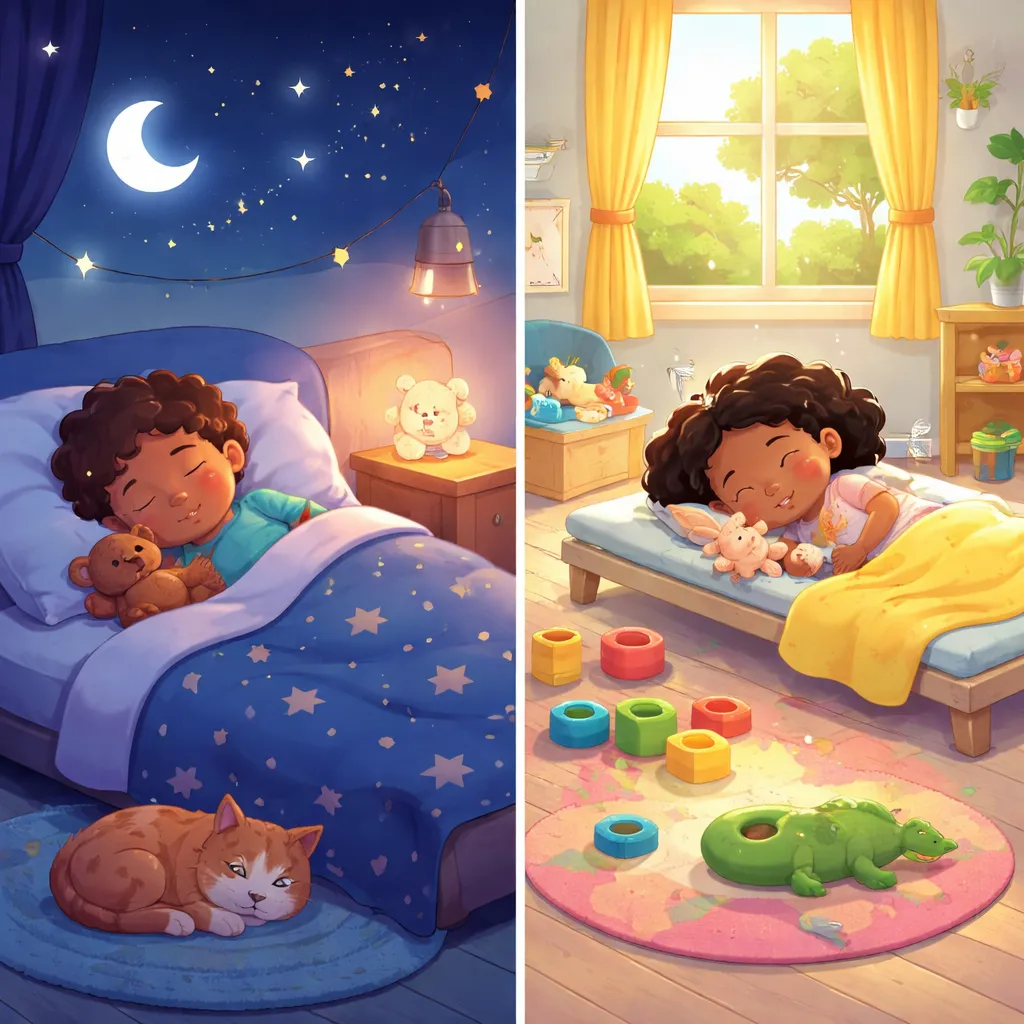

Hello, word explorer! Have you ever felt your eyes get heavy? Maybe at night in bed. Or maybe on a cozy afternoon. How do you talk about that? Do you go to sleep for the night? Or do you take a nap in the day? They both seem to mean closing your eyes to rest. But are they the same? They are like two different kinds of rest stops. One is a long, deep night at a hotel. One is a short, refreshing break at a park bench. Let's find out! Today, we explore the word friends "sleep" and "nap". Knowing their secret is a superpower. It helps you talk about your rest perfectly. Let's start our cozy adventure!
First, let's be Rest Detectives. Listen at home. Here are two sentences. "I need to sleep for eight hours to feel good in the morning." "My cat likes to take a short nap on the sunny windowsill." They both talk about resting with your eyes closed. A full night. A sunny break. Do they sound the same? One feels long and complete. One feels short and sweet. Can you sense it? Great observation! Now, let's look at the clock.
Adventure! Into the World of Resting
Welcome to the world of resting! "Sleep" and "nap" are two different clocks. Think of "sleep" as the big clock for the whole night. It measures a long, main period of rest. Think of "nap" as a small timer for the afternoon. It measures a short, extra period of rest. Both are about being asleep. But they are different in length and purpose. Let's learn about each clock.
The Big Night Clock vs. The Small Timer Think about the word "sleep". "Sleep" feels like the big night clock. It is the general word. It means the natural state of rest for your body and mind. It usually happens at night for a long time. Babies sleep a lot. I sleep in my bed. It is the main, long rest. Now, think about "nap". "Nap" feels like a small timer. It is a specific kind of sleep. It means a short period of sleep, often during the day. A nap can be 20 minutes or an hour. I took a nap after school. "Sleep" is the big clock. "Nap" is the small timer. One is the main event. The other is a quick break.
The Long, Main Rest vs. The Short, Extra Rest Let's compare their length and role. "Sleep" is your primary daily rest. It is essential and lasts for hours. You go to sleep at night. I need more sleep. It is a noun and a verb. "Nap" is an optional, short sleep. It gives you a little extra energy. It is not the main sleep. The baby is napping. I feel like a nap. "Sleep" is necessary. "Nap" is a bonus. One is long. The other is short. One is for night. The other is for day.
Their Special Word Partners and Common Contexts Words have best friends. "Sleep" loves to team up with night and health. Go to sleep. Sleep tight. Sleep deprivation. It is used in many common phrases. "Nap" has its own special teams. It often pairs with words about day and short breaks. Take a nap. Afternoon nap. Power nap. Note: We say "sleepover" (a night at a friend's). We say "catnap" (a very short nap). They are different.
Let's visit a school scene. You know that getting enough sleep helps you focus in class. This talks about the important night rest. Now, imagine a long school trip on a bus. Some kids might nap in their seats for part of the ride. This is a short, casual sleep during the day. Using "nap" for the night's rest is wrong. Using "sleep" for the bus ride is okay, but "nap" is more precise for the short, light sleep.
Now, let's go to the playground. After playing hard all afternoon, you might feel tired. You are ready for a good night's sleep. This is the long, main rest. But sometimes, if you are very tired, you might come home and take a quick nap before dinner. The word "sleep" paints the important night. The word "nap" paints the short, refreshing break.
Our Little Discovery So, what did we find? "Sleep" and "nap" are both about being asleep. But they are very different. "Sleep" is the general word for the long, main rest we need every day, usually at night. "Nap" is a specific word for a short period of sleep, often taken during the day for extra energy. You sleep for eight hours. You nap for twenty minutes. Knowing this helps you talk about rest like a pro.
Challenge! Become a Rest Word Champion
Ready for a fun test? Let's try your new skills!
"The Best Choice" Challenge Let's imagine a nature scene. A bear goes into its den for the whole winter. It is going to sleep for months. This is a very long, deep rest. Now, imagine a lion in the savanna. After a big meal, it lies under a tree. The lion might take a nap for a few hours in the shade. This is a shorter, daytime rest. "Sleep" wins for the bear's long hibernation. "Nap" is the champion for the lion's afternoon snooze.
"My Sentence Show" Your turn to create! Here is your scene: A long car trip with your family. Can you make two sentences? Use "sleep" in one. Use "nap" in the other. Try it! Here is an example: "I hope I can sleep most of the way in the back seat." This suggests a longer period of rest. "My dad might pull over to take a short nap if he gets tired." This is a brief, intentional rest break. Your sentences will show two types of rest!
"Eagle Eyes" Search Look at this sentence. Can you find the word that could be better? Let's check a home context. "I was so tired last night that I just took a 10-hour nap and missed my morning alarm." Hmm. A ten-hour rest is a very long period. The word "sleep" is the correct term for a long, night-time rest. "I was so tired last night that I just had 10 hours of sleep and missed my morning alarm." A "nap" is short, not ten hours long. Did you spot it? Excellent word work!
Harvest and Action! Turn Knowledge Into Your Superpower
Great exploring! We started thinking "sleep" and "nap" were the same. Now we know they are two different clocks. We can look at the big night clock of "sleep". We can set the small timer of "nap". You can now describe your rest with perfect accuracy. This is a great life skill.
What you can learn from this article: You can now feel that "sleep" is the main, long period of rest that your body needs, usually at night. You can feel that "nap" is a short, extra period of sleep that you might take during the day to feel refreshed. You know that you get a good night's "sleep", but you might take a "nap" on a lazy afternoon. You learned to match the word to the length: "sleep" for long, "nap" for short.
Life practice application: Try your new skill today! Tell your family how many hours of sleep you need. If you feel tired this afternoon, ask if you can take a short nap. Listen to how people use these words. Are they talking about a full night or a quick break? You are now a master of rest words! Keep listening to your body and describing its needs perfectly.