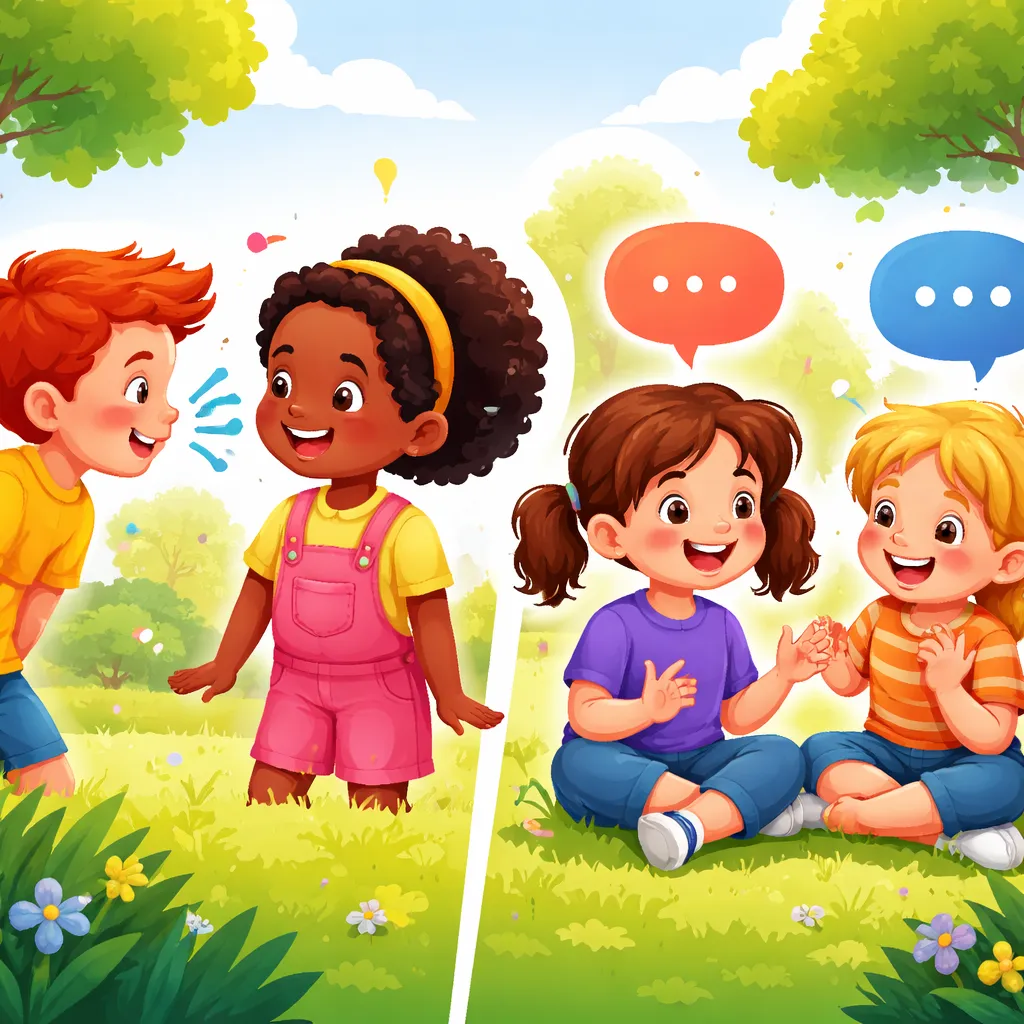

Hello, word explorer! Have you ever told a story to a friend? Or answered a question in class? How do you describe that? Do you speak? Or do you talk? People use both words all the time. They seem to mean the same thing. But are they exactly the same? They are like two different ways to share your voice. One is like giving a speech. One is like having a chat. Let's find out! Today, we explore the word friends "speak" and "talk". Knowing their secret is a superpower. It makes you a clear and confident communicator. Let's start our chatty adventure!
First, let's be Conversation Detectives. Listen at home. Here are two sentences. "My baby sister is learning to speak." "My dad and I talk about our day at dinner." They both involve using your voice. A baby learning. A dinner conversation. Do they sound the same? One feels more formal and skilled. One feels more casual and two-way. Can you sense it? Great observation! Now, let's listen closer with our word microphone.
Adventure! Inside the World of Conversation
Welcome to the world of conversation! "Speak" and "talk" are two different microphones. Think of "speak" as a podium microphone. It is for one person sharing information. Think of "talk" as a pair of walkie-talkies. It is for two or more people having an exchange. Both are about using your voice. But they are used in different situations. Let's learn about each one.
The Podium Microphone vs. The Walkie-Talkies Think about the word "speak". "Speak" feels like a podium microphone. It is often more formal. It focuses on the ability to use words or to address an audience. She will speak at the assembly. Do you speak French? It is about the act of producing words. Now, think about "talk". "Talk" feels like a pair of walkie-talkies. It is more casual and conversational. It suggests a two-way exchange or a discussion. Let's talk about it. They talked for hours. "Speak" is the formal address. "Talk" is the friendly chat. One is often one-way. The other is two-way.
Formal Ability vs. Casual Conversation Let's compare their use. "Speak" is often used for languages, formal situations, or one-person actions. He speaks clearly. I need to speak to the manager. It can sound more serious. "Talk" is used for informal conversations between people. We talked on the phone. Stop talking in class. It is the everyday word for chat. You can speak without anyone listening (like speaking your thoughts). You usually talk with someone. One is about the skill or formal act. The other is about the informal exchange.
Their Special Word Partners and Common Phrases Words have best friends. "Speak" loves to team up with words about languages and formalities. Speak up. Speak a language. Speak to the point. It is used in set phrases. "Talk" has its own special teams. It often pairs with words about discussions and informality. Talk it over. Talk back. Small talk. Note: We say "generally speaking" (in general). We say "talking-to" (a scolding). They are different teams.
Let's visit a school scene. In language class, you learn to speak Spanish. This is about learning the skill of using the language. Now, imagine you and your friend are sharing secrets during break. You are talking quietly. This is a casual, two-way chat. Using "talk" for learning Spanish is okay, but "speak" is more common for language ability. Using "speak" for sharing secrets is too formal. "Talk" fits the casual chat.
Now, let's go to the playground. The coach uses a whistle and then speaks to the whole team. This is a one-way address. Later, two friends sit on the swings and talk about their favorite games. This is a two-way conversation. The word "speak" paints the coach's address. The word "talk" paints the friends' chat.
Our Little Discovery So, what did we find? "Speak" and "talk" are both about using your voice to communicate. But they are used in slightly different ways. "Speak" is often more formal. It focuses on the ability to use words or on one-way communication. "Talk" is more casual. It focuses on a two-way conversation or chat. You speak in public. You talk to a friend. Knowing this helps you choose the perfect word.
Challenge! Become a Conversation Champion
Ready for a fun test? Let's try your new skills!
"The Best Choice" Challenge Let's imagine a nature scene. A parrot can mimic human words. The parrot can speak. This is about its ability to produce words. Now, imagine two dolphins communicating with clicks and whistles. The dolphins talk to each other. This suggests a two-way exchange of information. "Speak" wins for the parrot's ability. "Talk" is the champion for the dolphins' conversation.
"My Sentence Show" Your turn to create! Here is your scene: On the phone with a grandparent. Can you make two sentences? Use "speak" in one. Use "talk" in the other. Try it! Here is an example: "I can speak loudly so my grandpa can hear me." This focuses on the act of producing clear words. "My grandma and I talk about her garden every week." This focuses on the regular, casual conversation. Your sentences will show two ways of communicating!
"Eagle Eyes" Search Look at this sentence. Can you find the word that could be better? Let's check a home context. "The two leaders will talk at the United Nations about world peace." Hmm. This is a very formal, public address by leaders. The word "speak" is a better fit for a formal speech at the UN. "The two leaders will speak at the United Nations about world peace." "Talk" sounds too casual for this important event. Did you spot it? Excellent word work!
Harvest and Action! Turn Knowledge Into Your Superpower
Great exploring! We started thinking "speak" and "talk" were the same. Now we know they are two styles of communication. We can use the podium microphone of "speak". We can use the walkie-talkies of "talk". You can now describe your conversations with perfect accuracy. This is a great social skill.
What you can learn from this article: You can now feel that "speak" is often used for more formal situations, one-way communication, or the ability to use a language. You can feel that "talk" is often used for casual, two-way conversations and chats. You know that a teacher might speak to the class, but friends talk at lunch. You learned to match the word to the situation: "speak" for formal or one-way, "talk" for informal and two-way.
Life practice application: Try your new skill today! In class, you speak when you give an answer. At home, you talk with your family about your day. Listen to how people on the news use these words. Tell a friend one language you want to speak. Have a good talk with someone you care about. You are now a master of conversation words! Keep sharing your voice with the world.