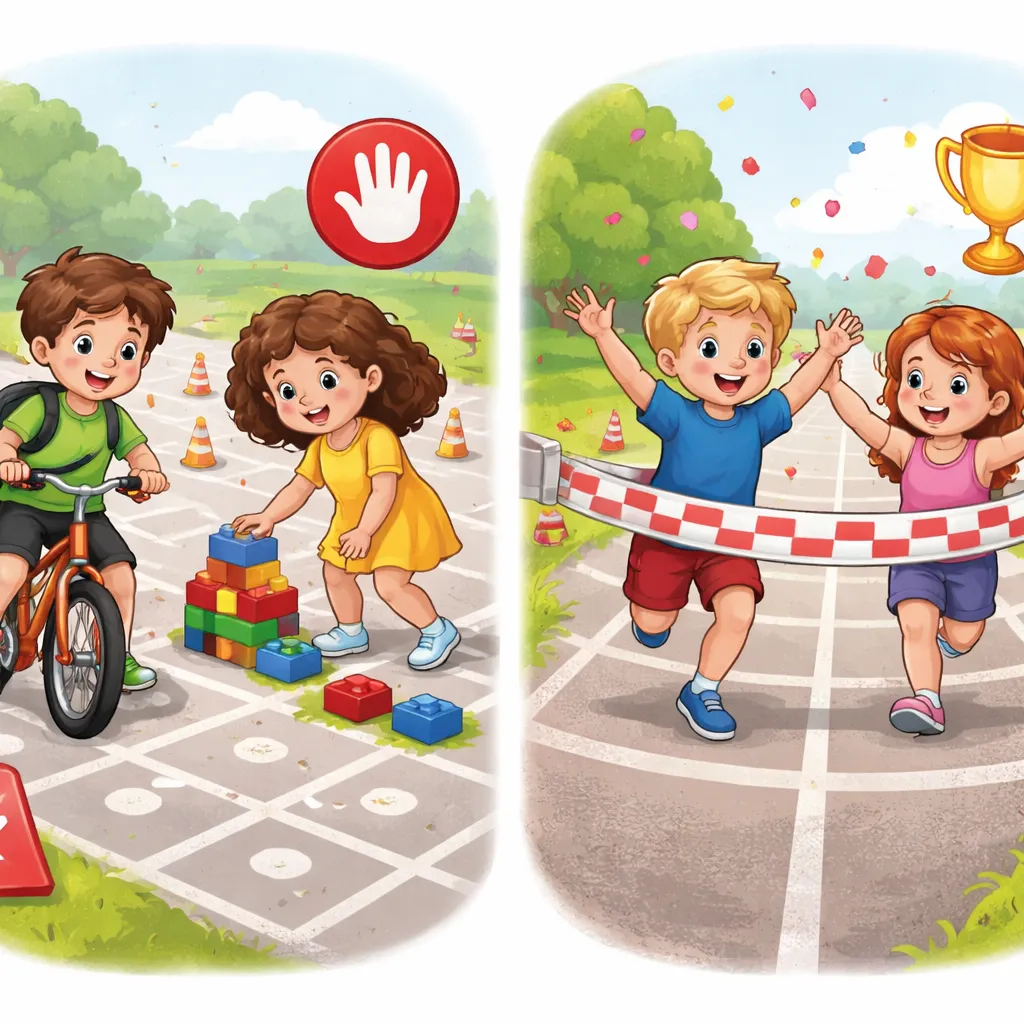

Hello, word explorer! Have you ever been playing a game and someone said, "Time to stop!"? Or have you finished a puzzle and felt proud? They both seem to mean "to end". But are they the same? They are like two different ways to end a song. One is a sudden, loud cymbal crash. One is the last, perfect note. Let's find out! Today, we explore the word friends "stop" and "finish". Knowing their secret is a superpower. It helps you talk about endings perfectly. Let's start our adventure!
First, let's be End Detectives. Listen at home. Here are two sentences. "Stop running in the house, please!" "I will finish my homework before dinner." They both talk about ending something. Running. Homework. Do they sound the same? One feels like a sudden halt. One feels like completing a task. Can you sense it? Great observation! Now, let's look closer at these endings.
Adventure! At the Finish Line of Words
Welcome to the world of endings! "Stop" and "finish" are two different finish lines. Think of "stop" as a big, red stop sign. It means to end movement or action suddenly. Think of "finish" as a checkered flag at the end of a race. It means to complete something you started. Both are about ending. But they end in different ways. Let's learn about each one.
The Stop Sign vs. The Checkered Flag Think about the word "stop". "Stop" feels like a big, red stop sign. It means to end an action or movement. It does not mean the task is complete. Stop talking. The rain stopped. The car stopped. The action halts. Now, think about "finish". "Finish" feels like a checkered flag. It means to complete an activity or task. You reach the end goal. Finish your milk. I finished the book. The project is finished. "Stop" is the red sign. "Finish" is the checkered flag. One halts. The other completes.
Halting vs. Completing Let's compare their meaning. "Stop" is about halting. It focuses on the moment of ending the action. It can be temporary. Let's stop for a break. He never stops asking questions. "Finish" is about completing. It focuses on reaching the end of a process. It implies the task is done. I must finish this level. She finished in first place. You can stop doing something without finishing it. You can finish something without stopping (you just complete it). One is about interruption. The other is about accomplishment.
Their Special Word Partners and Grammar Rules Words have best friends. "Stop" loves to team up with actions and movements. Stop it! Stop the clock. Stop by for a visit. It can be followed by "-ing" (stop running) or "to" + verb (stop to eat). "Finish" loves to team up with tasks and activities. Finish up. Finish line. Finish with a win. It is usually followed by a noun or "-ing" (finish eating). Note: We say "full stop" (punctuation). We say "photo finish" (a close race). They are different teams.
Let's visit a school scene. The bell rings for recess. Your teacher says, "Please stop writing and put your pencils down." This is a command to halt the action right now. Now, at the end of art class, you say, "I need five more minutes to finish my painting." This means you want to complete it. Using "finish" for putting pencils down is odd because you're not completing the writing. Using "stop" for the painting is okay, but "finish" better shows your goal is completion.
Now, let's go to the playground. Your friend yells, "Stop! The ball is going into the street!" This is a sudden command to halt action. Later, you complete a long game of tag. You say, "We finished the game, and I won!" This means you played it to the end. The word "stop" paints the sudden warning. The word "finish" paints the completed game.
Our Little Discovery So, what did we find? "Stop" and "finish" are both about endings. But they are different kinds of endings. "Stop" means to end an action or movement. It halts the process. "Finish" means to complete an activity or task. It reaches the goal. You stop a car. You finish a race. Knowing this helps you describe endings accurately.
Challenge! Become a Word Choice Champion
Ready for a fun test? Let's try your new skills!
"The Best Choice" Challenge Let's imagine a nature scene. A squirrel is crossing the road. It hears a car. The squirrel must... what? Stop or finish? The squirrel must stop. It needs to halt its movement. Now, imagine a bee collecting nectar from a flower. It takes the last bit. The bee finishes collecting from that flower. It completes its task. "Stop" wins for the squirrel's sudden halt. "Finish" is the champion for the bee's completed job.
"My Sentence Show" Your turn to create! Here is your scene: Building a sandcastle at the beach. Can you make two sentences? Use "stop" in one. Use "finish" in the other. Try it! Here is an example: "We had to stop building when the tide came in." This means we had to halt. "I wanted to finish the castle tower before we left." This means I wanted to complete it. Your sentences will show two different endings!
"Eagle Eyes" Search Look at this sentence. Can you find the word that could be better? Let's check a home context. "I stopped my dinner because I was full, so I ate all my vegetables." Hmm. The phrase "ate all my vegetables" suggests completion. The word "finished" fits better for completing a meal. "I finished my dinner because I was full, so I ate all my vegetables." "Stopped" would mean you left food on your plate. Did you spot it? Excellent word work!
Harvest and Action! Turn Knowledge Into Your Superpower
Great exploring! We started thinking "stop" and "finish" were the same. Now we know they are two different finish lines. We can see the red stop sign of "stop". We can see the checkered flag of "finish". You can now talk about endings with perfect accuracy. This is a great skill for following and giving instructions.
What you can learn from this article: You can now feel that "stop" means to halt or end an action, like stopping a bike or stopping a noise. You can feel that "finish" means to complete a task or activity, like finishing a book or finishing your chores. You know that you "stop" at a red light, but you "finish" a race. You learned to match the word to the type of ending: "stop" for halting, "finish" for completing.
Life practice application: Try your new skill today! Listen to instructions. Does a coach say "Stop!" or "Finish the drill!"? Tell a friend you need to stop talking. Tell your parent you will finish your job. Listen to how people use these words. You are now a master of ending words! Keep exploring the wonderful world of language.