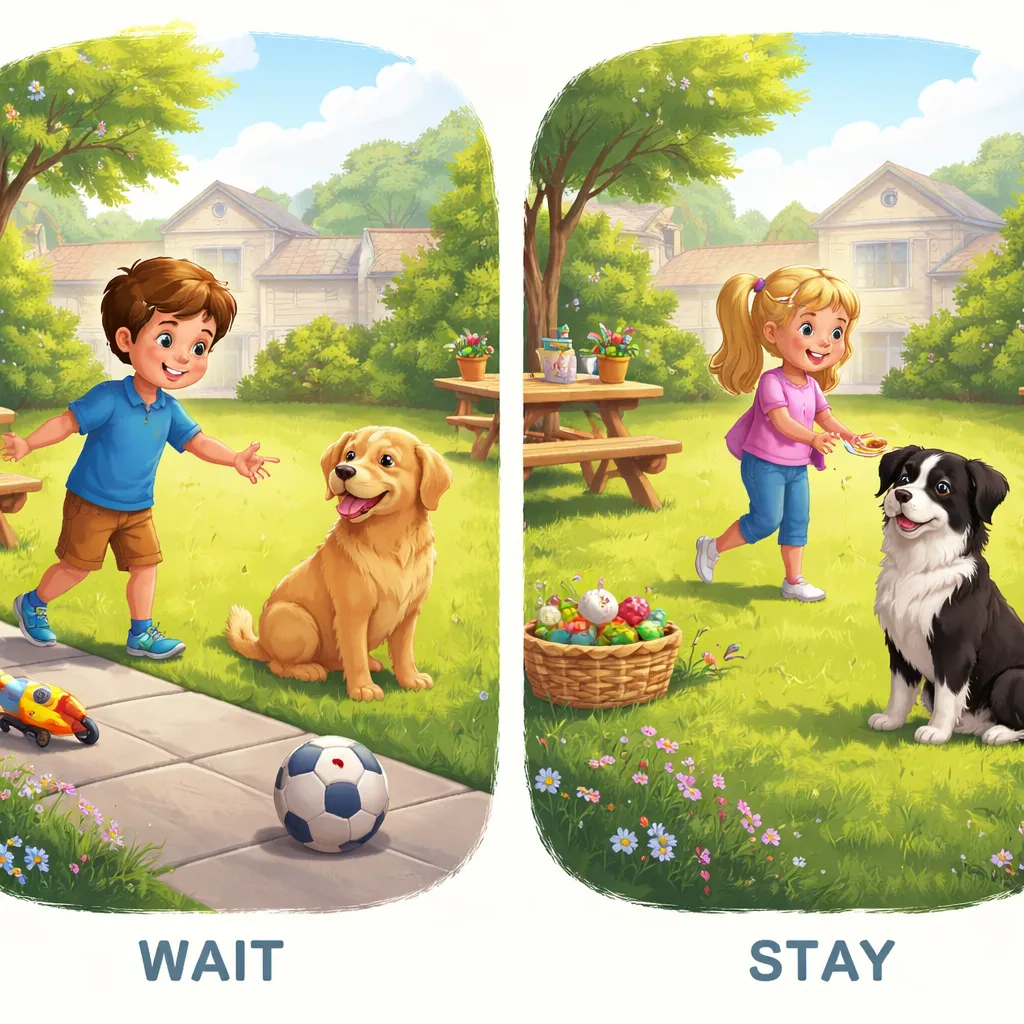

Hello, word explorer! Have you ever been in a line? Or been asked to remain in your seat? How do you talk about that? Do you wait in line? Or do you stay in your seat? They both seem to mean not moving. But are they the same? They are like two different pause buttons. One is a pause for time, expecting something. One is a pause for movement, remaining somewhere. Let's find out! Today, we explore the word friends "wait" and "stay". Knowing their secret is a superpower. It makes you clear about time and place. Let's start our pause adventure!
First, let's be Pause Detectives. Listen at home. Here are two sentences. "Please wait here for me; I will be right back with your present." "Can you stay at the table until everyone finishes eating?" They both talk about not leaving. For a present. At the table. Do they sound the same? One feels temporary, expecting a return. One feels about continuing in a place. Can you sense it? Great observation! Now, let's look at the pause button.
Adventure! Inside the World of Pausing
Welcome to the world of pausing! "Wait" and "stay" are two different pause buttons. Think of "wait" as a pause button for time. You press it expecting something to happen soon. Think of "stay" as a pause button for movement. You press it to remain in one place or state. Both are about stopping. But they stop for different reasons. Let's learn about each button.
The Time Pause vs. The Movement Pause Think about the word "wait". "Wait" feels like a pause button for time. It means to spend time expecting something to happen. The focus is on the future event. Wait for the bus. Wait your turn. I can't wait for summer! It is about anticipation. Now, think about "stay". "Stay" feels like a pause button for movement. It means to continue to be in a place or condition. The focus is on not leaving or changing. Stay in bed. Stay calm. The picture won't stay on the wall. "Wait" is the time pause. "Stay" is the movement pause. One is for expecting. The other is for remaining.
Expecting an Event vs. Remaining in a State Let's compare their purpose. "Wait" is active in a way. You are in a state of expectation. You are waiting for something. I will wait for your call. We waited an hour. The action ends when the event happens. "Stay" is more about the state itself. You are staying in a place or condition. I will stay home tonight. Stay still for the photo. The action continues. "Wait" looks forward. "Stay" focuses on the present condition. One is about the future. The other is about the now.
Their Special Word Partners and Grammar Rules Words have best friends. "Wait" loves to team up with "for" and time words. Wait for a minute. Wait and see. Wait in line. It is about duration until an event. "Stay" has its own special teams. It often pairs with place and state words. Stay up late. Stay the night. Stay safe. Note: We say "waiting room" (a room for waiting). We say "staycation" (a vacation at home). They are different.
Let's visit a school scene. The bell rings. Your teacher says, "Please wait quietly for the next instruction." This means pause and expect me to speak again soon. Later, during a fire drill, the teacher says, "Stay with your class and stay in line." This means remain with your group and in formation. Using "stay" for the instruction is okay, but "wait" better shows the expectation. Using "wait" for the fire drill is wrong because it's about staying together, not expecting an event.
Now, let's go to the playground. You are at the slide. You must wait for the child in front to go first. This is about your turn in time. Your friend gets hurt. You tell them, "Stay right here while I get help." This means do not move from this spot. The word "wait" paints the time until your turn. The word "stay" paints the command to not move.
Our Little Discovery So, what did we find? "Wait" and "stay" are both about pausing. But they pause for different reasons. "Wait" means to spend time expecting something to happen. It is about anticipation. "Stay" means to continue to be in a place or condition. It is about remaining. You wait for a friend. You stay at a friend's house. Knowing this helps you use the right pause button.
Challenge! Become a Pause Word Champion
Ready for a fun test? Let's try your new skills!
"The Best Choice" Challenge Let's imagine a nature scene. A bird is on a branch. It watches the ground for a worm. The bird will wait for the right moment to swoop down. This is about expecting the perfect time. Now, imagine a bear in winter. It finds a cozy den. The bear will stay in its den for months to hibernate. This is about remaining in one place for a long time. "Wait" wins for the bird's timed action. "Stay" is the champion for the bear's long rest.
"My Sentence Show" Your turn to create! Here is your scene: At the doctor's office with a parent. Can you make two sentences? Use "wait" in one. Use "stay" in the other. Try it! Here is an example: "We have to wait in the reception area until the nurse calls our name." This is about expecting our turn. "The doctor told me to stay home from school tomorrow to rest." This is about remaining at home. Your sentences will show two kinds of pauses!
"Eagle Eyes" Search Look at this sentence. Can you find the word that could be better? Let's check a home context. "I asked my dog to wait on the porch while I ran inside, but he followed me anyway." Hmm. The intention was for the dog to remain on the porch. The word "stay" is the command for a dog to remain in one place. "I asked my dog to stay on the porch while I ran inside, but he followed me anyway." "Wait" would be used if you were coming right back, but "stay" is the standard command for not moving. Did you spot it? Excellent word work!
Harvest and Action! Turn Knowledge Into Your Superpower
Great exploring! We started thinking "wait" and "stay" were the same. Now we know they are two different pause buttons. We can press the time pause of "wait". We can press the movement pause of "stay". You can now talk about pausing with perfect accuracy. This is a great skill for following and giving instructions.
What you can learn from this article: You can now feel that "wait" is about spending time expecting something to happen, like waiting for a bus or waiting your turn. You can feel that "stay" is about continuing to be in a place or condition, like staying in your seat or staying quiet. You know that you "wait for" something, but you "stay in" a place. You learned to match the word to the reason: "wait" for anticipation, "stay" for remaining.
Life practice application: Try your new skill today! When you are expecting a delivery, you are waiting. When you are told to remain in your room, you are staying. Listen to instructions from adults. Do they say "wait" or "stay"? You are now a master of pause words! Keep being clear about time and place.