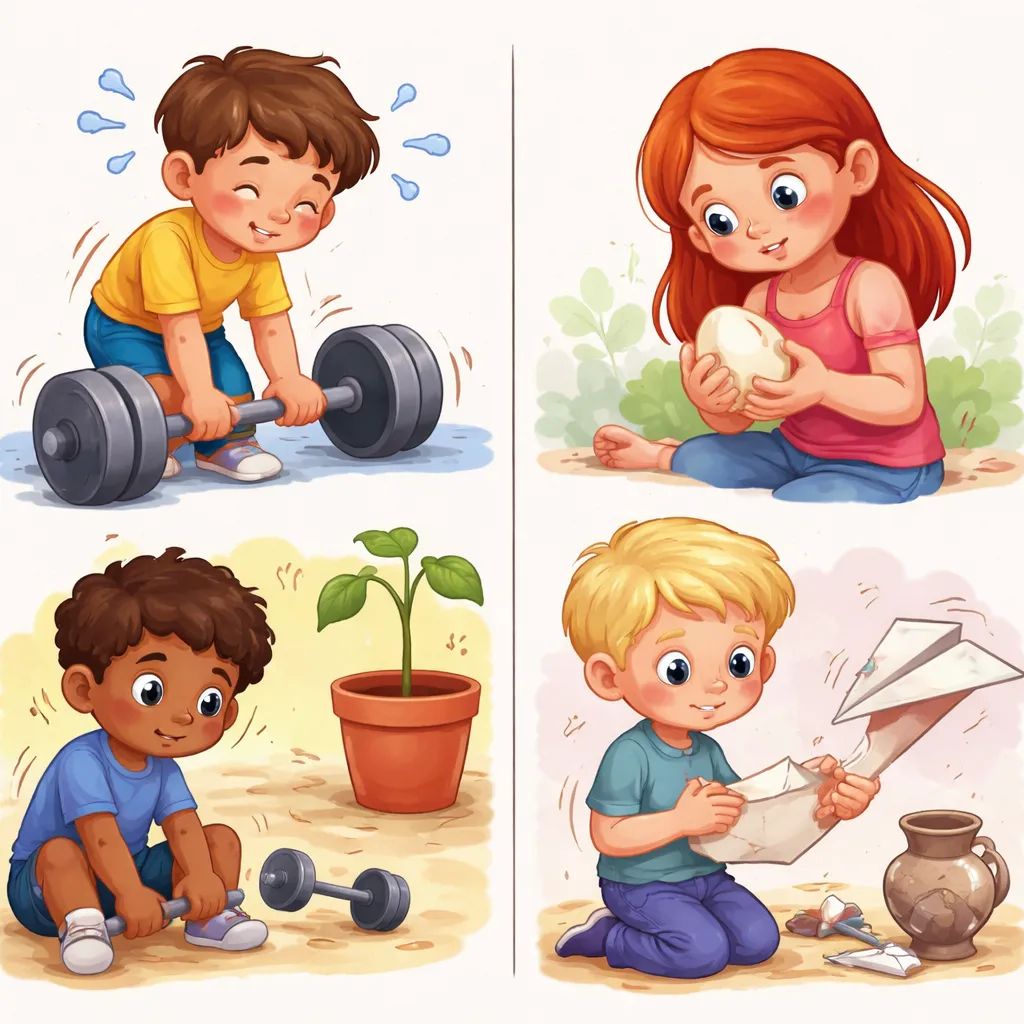

Hello, careful word explorer! Have you ever seen a baby bird? Or held a light bulb? How do you describe them? You might say the bird is weak. The light bulb is fragile. They both seem to mean "not strong". But are they the same? They are like two different kinds of "careful". One needs help to do things. One needs help not to break. Let's find out! Today, we explore the word friends "weak" and "fragile". Knowing their secret is a superpower. It helps you be careful and kind. Let's start our gentle adventure!
First, let's be Careful Detectives. Listen at home. Here are two sentences. "I felt weak after being sick in bed." "Please carry the fragile glass vase carefully." They both talk about needing care. A person. A vase. Do they sound the same? One feels like a lack of strength. One feels like easy to break. Can you sense it? Great observation! Now, let's look closer with our word kindness lens.
Adventure! Into the World of "Not Strong"
Welcome to the world of "not strong"! "Weak" and "fragile" are two different needs. Think of "weak" as a thin, tired thread. It cannot pull much weight. Think of "fragile" as a perfect soap bubble. It is beautiful but can pop easily. Both need care. But they need different kinds of care. Let's learn about each one.
The Thin Thread vs. The Soap Bubble Think about the word "weak". "Weak" feels like a thin, tired thread. It describes a lack of strength, power, or force. A weak signal. A weak argument. My legs feel weak. It is about not being strong enough. Now, think about "fragile". "Fragile" feels like a perfect, shiny soap bubble. It describes something that is easily broken, damaged, or destroyed. A fragile ecosystem. Fragile antiques. Handle with care, fragile. "Weak" is the thread that can't pull. "Fragile" is the bubble that can pop. One lacks power. The other can break easily.
Lacking Power vs. Easily Broken Let's compare their focus. "Weak" is about lacking strength or intensity. It is the opposite of strong. A weak voice. A weak password. A weak smile. It can be temporary or permanent. "Fragile" is about delicate structure. It is about how easily something can be damaged. A fragile peace. Fragile bones. Fragile feelings. "Weak" means it cannot do much. "Fragile" means it can be harmed easily. One is about ability. The other is about durability.
Their Special Word Partners and Common Uses Words have best friends. "Weak" loves to team up with words about the body, signals, and reasons. Weak muscles. A weak Wi-Fi signal. A weak excuse. It is a common, everyday word. "Fragile" has its own special teams. It often pairs with words about delicate objects, situations, and emotions. Fragile item. Fragile state of mind. Fragile package. Note: We say "weak at the knees" (feeling emotional). We see "Fragile" written on boxes. They are different teams.
Let's visit a school scene. After running a long race, your friend feels tired. Their legs are weak. This describes their temporary lack of strength. Now, in art class, you work with thin, dry clay. Before it is baked, it is fragile. It can crumble in your hand. Using "fragile" for the tired legs is not right. Using "weak" for the dry clay is possible, but "fragile" is more precise for its breakable nature.
Now, let's go to the playground. You try to open a tight jar lid. Your grip is too weak. You need help. Later, you find a butterfly's empty cocoon. It is dry and fragile to the touch. The word "weak" paints the lack of grip strength. The word "fragile" paints the delicate, breakable cocoon.
Our Little Discovery So, what did we find? "Weak" and "fragile" are both about lacking strength. But they mean different things. "Weak" means not having much power, force, or intensity. A weak battery is almost dead. "Fragile" means easily broken or damaged. A fragile ornament can shatter. A person can be weak (not strong) but not fragile. A glass can be fragile (breakable) but also strong (if thick). Knowing this helps you be more precise and caring.
Challenge! Become a Careful Word Champion
Ready for a thoughtful test? Let's try your new skills!
"The Best Choice" Challenge Let's imagine a nature scene. A newborn fawn has thin, wobbly legs. It is learning to stand. Its legs are... what? Weak or fragile? The fawn's legs are weak. They lack strength and stability. Now, imagine a spider's web glistening with morning dew. It is beautiful and intricate. The web is fragile. A touch can break it. "Weak" wins for the wobbly fawn. "Fragile" is the champion for the delicate spiderweb.
"My Sentence Show" Your turn to create! Here is your scene: Moving to a new house. Can you make two sentences? Use "weak" in one. Use "fragile" in the other. Try it! Here is an example: "After carrying boxes all day, my arms felt weak." This describes a lack of strength. "We packed the fragile dishes in a special box with lots of paper." This describes items that break easily. Your sentences will show two different ideas!
"Eagle Eyes" Search Look at this sentence. Can you find the word that could be better? Let's check a home context. "The fragile battery in the remote control needs to be replaced because it has no power." Hmm. A battery that has no power is dead or lacking energy. The word "weak" is the correct term for a battery with low power. "The weak battery in the remote control needs to be replaced." "Fragile" would mean the battery is easily broken, which is not the main problem. Did you spot it? Excellent and careful word work!
Harvest and Action! Turn Knowledge Into Your Superpower
Great exploring! We started thinking "weak" and "fragile" were the same. Now we know they point to different needs. We can see the thin thread of "weak". We can see the soap bubble of "fragile". You can now describe things that need care with perfect accuracy. This is a great skill for being helpful and kind.
What you can learn from this article: You can now feel that "weak" describes something that lacks strength, power, or intensity, like a weak signal or weak muscles. You can feel that "fragile" describes something that is easily broken or damaged, like a fragile glass or a fragile feeling. You know that a sick person might be "weak", but a butterfly's wing is "fragile". You learned to match the word to the need: "weak" for lack of power, "fragile" for need of gentle care.
Life practice application: Try your new skill today! Listen to your body. Do you feel weak after exercise? Look at something delicate. Is it fragile? Tell a family member if you need help with something weak (like opening a jar). Point out something fragile that needs careful handling. Use your words to be kind and helpful. You are now a master of careful words!