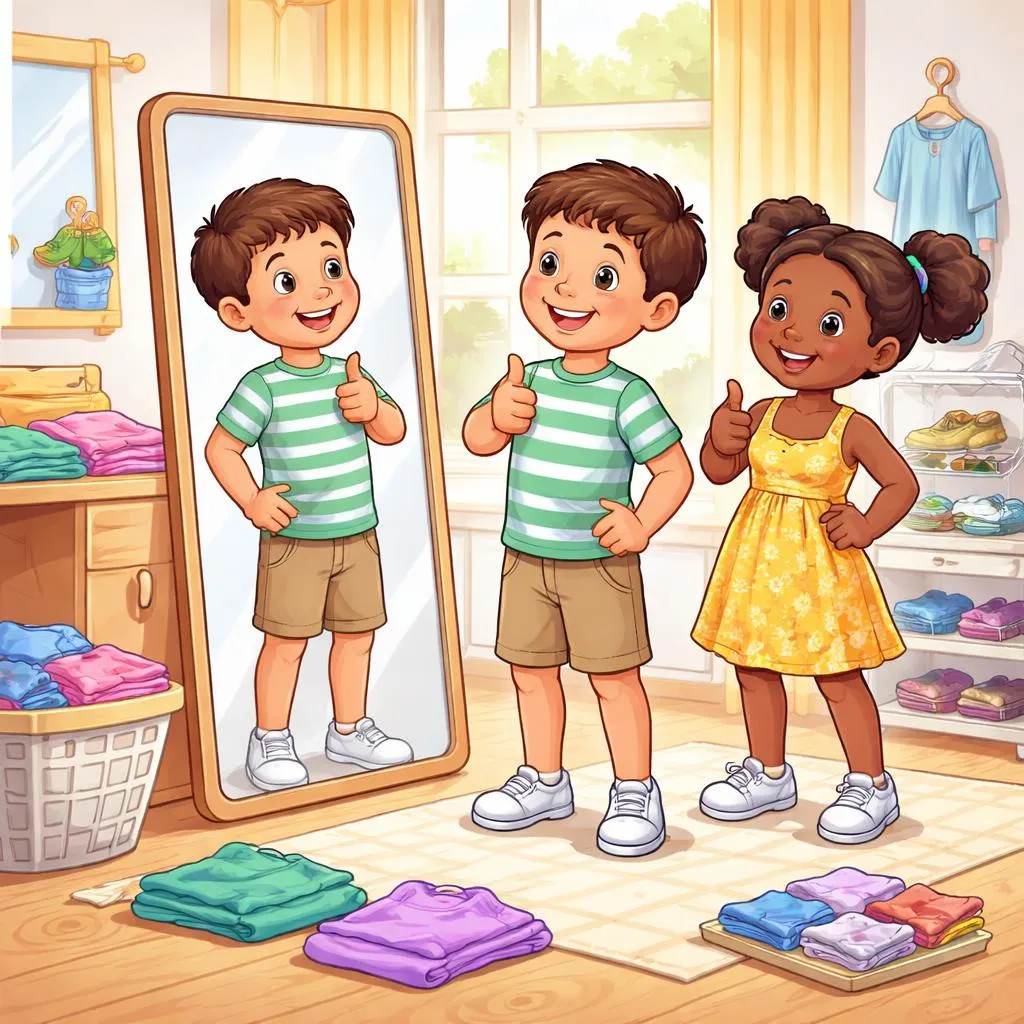

What Do These Expressions Mean? “Fits well” and “the right size” both describe clothing or items that are exactly the correct dimension. They tell someone that the item is comfortable and not too big or too small. Children say these words when trying on new clothes or using tools. Both express relief and satisfaction.
“Fits well” means the item is comfortable and sits properly on the body. It is active and descriptive. A child says it when shoes don't pinch and sleeves don't hang over hands. It focuses on comfort and feel.
“The right size” means the dimensions match what is needed. It is a simple statement of fact. A child says it when a helmet is not too tight and not too loose. It focuses on correctness.
These expressions seem similar. Both say “this works for my body.” Both are positive. But one describes the feeling while one describes the fact.
What's the Difference? One is about feeling. One is about fact. “Fits well” describes how the item feels on the body. It is about comfort and movement. It is more personal.
“The right size” is a factual statement. It means the numbers match. It does not necessarily mean it feels good. It is more about correctness than comfort.
Think of a child putting on a jacket. It allows them to move freely. “It fits well” is right. The size tag says 8 and they are 8. “It's the right size” is also right. One is about feeling. One is about label.
One is for comfort. The other is for accuracy. “Fits well” means it is comfortable. “The right size” means it matches the size chart. Use the first for happiness. Use the second for facts.
Also, “the right size” can be used for things you don't wear. “This box is the right size for my books.” “Fits well” is mostly for clothing and things worn on the body.
When Do We Use Each One? Use “fits well” for clothing and accessories that feel comfortable. Use it for shoes, hats, jackets, and backpacks. Use it to express satisfaction. It fits comfort moments.
Examples at home: “These shoes fit well. My toes don't hurt.” “The helmet fits well. It doesn't wiggle.” “This hat fits well. It stays on my head.”
Use “the right size” for facts and non-clothing items. Use it for boxes, containers, or comparing sizes. Use it to say the dimensions match. It fits factual moments.
Examples for facts: “This frame is the right size for the picture.” “The shelf is the right size for my books.” “This bike is the right size for your height.”
Children can use both. “Fits well” for comfort. “The right size” for facts. Both are positive.
Example Sentences for Kids Fits well: “This jacket fits well. I can move my arms.” “My new helmet fits well. It's snug but not tight.” “The gloves fit well. I can grab everything.”
The right size: “This cup is the right size for my juice.” “The backpack is the right size for my laptop.” “This puzzle piece is the right size for the spot.”
Notice “fits well” is about how something feels on your body. “The right size” is about matching dimensions. Children learn both. One for comfort. One for facts.
Parents can use both. Clothes: “these fit well.” Containers: “this is the right size.” Children learn different contexts.
Common Mistakes to Avoid Some children say “fits well” for objects not worn. A box does not “fit well.” It is “the right size.” Save “fits well” for things you put on your body.
Wrong: “The box fits well in the closet.” Better: “The box is the right size for the closet.”
Another mistake: saying “the right size” when it is actually uncomfortable. If a shirt is the right size but scratchy, say “it's the right size but uncomfortable.” Be honest about both.
Wrong: “This shirt is the right size” (tight, itchy). Better: “This shirt is the right size, but it's uncomfortable.”
Some learners forget that “fits well” can also mean “is suitable.” “This plan fits well with our goals.” For children, keep it for clothing.
Also avoid saying “fits well” about people. We do not say “she fits well in that dress.” Say “the dress looks good on her.” Be kind in your words.
Easy Memory Tips Think of “fits well” as a happy wiggle. You wiggle your arms. The sleeves move with you. Comfortable and easy. For clothing.
Think of “the right size” as a puzzle piece. The piece snaps into place. Perfect match. For facts and objects.
Another trick: remember the subject. “Fits well” is for clothes on bodies. “The right size” is for objects and comparisons. Bodies get “fits well.” Objects get “the right size.”
Parents can say: “Fits for a wiggle. Right size for a jiggle.” That means clothes get “fits well.” Boxes and objects get “the right size.”
Practice at home. Try on a jacket: “it fits well.” Find a bookcase for a corner: “it's the right size.” Two different kinds of “just right.”
Quick Practice Time Let us try a small exercise. Choose the better phrase for each situation.
A child puts on a new pair of shoes. They are comfortable. The child can run easily. a) “These shoes are the right size.” b) “These shoes fit well.”
A child needs a container for their crayons. They find one that holds them perfectly. a) “This container fits well.” b) “This container is the right size for my crayons.”
Answers: 1 – b. Comfortable clothing that moves with you fits “fits well.” 2 – b. A container that holds objects perfectly fits “the right size.”
Fill in the blank: “When I try on a jacket and I can move my arms easily, I say it ______.” (“Fits well” is the comfort-focused choice.)
One more: “When a shelf is exactly the length I need for my books, I say it is ______.” (“The right size” fits factual, object-focused matching.)
Finding the right size is a joy. “Fits well” celebrates comfort. “The right size” celebrates accuracy. Teach your child both. A child who knows their own size learns to choose wisely.
Wrap-up “Fits well” describes how comfortable clothing feels on the body. “The right size” states that the dimensions match what is needed, often for objects or comparisons. Use “fits well” for clothing, shoes, hats, and backpacks. Use “the right size” for boxes, shelves, and any item whose dimensions match a space or need. Both phrases mean “this is just right.” A child who learns both can talk about size with confidence and accuracy.