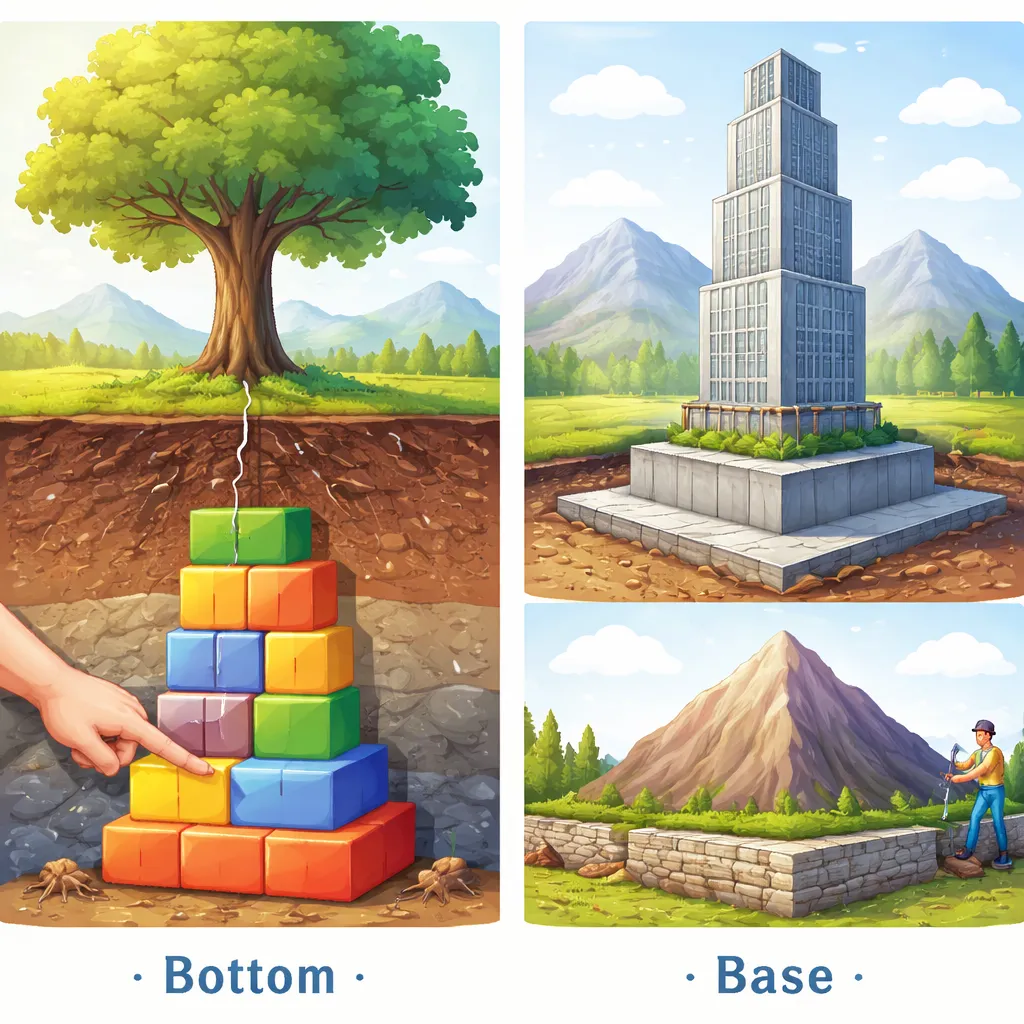

Children learn “bottom” early. They use it for cups, beds, and the ocean. Then they meet “base”. This word sounds more structural. Many parents ask if “bottom and base” mean the same thing. They are similar but not identical. The bottom of a glass is different from the base of a statue. The base of a mountain is different from the bottom of a box. Kids need clear examples. Parents can help by exploring objects and buildings together. This article gives you simple rules. You will find friendly explanations. Let’s explore “bottom and base” step by step.
Are Similar Words Really Interchangeable? Similar words often create confusion. “Bottom and base” seem like close cousins. Both mean the lowest part. But you cannot always swap them. The bottom of a river works. The base of a river sounds strange. The base of a lamp works. The bottom of a lamp also works but feels different. Language gives each word a different job. Children benefit from knowing these jobs. Parents can point out both words in furniture and nature. This article focuses only on “bottom and base”. We will compare them clearly.
Set 1: Bottom vs Base — Which One Is More Common? “Bottom” appears much more often. We say bottom of the page. We say bottom of the sea. We say bottom line. “Base” appears less often. We say base of the mountain. We say base of operations. We say first base. For everyday talk, “bottom” wins easily. Children hear “bottom” for containers, bodies, and rankings. “Base” sounds more technical or structural. The bottom of a cup is normal. The base of a cup is also fine but sounds more formal. Parents can teach this by using “bottom” for most things. Save “base” for supports, foundations, and military terms.
Set 2: Bottom vs Base — Same Meaning, Different Contexts Sometimes “bottom and base” describe the same lowest part. The bottom of a lamp. The base of a lamp. Both mean the part that touches the table. But “base” suggests support. “Bottom” suggests the lowest point without the idea of support. Consider a mountain. The bottom of a mountain is where it meets the ground. The base of a mountain is the same but sounds more like the foundation. Consider a person. The bottom of a person means the buttocks. The base of a person is not used. For children, explain it this way. “Bottom” is for the lowest point of anything. “Base” is for the supporting part of an object. Use “bottom” for containers and rankings. Use “base” for structures and supports.
Set 3: Bottom vs Base — Which Word Is “Bigger” or More Emphatic? “Base” often feels more important and structural. It suggests something that holds up the rest. The base of a building is critical. The bottom of a building is just the lowest floor. “Base” adds a sense of foundation. “Bottom” feels neutral and simple. The bottom of a bag. The base of a column. For children, this difference appears in descriptions. “The base of the statue is made of marble” sounds important. “The bottom of the statue is dirty” sounds like a simple fact. Parents can practice by describing a tower. “The base of the tower must be strong” emphasizes support. “The bottom of the tower is underground” states location. Use “base” for foundations and support.
Set 4: Bottom vs Base — Concrete vs Abstract “Bottom” works for concrete and abstract things. The bottom of a box (concrete). The bottom of my heart (abstract). The bottom of the class (abstract). “Base” also works for both but leans toward concrete support and abstract foundations. The base of a lamp (concrete). The base of an argument (abstract). The base of knowledge (abstract). For children, this is a helpful rule. Use “bottom” for lowest points in space and rankings. Use “base” for physical supports and abstract foundations. The bottom of the ocean. The base of the theory. Parents can make two columns. One column for bottom things (cup, sea, list, heart). One column for base things (mountain, building, argument, knowledge).
Set 5: Bottom vs Base — Verb or Noun? First Understand the Role Both “bottom and base” are nouns. “Bottom” also works as a verb and adjective. “The ship bottomed out” uses “bottom” as a verb. “The bottom shelf” uses “bottom” as an adjective. “Base” works as a verb and adjective too. “We base our decision on facts” uses “base” as a verb. “Base camp” uses “base” as an adjective. Children know “bottom” as a noun and adjective already. Focus on the noun meanings for comparison. The bottom of the stairs. The base of the tree. A useful tip: use “bottom” for the lowest point of containers and vertical things. Use “base” for the supporting part of structures. The bottom of a bottle. The base of a column. Teach your child to ask: Does this part support what is above? If yes, consider “base”. If just the lowest point, use “bottom”.
Set 6: Bottom vs Base — American English vs British English American and British English treat “bottom and base” almost the same. One small difference: British English uses “base” more often for military locations. “The army base” is common in both, but British English also says “base” for other foundations. Another difference: sports. American English says “first base” in baseball. British English does not use baseball terms. For children, these differences do not matter. Teach international English. Say “bottom of the page” and “base of the mountain”. Both dialects accept these. Parents only need to know that “base” sounds more technical. Use it for science and construction.
Set 7: Bottom vs Base — Which Fits Formal Situations? Formal English prefers “base” for technical and structural contexts. An engineering report says “the base of the column”. A geography text says “the base of the glacier”. “Bottom” works in formal writing too but sounds less precise. “The bottom of the ocean” is fine. “The ocean base” is not used. For children, school writing benefits from “base” for science and architecture. “The base of the volcano is wide” sounds clear. “The bottom of the volcano” is also fine but less technical. Use “bottom” for everyday descriptions. “The bottom of the page” is perfect. This builds register awareness.
Set 8: Bottom vs Base — Which One Is Easier for Kids to Remember? “Bottom” is easier for young children. It has six letters. It sounds like “bottom” (same as it looks). Children use “bottom” for their own bodies, cups, and toys. Bottom of a chair. Bottom of a pool. “Base” has four letters. It sounds like “ace” with a B. The “long a” sound can be clear. Both are easy. Start with “bottom”. Use “bottom” for several weeks. Then introduce “base”. Connect “base” to “baseball” and “basement”. A base holds things up. A basement is at the base of a house. That image helps memory. Also use hand gestures. Point to the bottom of your shirt (lowest edge). Then tap the base of a lamp (supporting part). Bottom is lowest. Base is support. Parents can play a support game. Gather a lamp, a cup, and a toy tower. Point to the base of the lamp. Point to the bottom of the cup. Point to the base of the tower. Ask your child which word fits each. This builds real-world understanding.
Mini Exercise: Can You Spot the Differences Between These Similar Words? Let’s practice with ten sentences. Choose “bottom” or “base”. Answers are below.
The __________ of the ocean is dark and cold.
The lamp has a heavy __________ so it doesn't tip over.
Please write your name at the __________ of the page.
The __________ of the mountain is covered in trees.
The __________ of the glass has a crack.
The soldier returned to the military __________.
The __________ of the column is made of stone.
She started at the __________ of the class and worked her way up.
The __________ of the tree was covered in moss.
The __________ of the cake was burnt.
Answers: 1 bottom, 2 base, 3 bottom, 4 base or bottom (base is more common for mountains), 5 bottom, 6 base, 7 base, 8 bottom, 9 base or bottom (base is more common for trees), 10 bottom.
Count the correct answers. For sentences 4 and 9, accept either. 8-10 correct means your child understands “bottom and base” well. 5-7 correct means review the concrete vs abstract section. Below 5 correct means focus only on “bottom” for two weeks. Then add “base” for supports and foundations.
Parent Tips: How to Help Kids Learn and Remember Similar Words You do not need teaching tools. You just need daily noticing. Every day has chances to use “bottom and base”. At breakfast: “The bottom of the bowl is empty. The base of the toaster is hot.” At the park: “The bottom of the slide is where you land. The base of the statue is very wide.” At bedtime: “The bottom of your bed has a blanket. The base of the nightstand holds the lamp.” Use a warm voice. Do not correct harshly. If your child says “The base of the cup”, you say “That is the bottom of the cup. Base is for things that support, like a lamp or a building.” Keep it kind. Another tip: create a support chart. Draw a lamp. Label the “base”. Draw a cup. Label the “bottom”. Draw a mountain. Label the “base”. Draw a swimming pool. Label the “bottom”. Hang the chart in the playroom. Children learn from seeing different kinds of lowest parts. Finally, play the “bottom vs base” building game. Build a tower of blocks. The block on the bottom is the bottom block. The whole bottom layer is the base. This shows how base means support, not just lowest. You and your child will master “bottom and base” through playful exploration. Keep looking down and looking for support. Every word helps you understand how things are built.