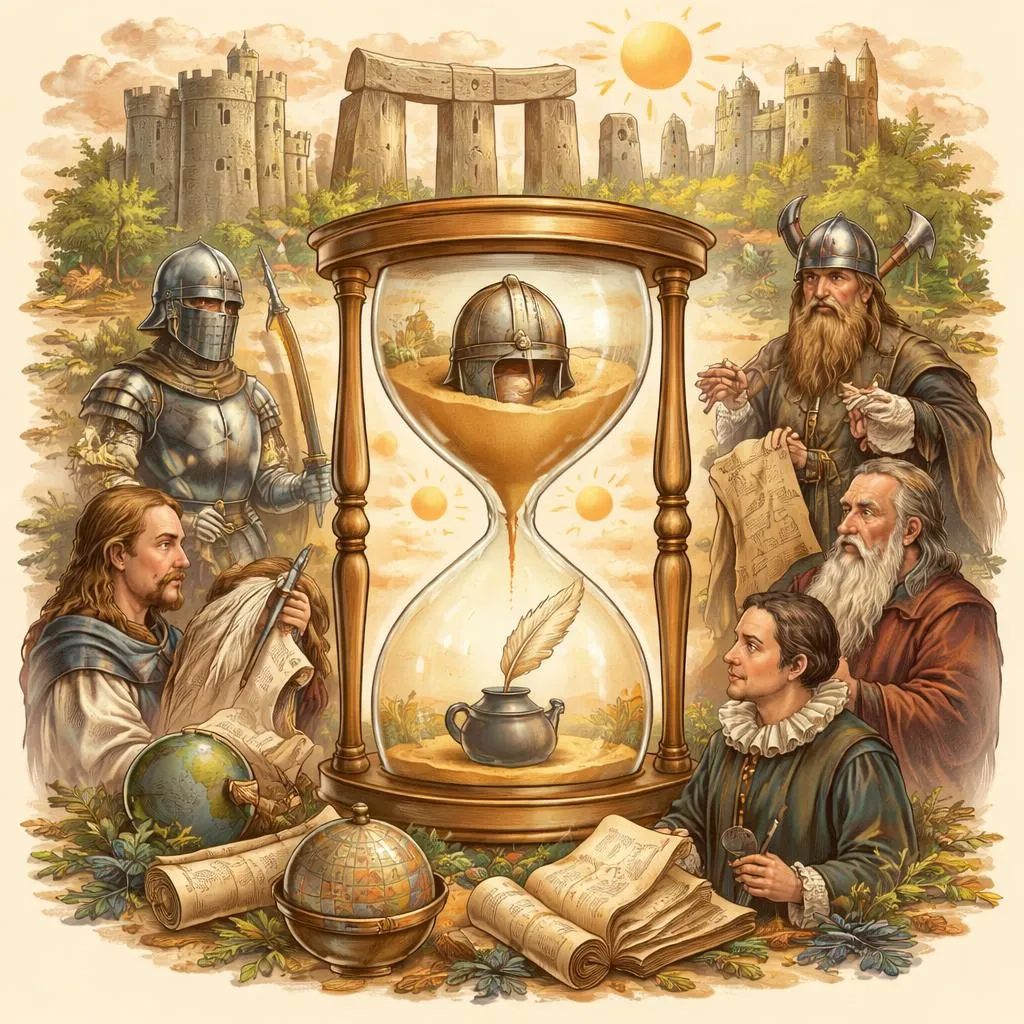

The English language was not “made” at one specific time, because languages usually develop slowly over many centuries. Instead of being invented in a single year, English grew step by step from older languages spoken in Europe.
Most historians trace the beginning of English to around the 5th century, when Germanic tribes arrived in Britain.
The Early Beginning of English (5th Century)
Around the year 450 AD, three Germanic tribes — the Angles, the Saxons, and the Jutes — migrated to Britain from northern Europe.
They brought their own languages.
These languages mixed together.
Over time, this mixture became Old English.
The word “English” actually comes from the name “Angles.”
Old English (450–1100 AD)
Old English was very different from modern English.
It looked and sounded closer to German.
One famous example of Old English writing appears in the epic poem Beowulf.
If you saw Old English today, you probably would not understand it easily.
Example of Old English:
“Hwæt! We Gardena in geardagum…”
Modern speakers usually cannot read this without study.
Middle English (1100–1500 AD)
In 1066, the William the Conqueror invaded England in the Norman Conquest.
After this event, French became the language of the royal court and government.
English changed again.
It borrowed many French words.
This period is called Middle English.
A famous writer from this time is Geoffrey Chaucer, who wrote The Canterbury Tales.
Middle English is easier to recognize than Old English, but it is still different from today’s English.
Early Modern English (1500–1700 AD)
During the 1500s, English continued to change.
Printing became common in England.
Vocabulary expanded.
Spelling slowly became more regular.
One of the most important writers of this period was William Shakespeare.
His works greatly influenced English vocabulary.
Many common words and expressions today first appeared in his plays.
The King James Bible also helped standardize English.
Modern English (1700–Today)
From the 18th century onward, English continued to grow.
The British Empire spread English around the world.
Later, the United States became a global influence.
English vocabulary expanded through science, technology, trade, and media.
Today, English is spoken in many countries and has many varieties.
So, When Was English Language Made?
English was not created in one year.
However, its earliest form began around the 5th century (about 1,500 years ago).
Since then, it has changed continuously.
Language is always evolving.
Modern English is the result of centuries of history, migration, and cultural influence.
If you would like, I can add another 1,000 words with deeper historical detail, timeline comparison, or language family explanation.
The Germanic Roots of English
To better understand when the English language was made, it is helpful to look at its deeper roots. English belongs to the Germanic branch of the Indo-European language family, which is one of the largest language families in the world. This means English is related to languages such as German and Dutch, even though they may sound different today.
Before the 5th century migration to Britain, the ancestors of the Angles, Saxons, and Jutes spoke early Germanic dialects in northern Europe. When these groups settled in Britain, their dialects blended and gradually formed what we now call Old English.
At that time, Britain was already home to Celtic-speaking peoples, so some Celtic words entered early English, although their influence was smaller than many people expect.
The Viking Influence on English
Another important stage in the development of English occurred between the 8th and 11th centuries, when Viking settlers from Scandinavia arrived in parts of Britain. These Norse-speaking groups had frequent contact with English speakers, and as a result, many Old Norse words entered the language.
Common modern words such as “sky,” “egg,” “law,” and even the pronoun “they” have roots in Old Norse. This mixing of languages simplified certain grammar structures and helped shape English into a more flexible system.
Therefore, English was not made in isolation; it developed through constant contact with other cultures.
The Norman Conquest and Vocabulary Expansion
The year 1066 is often considered one of the most important turning points in English history because of the Norman Conquest led by William the Conqueror. After the conquest, French became the language of government, law, and the royal court.
For several centuries, English existed mainly as the language of ordinary people, while French dominated official life. During this time, thousands of French words entered English, especially in areas such as law, politics, food, and art.
For example:
Government Justice Court Beef Pork Beauty
This is one reason why English often has two words for similar ideas, one Germanic and one French in origin. For example, “ask” (Germanic) and “inquire” (French origin) have similar meanings but slightly different tones.
The Printing Press and Standardization
In the late 15th century, the introduction of the printing press to England played a major role in shaping Modern English. When books began to be printed widely, spelling and grammar gradually became more standardized.
Although spelling was not fully fixed, printed materials helped create a more unified written form of English. Writers such as William Shakespeare introduced new vocabulary and creative expressions that are still used today.
Because of printing, English became more consistent across regions, which helped it develop into a national language rather than just a collection of regional dialects.
The Rise of Global English
From the 17th century onward, British exploration and colonization carried English to North America, Africa, Asia, and Australia. As a result, new varieties of English developed, including American English, Australian English, and many others.
Later, the global influence of the United States in business, science, technology, and entertainment further strengthened the international role of English. Today, English functions as a global lingua franca in many international contexts.
Although modern English speakers can communicate across continents, the language continues to evolve through new slang, borrowed words, and technological terms.
Why English Keeps Changing
Even now, English is not finished developing. New words enter the language every year, especially in fields like technology and social media. Words such as “internet,” “email,” and “smartphone” did not exist a century ago.
Pronunciation and grammar also shift slowly over time. For example, some traditional grammar rules are becoming less strict in everyday speech.
This continuous change shows that English was not made at a single moment in history; instead, it has been forming and reforming for more than 1,500 years.
Final Perspective on the Origin of English
If someone asks, “When was English language made?” the simplest answer is that its earliest recognizable form began around the 5th century, when Germanic tribes settled in Britain. However, the language we speak today is the result of many historical layers, including Germanic roots, Viking influence, Norman French vocabulary, Renaissance creativity, colonial expansion, and modern globalization.
English is therefore not the product of one invention or one person, but a living language shaped by centuries of cultural exchange and historical change.