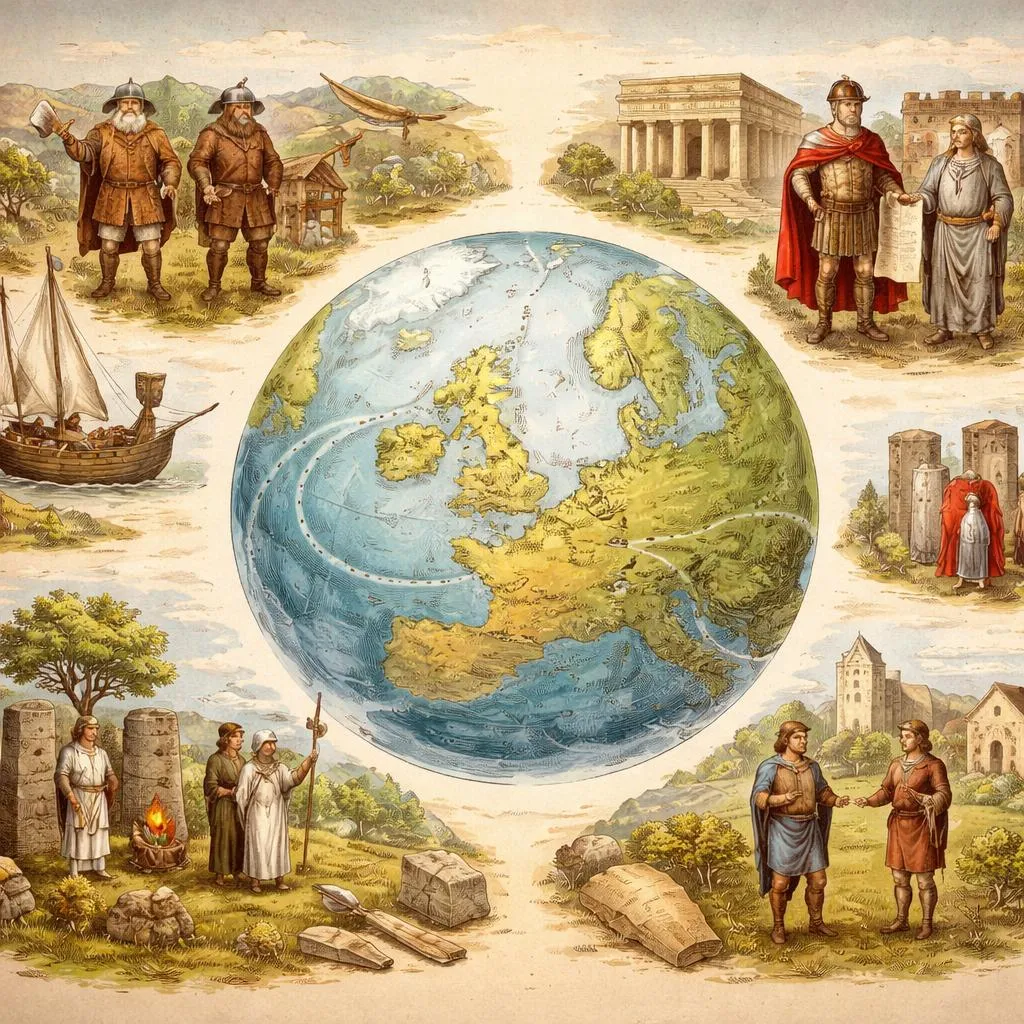

English comes from a group of languages called the Germanic languages.
It developed over many centuries.
It changed through invasion, migration, and cultural contact.
The story of English begins in early medieval Britain.
Anglo-Saxon Roots
Around the 5th century, tribes from northern Europe moved to Britain.
These tribes included the Angles, Saxons, and Jutes.
They spoke Germanic dialects.
Their speech became Old English.
The name “English” comes from the Angles.
Old English looked very different from modern English.
It had complex grammar.
It had many endings on words.
It sounded closer to German than modern English does today.
One famous example of Old English literature is Beowulf, which shows how different early English was in spelling and structure.
Norse Influence
Later, Viking groups from Scandinavia invaded parts of Britain.
They spoke Old Norse.
Old Norse and Old English were related.
Because of this similarity, many words blended together.
Common words like “sky,” “egg,” and “window” came from Norse influence.
This contact simplified grammar.
It reduced some word endings.
Language contact shaped development.
Norman Conquest and French Influence
In 1066, the Norman Conquest changed English history.
The Normans came from France.
They spoke a form of French.
For several centuries, French was used by the ruling class in England.
Because of this, thousands of French words entered English vocabulary, especially in law, government, food, and art.
Words like “court,” “judge,” “beauty,” and “dinner” came from French influence.
This period helped create Middle English.
Grammar became simpler.
Vocabulary became richer.
Latin Influence
Latin also influenced English.
Latin words entered through religion.
They entered through education.
They entered through science.
Later, during the Renaissance, scholars borrowed many Latin terms for academic and scientific writing.
This expanded English vocabulary even more.
Modern English
From about the 1500s onward, English continued to change.
Printing spread standard spelling.
Exploration spread English to other continents.
Colonization carried English worldwide.
Writers like William Shakespeare added new words and expressions to the language.
Over time, English became more standardized.
It also developed many regional varieties.
English Today
Today, English is spoken in many countries.
It is an official language in places like the United Kingdom, the United States, Canada, Australia, and others.
It is also widely learned as a second language.
Modern English contains Germanic structure.
It contains French vocabulary.
It contains Latin academic terms.
It is a mixture of influences.
Long Explanation Sentence
English developed from the Germanic dialects brought to Britain by the Angles, Saxons, and Jutes in the early medieval period, later absorbing significant vocabulary and structural influence from Old Norse through Viking contact and from French after the Norman Conquest, while continuing to expand through Latin borrowing, global exploration, and cultural exchange into the modern international language recognized today.
Simple Answer
English came from Germanic languages.
It grew in Britain.
It changed through history.
It absorbed words from Norse, French, and Latin.
It developed into the modern English spoken around the world today.
The Three Main Periods of English
The history of English is usually divided into three main periods.
Old English.
Middle English.
Modern English.
Each period shows clear changes in grammar, spelling, pronunciation, and vocabulary, reflecting political events, migration patterns, cultural influence, and technological development that shaped how people spoke and wrote over time.
Old English lasted from about 450 to 1100.
It had many noun endings.
Word order was flexible.
Vocabulary was mostly Germanic.
Middle English lasted from about 1100 to 1500.
Grammar became simpler.
French vocabulary increased.
Spelling was not standardized.
Modern English began around 1500.
Printing helped fix spelling patterns.
Grammar continued to simplify.
Vocabulary expanded rapidly.
The Great Vowel Shift
Between the 1400s and 1700s, English pronunciation changed dramatically in a process known as the Great Vowel Shift, during which long vowel sounds gradually shifted upward in pronunciation, creating differences between spelling and sound that still exist in modern English.
For example, the vowel in “time” used to sound different.
The vowel in “house” shifted.
Spelling stayed similar.
Pronunciation changed.
This explains why English spelling can seem irregular.
Sound change shaped modern speech.
Expansion Through Exploration
As England explored and established colonies, English traveled to North America, the Caribbean, Africa, Asia, and Oceania, where it adapted to local conditions, absorbed new vocabulary, and developed regional varieties that reflected cultural contact and multilingual environments.
New words entered English.
Words for plants and animals were borrowed.
Food names were adopted.
Cultural terms were included.
American English developed differences from British English.
Australian English formed its own patterns.
Regional accents expanded.
Vocabulary diversity increased.
Influence of Literature and Media
Writers, scholars, and translators helped standardize English by producing widely distributed texts that shaped spelling, grammar, and vocabulary usage across regions and generations.
The printing press increased access to books.
Dictionaries organized definitions.
Grammar guides described usage.
Writers experimented with expression.
One influential dictionary was created by Samuel Johnson, whose work helped standardize spelling and definitions in the 18th century.
Later, global media strengthened shared usage.
Radio spread pronunciation models.
Television reinforced vocabulary.
The internet accelerated language change.
Borrowed Words in English
English is known for borrowing words.
From French came words about government and cuisine.
From Latin came scientific terminology.
From Greek came academic terms.
From Hindi came words like “shampoo.”
From Arabic came words like “algebra.”
From Spanish came words like “tomato.”
Borrowing enriched vocabulary.
Borrowing increased flexibility.
Borrowing expanded expression.
English became adaptable.
Grammar Simplification
Compared to Old English, modern English grammar is much simpler because many noun endings disappeared, gender distinctions were reduced, and word order became more fixed, making subject-verb-object structure central to sentence clarity.
Case endings mostly disappeared.
Verb endings reduced.
Pronouns retained some case differences.
Word order became important.
Structure supports meaning.
English as a Global Language
Today English functions as an international language in business, science, aviation, education, and digital communication, connecting speakers across continents and serving as a common medium for global cooperation, academic research, technological innovation, and cross-cultural exchange.
International companies use English.
Air travel uses English terminology.
Scientific journals publish in English.
Online content often appears in English.
Global communication increases demand.
Learning English supports opportunity.
Extended Historical Sentence
English originated from the Germanic dialects brought to Britain by early settlers, evolved through contact with Old Norse during Viking invasions and with Norman French after 1066, transformed significantly during the Great Vowel Shift, expanded through colonial exploration and global trade, absorbed vocabulary from numerous languages worldwide, and gradually developed into a standardized yet highly adaptable global language shaped by centuries of political, cultural, and technological change.
Restated Clear Explanation
English began as a Germanic language in Britain.
It changed after Viking contact.
It changed after French rule.
It absorbed Latin and other languages.
It spread through exploration.
It continues to change today.
English reflects history.
English reflects contact.
English reflects global connection.