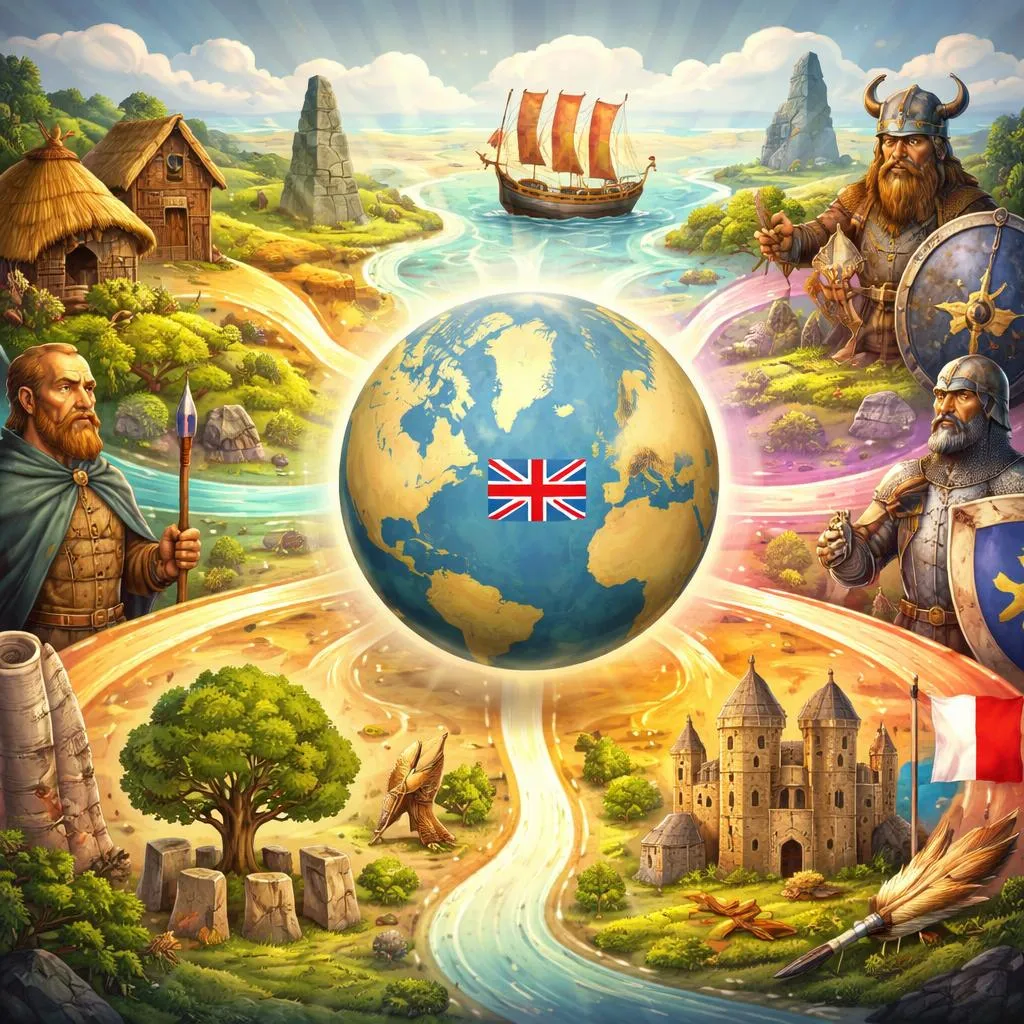

The English language comes from a long history of migration, cultural contact, and gradual change. It was not created at one single moment, and it was not invented by one person. Instead, English developed over many centuries as different groups of people settled in Britain and influenced the way people spoke.
To understand where the English language comes from, it is helpful to look at its historical roots step by step.
Germanic Origins
English belongs to the Germanic branch of the Indo-European language family, which means it is related to languages such as German and Dutch. The earliest stage of English began around the 5th century, when three Germanic tribes — the Angles, the Saxons, and the Jutes — migrated to Britain.
These groups brought their own dialects, and over time those dialects blended together. This new combined language became what we now call Old English. In fact, the word “English” comes from the name “Angles.”
Old English was very different from modern English in grammar, spelling, and pronunciation. Most modern speakers would not be able to understand it without study.
Viking Influence
Between the 8th and 11th centuries, Viking settlers from Scandinavia arrived in parts of Britain. They spoke Old Norse, another Germanic language. Because the Vikings lived and traded with English speakers, many Norse words entered the English vocabulary.
Common modern words such as “sky,” “egg,” “law,” and even the pronoun “they” come from Old Norse. This contact also helped simplify some grammar rules, which made English gradually easier in structure.
The Viking influence shows that English developed through contact and exchange rather than isolation.
The Norman Conquest and French Impact
In 1066, the Norman Conquest changed the English language dramatically. The invasion was led by William the Conqueror, and after this event, French became the language of government, law, and the royal court in England.
For several centuries, English continued to be spoken by ordinary people, but it absorbed thousands of French words. Vocabulary related to government, law, art, and food often has French origins.
For example:
Government Justice Court Beef Pork
Because of this history, English often has two words with similar meanings — one from Germanic roots and one from French influence.
The Growth of Modern English
During the 15th and 16th centuries, printing technology helped standardize spelling and grammar. Writers such as William Shakespeare expanded the vocabulary by creating new words and expressions. As exploration and trade increased, English also borrowed words from many other languages around the world.
Later, the expansion of the British Empire and the global influence of the United States spread English internationally. Today, English is spoken in many countries and continues to evolve.
A Language That Keeps Changing
The English language did not come from one source alone. It began with Germanic tribes, absorbed Norse and French influences, and continued to grow through global contact. Even now, English keeps changing as new words are added through technology, culture, and international communication.
Understanding where English comes from helps learners appreciate its rich history and diverse vocabulary.
The Transition from Old English to Middle English
After the early Germanic period, English continued to change naturally as generations of speakers simplified grammar and adjusted pronunciation. Old English originally had complex noun endings and grammatical gender, similar to modern German. Over time, many of these endings disappeared, and sentence structure became more dependent on word order rather than endings.
This gradual simplification made English more flexible and easier to adapt. However, the biggest transformation came after the Norman Conquest in 1066, when French-speaking rulers controlled England for several centuries. During this time, English absorbed a large amount of French vocabulary, especially in areas such as government, law, religion, fashion, and cuisine.
As a result, Middle English developed as a blend of Germanic structure and French vocabulary. This period shows clearly that English did not come from one single source, but from layers of influence built over time.
The Renaissance and Latin Influence
During the Renaissance, scholars in England were strongly influenced by classical learning from ancient Rome and Greece. As education expanded, many Latin and Greek words entered English, especially in science, medicine, philosophy, and literature.
For example, words such as “temperature,” “education,” “science,” and “philosophy” have Latin roots. These additions greatly expanded English vocabulary and allowed it to express more abstract and academic ideas.
Because English was open to borrowing from other languages, it became rich and flexible. Instead of replacing older words, English often kept both the old and new forms, which explains why it has such a large vocabulary today.
The Role of Exploration and Trade
From the 16th century onward, British exploration and global trade introduced English to many parts of the world. As sailors, traders, and settlers traveled to Africa, Asia, the Americas, and Australia, they encountered new cultures and languages. English speakers borrowed words to describe new plants, animals, foods, and customs.
For example, words like “kangaroo” came from Indigenous Australian languages, and “tea” entered English through trade with China. These borrowings show that English continued to grow by interacting with other societies.
This global contact helped shape English into an international language.
The Rise of American English
In the 17th century, English settlers traveled to North America. Over time, American English developed its own pronunciation patterns, spelling preferences, and vocabulary differences. Although British English and American English remain mutually understandable, they show how one language can grow in different directions depending on geography and culture.
For example, spelling differences such as “color” and “colour” reflect historical language reforms in the United States. Vocabulary differences, such as “truck” in American English and “lorry” in British English, also developed over time.
These differences demonstrate that English continues to evolve based on social and regional influences.
English as a Global Language Today
In modern times, English has become one of the most widely spoken languages in the world. It is used in international business, science, technology, aviation, and entertainment. Many countries use English as a second language for communication across borders.
Because of globalization and the internet, English continues to change rapidly. New words related to technology, social media, and popular culture appear every year. This constant development proves that English is still growing and adapting.
A Language Shaped by History
The English language comes from Germanic roots, but it was shaped by Viking contact, French rule, Latin scholarship, global trade, and cultural exchange. It did not appear suddenly; it formed slowly through centuries of interaction between different peoples and languages.
Understanding where English comes from helps learners appreciate its diversity and complexity. It also explains why English vocabulary has many layers and why the language contains words from so many different origins.