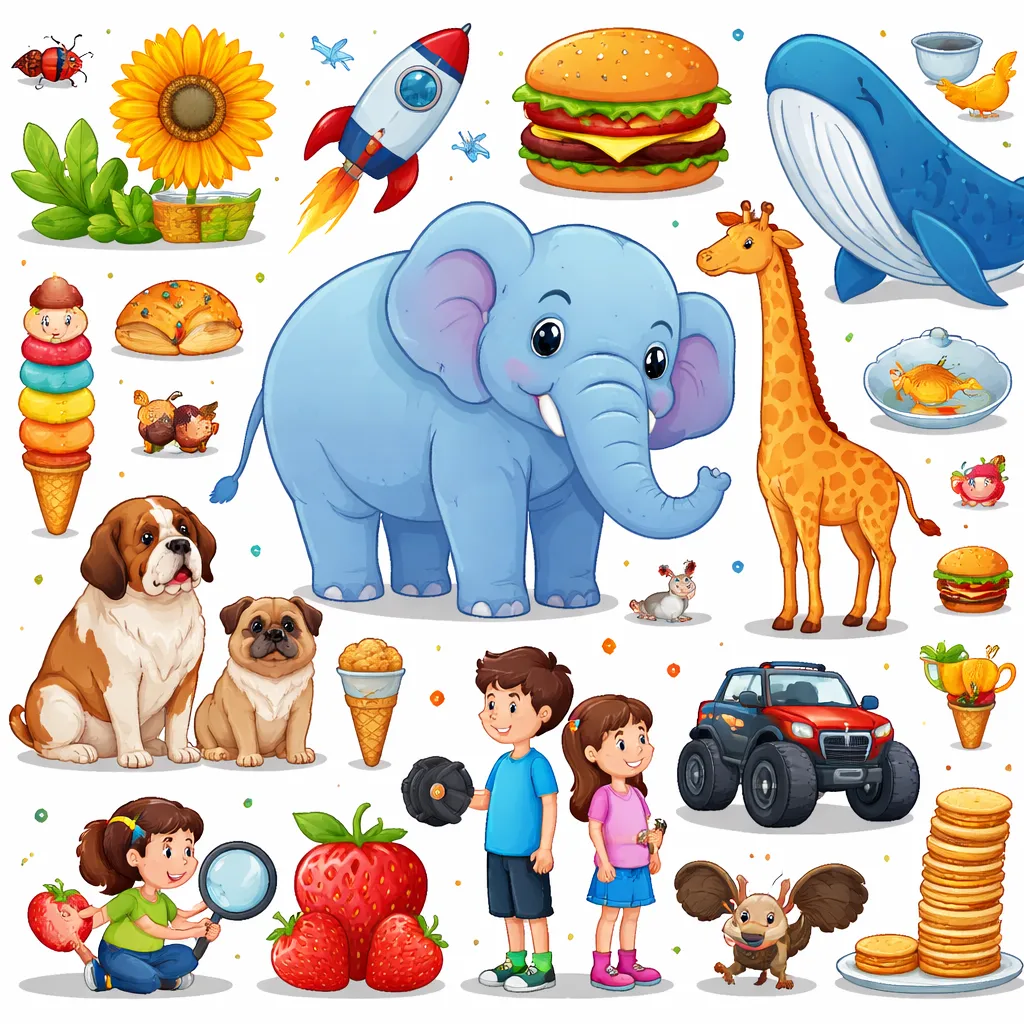

Hello, little word detective! Meet two special brothers. Their names are Comp and Sup. Comp likes to say "more" or "-er". Sup likes to say "the most" or "-est". They help us compare things every day! When we compare two things, we use a Comparative. It often ends in "-er" or uses "more". When we compare three or more things to find the winner, we use a Superlative. It often ends in "-est" or uses "the most". Let's follow Comp and Sup on a fun race to learn about them at home, the playground, school, and in nature.
What are Comparatives and Superlatives?
They are special forms of describing words (adjectives). We use them to show differences. A Comparative compares TWO things. A Superlative compares THREE or MORE things. Think about size. "Big" is a normal word. "My ball is bigger than your ball." (Comparative, two balls). "My ball is the biggest of all the balls." (Superlative, many balls). They are some of the most common Comparatives and Superlatives for Kindergarten students. Comp and Sup make talking about our world more fun and clear.
Why are Comp and Sup Your Comparison Friends?
Using Comparatives and Superlatives makes you a great explainer. It helps your ears listen. You can hear who is taller or what is the best. It helps your mouth speak. You can say what you like more. "This cake is yummier." It helps your eyes read. You can spot "-er" and "-est" and understand comparisons. It helps your hand write. You can write about the fastest runner or the softest toy. They help you share your thoughts about the world.
What Rules Do Comp and Sup Follow?
Comp and Sup have two main ways to change. Each way has simple rules.
The Simple "-er/-est" Rule. For short describing words, Comp adds "-er". Sup adds "-est". At home: "My cup is bigger. Dad's cup is the biggest." At school: "My pencil is shorter. Her pencil is the shortest." On the playground: "I run faster. He runs the fastest." In nature: "A mouse is smaller. A bug is the smallest."
The Tricky "More/Most" Rule. For longer describing words, Comp uses "more" before the word. Sup uses "the most" before the word. At home: "This sofa is more comfortable." "That bed is the most comfortable." At school: "Reading is more interesting." "Math is the most interesting." On the playground: "Swings are more fun." "The slide is the most fun." In nature: "A lion is more beautiful." "A peacock is the most beautiful."
Special Friends (Irregulars). Some words change in a special way. They don't follow the normal rules. Good -> Better -> Best. Bad -> Worse -> Worst. Many/Much -> More -> Most. Little -> Less -> Least. At home: "My drawing is good. Yours is better. Hers is the best." On the playground: "Today is bad. Yesterday was worse. That was the worst day."
How Can You Spot Comp and Sup?
Comp and Sup have special detective clues. Look for these signs.
Look for the "-er" or "-est" Tail. Find a describing word with "-er" or "-est" at the end. "Bigger", "fastest". That is a big clue!
Listen for "Than". The word "than" often comes after a comparative. "I am taller than you." If you hear "than", look for a comparative before it.
Look for "The" Before "-est". Superlatives often have "the" in front. "This is the biggest cake." "She is the fastest."
Ask a Comparison Question. Ask: "Are we comparing two things?" Look for "-er" or "more". Ask: "Are we finding the number one in a group?" Look for "-est" or "the most".
How Do We Use Our Comparison Friends?
Using them is easy. Follow Comp and Sup's favorite sentence paths.
Comp's Path for Two Things: [Thing A] + is + [Comparative] + than + [Thing B]. "My dog is bigger than your cat." "Summer is hotter than spring."
Sup's Path for a Group: [Thing] + is + the + [Superlative] + (in/of/ever). "This is the biggest dog in the park." "It was the best day ever."
The "More/Most" Path: [Thing A] + is + more + [Long Adjective] + than + [Thing B]. "This game is more exciting than that one." "This is the most exciting game of all."
Let’s Fix Some Comparison Mistakes!
Sometimes Comp and Sup get mixed up. Let's help them.
Using "-est" for Two Things.
Wrong: "This is the biggest of the two balls." We only use "the biggest" for three or more. For two, use the comparative.
Right: "This ball is bigger than that ball."
Using "More" with a Short "-er" Word.
Wrong: "This is more big than that." "Big" is a short word. We should use its "-er" form.
Right: "This is bigger than that."
Forgetting "The" with the Superlative.
Wrong: "He is fastest runner." The superlative usually needs "the" in front.
Right: "He is the fastest runner."
Using "Gooder" or "Badder".
Wrong: "My toy is gooder." "Good" is a special friend. It changes to "better" and "best".
Right: "My toy is better." "It is the best toy."
Can You Be a Comparison Detective?
Let's play. I will name two things. You compare them. "A mouse and an elephant." (Size). Good! "The elephant is bigger." Now, name three things. Find the winner. "A car, a bike, and a scooter." (Speed). "The car is the fastest." Great job, detective!
Comp and Sup's 100 Common Comparison Words.
Here are one hundred ways to compare. They are common Comparatives and Superlatives for Kindergarten students.
Simple "-er/-est" Friends:
big / bigger / biggest
small / smaller / smallest
tall / taller / tallest
short / shorter / shortest
long / longer / longest
fast / faster / fastest
slow / slower / slowest
high / higher / highest
low / lower / lowest
hot / hotter / hottest
cold / colder / coldest
warm / warmer / warmest
cool / cooler / coolest
dark / darker / darkest
light / lighter / lightest
bright / brighter / brightest
clean / cleaner / cleanest
dirty / dirtier / dirtiest
new / newer / newest
old / older / oldest
young / younger / youngest
happy / happier / happiest
sad / sadder / saddest
fat / fatter / fattest
thin / thinner / thinnest
wet / wetter / wettest
dry / drier / driest
loud / louder / loudest
quiet / quieter / quietest
near / nearer / nearest
far / farther / farthest
hard / harder / hardest
soft / softer / softest
strong / stronger / strongest
weak / weaker / weakest
sweet / sweeter / sweetest
kind / kinder / kindest
rich / richer / richest (in toys!)
"More/Most" Friends (Longer Words):
beautiful / more beautiful / most beautiful
careful / more careful / most careful
colorful / more colorful / most colorful
comfortable / more comfortable / most comfortable
delicious / more delicious / most delicious
exciting / more exciting / most exciting
expensive / more expensive / most expensive
famous / more famous / most famous
friendly / more friendly / most friendly
funny / more funny / most funny
generous / more generous / most generous
handsome / more handsome / most handsome
important / more important / most important
intelligent / more intelligent / most intelligent
interesting / more interesting / most interesting
obedient / more obedient / most obedient
patient / more patient / most patient
peaceful / more peaceful / most peaceful
pleasant / more pleasant / most pleasant
popular / more popular / most popular
powerful / more powerful / most powerful
precious / more precious / most precious
pretty / more pretty / most pretty
special / more special / most special
wonderful / more wonderful / most wonderful
Special Friends (Irregulars):
good / better / best
bad / worse / worst
many / more / most
much / more / most
little (amount) / less / least
far (distance) / farther / farthest
far (extent) / further / furthest
old (people) / elder / eldest
Using Them in Sentences:
My dad is taller than my mom.
Our house is the biggest on the street.
This ice cream is colder than that one.
Winter is the coldest season.
I am faster than my sister.
She is the fastest in our class.
My cookie is bigger than yours.
That is the biggest cookie ever!
This puzzle is easier than that one.
This is the easiest puzzle in the box.
My room is cleaner than your room.
Her room is the cleanest.
This story is funnier.
That is the funniest story I know.
I am happier today.
That was the happiest day of my life.
This juice is sweeter.
Honey is the sweetest.
My grandpa is older than my grandma.
He is the oldest person I know.
My baby brother is younger than me.
He is the youngest in our family.
A whisper is quieter than a talk.
A library is the quietest place.
A shout is louder than a scream.
The fire alarm is the loudest sound.
A feather is lighter than a paper.
Air is the lightest thing.
This rock is heavier than that one.
The anvil is the heaviest.
You Are a Comparison Expert Now!
You did it! You know that Comparatives (like -er) compare two things. Superlatives (like -est) pick the winner in a group. Comp and Sup give you a shiny medal. You have learned one hundred common Comparatives and Superlatives for Kindergarten students. You can make words bigger, smaller, faster, and the most fun!
Here is what you learned from our comparison race. You know comparatives often end in "-er" or use "more" to compare two things. You know superlatives often end in "-est" or use "the most" to compare three or more things. You know some special words like good/better/best. You can spot them by their "-er/-est" tails or the words "more/most". You can use the sentence formulas. You can fix common mistakes like using "-est" for only two things.
Now, let’s do some life practice! Your mission is today. Be a Family Comparer. Look at your family. Compare two people. Say: "My mom is taller than me." Then, find the "winner" in your house. Say: "My dad has the biggest hands." Or, compare your toys. Say: "The teddy bear is softer than the truck. The blanket is the softest." You are a wonderful word detective.