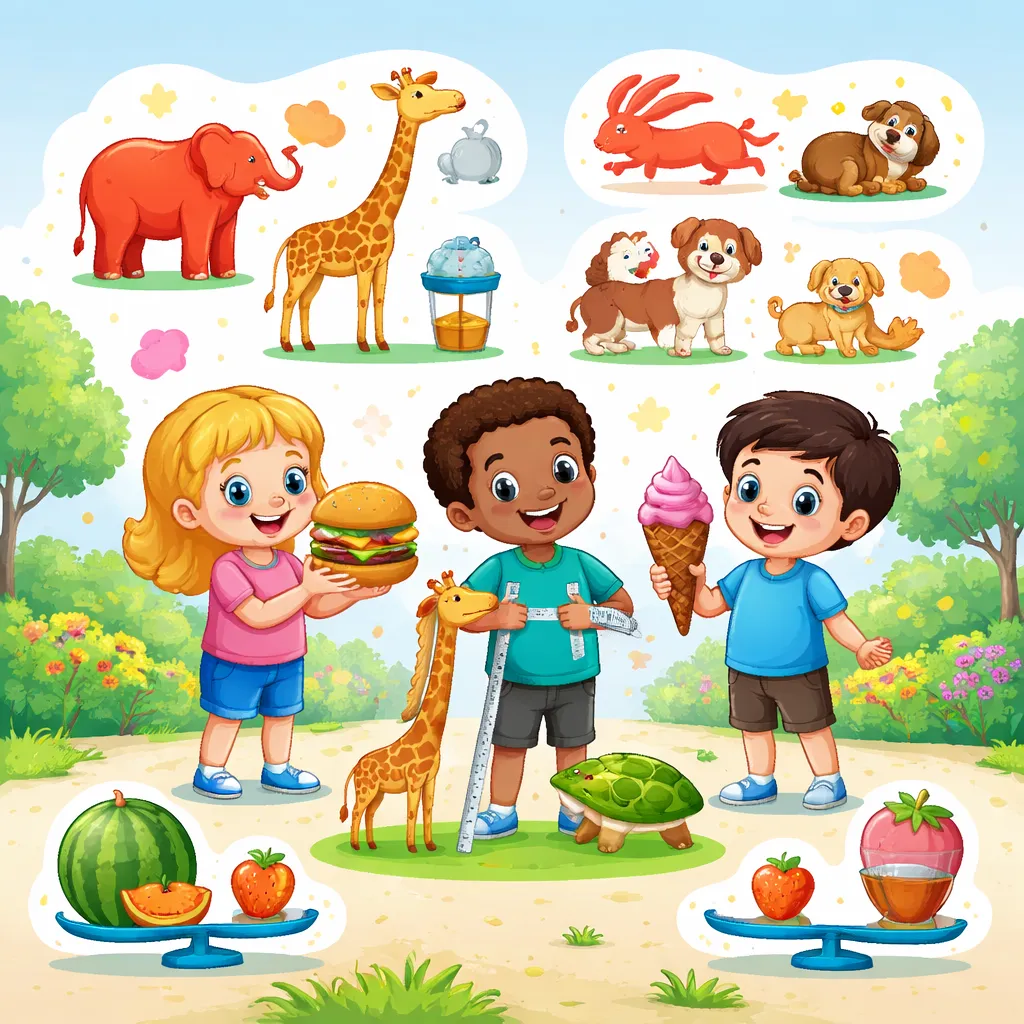

Your child loves to compare things. "My dog is bigger than yours." "This is the best day ever!" "She is the tallest in our class." These are comparatives and superlatives. Comparatives compare two things. Superlatives compare three or more and show the extreme. Mastering the top 100 comparatives and superlatives for elementary students helps children express comparisons clearly and correctly. This guide will explain what comparatives and superlatives are, list the most important examples, and show how to practice at home.
Meaning: What Are Comparatives and Superlatives?
Comparatives and superlatives are special forms of adjectives and adverbs used for comparing. Comparatives compare two things. They often end in -er or use the word more. Superlatives compare three or more things and show the highest or lowest degree. They often end in -est or use the word most.
Think about comparatives. "My cat is smaller than yours." This compares two cats. "This book is more interesting than that one." This compares two books using more.
Think about superlatives. "She is the tallest in her class." This compares her to everyone else. "This is the most delicious cake I've ever eaten." This compares this cake to all other cakes using most.
These forms help children express opinions, describe differences, and understand comparisons they hear.
The top 100 comparatives and superlatives for elementary children cover all the common forms they need.
Conjugation: How to Form Comparatives and Superlatives
Forming comparatives and superlatives follows clear rules. Most short adjectives add -er for comparative and -est for superlative. Tall becomes taller and tallest. Small becomes smaller and smallest. Fast becomes faster and fastest.
For adjectives ending in -y, change the y to i and add -er or -est. Happy becomes happier and happiest. Funny becomes funnier and funniest. Crazy becomes crazier and craziest.
For longer adjectives with two or more syllables, use more for comparative and most for superlative. Beautiful becomes more beautiful and most beautiful. Interesting becomes more interesting and most interesting. Dangerous becomes more dangerous and most dangerous.
Some common adjectives have irregular forms. Good becomes better and best. Bad becomes worse and worst. Far becomes farther or further and farthest or furthest. Little becomes less and least. Much and many become more and most.
Adverbs also have comparative and superlative forms. Carefully becomes more carefully and most carefully. Early becomes earlier and earliest.
The top 100 comparatives and superlatives for elementary students include practice with all these formation rules.
Categories or Lists: The Top 100 Comparatives and Superlatives
Here are the top 100 comparatives and superlatives for elementary students, grouped by category. These are the words children use and encounter most often.
Size Comparatives and Superlatives (15): bigger, biggest, smaller, smallest, taller, tallest, shorter, shortest, longer, longest, wider, widest, thicker, thickest, thinner, thinnest. "My house is bigger than yours." "This is the tallest building in town." "My pencil is longer than that one."
Quality Comparatives and Superlatives (15): better, best, worse, worst, nicer, nicest, friendlier, friendliest, kinder, kindest, smarter, smartest, funnier, funniest, more beautiful, most beautiful, more interesting, most interesting. "This movie is better than the last one." "She is the kindest person I know." "That's the most interesting book I've read."
Quantity Comparatives and Superlatives (10): more, most, less, least, fewer, fewest. "I have more stickers than you." "She has the most friends." "He has less homework today." "This class has the fewest students."
Age Comparatives and Superlatives (10): older, oldest, younger, youngest, newer, newest, older, oldest, elder, eldest. "My sister is older than me." "This is the newest phone." "He is the youngest in our family."
Speed Comparatives and Superlatives (10): faster, fastest, slower, slowest, quicker, quickest. "He runs faster than I do." "This is the slowest turtle." "She finished quicker than everyone else."
Temperature Comparatives and Superlatives (10): hotter, hottest, colder, coldest, warmer, warmest, cooler, coolest. "Today is hotter than yesterday." "This is the coldest day of winter." "The water is warmer near the shore."
Distance Comparatives and Superlatives (10): farther, farthest, further, furthest, nearer, nearest, closer, closest. "My school is farther than yours." "This is the nearest store." "She sat closer to the window."
Intensity Comparatives and Superlatives (10): happier, happiest, sadder, saddest, angrier, angriest, more excited, most excited, more scared, most scared. "I am happier today." "That was the most exciting game." "She was the most scared in the haunted house."
Irregular Comparatives and Superlatives (10): good, better, best; bad, worse, worst; far, farther/further, farthest/furthest; little, less, least; much/many, more, most. "This is good, but that is better." "That was the worst day ever." "I have less candy than you."
The top 100 comparatives and superlatives for elementary students include these essential examples. Children will use them every day.
Daily Life Examples: Comparatives and Superlatives All Around Us
Comparatives and superlatives appear constantly in everyday language. They help us compare and choose. Pointing them out helps children see that these comparison words are part of real communication.
In morning routines, we use comparisons. "This cereal is better than that one." "You are taller than yesterday!" "Today feels colder than yesterday." "This is the warmest sweater." "I want the bigger bowl." Each comparison adds meaning.
During meals, children compare food. "I like broccoli more than carrots." "This is the best pizza ever!" "My piece is smaller than yours." "These grapes are sweeter than those." "This is the spiciest soup." Comparisons are everywhere.
In car rides, we compare distances and speeds. "Are we there yet? It seems longer than last time." "That car is going faster than us." "This is the shortest route." "That's the biggest truck I've ever seen." "The sky is getting darker."
At school, children compare constantly. "My drawing is better than his." "She is the smartest in class." "This book is more interesting than the last one." "I finished earlier than everyone." "His handwriting is neater than mine."
In stores, signs use superlatives. "Best value!" "Lowest prices!" "Biggest sale of the year!" "Newest styles!" "Fastest delivery!" Children see these everywhere.
The top 100 comparatives and superlatives for elementary students help them notice and use these comparison words.
Printable Flashcards: Visual Tools for Learning
Flashcards make comparisons concrete. Creating and using them together turns learning into an activity. Here are some ways to use flashcards for comparative and superlative practice.
Create cards with base adjectives on one side and their comparative and superlative forms on the other. "tall" becomes "taller, tallest" "happy" becomes "happier, happiest" "beautiful" becomes "more beautiful, most beautiful" "good" becomes "better, best" "bad" becomes "worse, worst."
Create picture cards showing comparisons. A picture of a small dog and a big dog. Your child says "The big dog is bigger than the small dog." A picture of three trees of different heights. Your child says "This is the tallest tree." A picture of one happy face and one happier face. "She is happier than him."
Create sentence cards with the comparison word missing. "My dog is ___ than yours." (bigger) "She is the ___ girl in class." (tallest) "This is ___ than that." (more interesting) "This is the ___ day ever." (best) Your child fills in the correct form.
Create matching cards that pair base forms with their irregular forms. Match "good" with "better" and "best." Match "bad" with "worse" and "worst." Match "many" with "more" and "most."
Learning Activities or Games: Making Comparisons Fun
Games turn grammar into play. Here are some games that help children practice the top 100 comparatives and superlatives for elementary students in enjoyable ways.
Compare Things Game: Hold up two objects and have your child compare them. "This pencil is longer than that one." "This apple is redder than that one." "This book is heavier than that one." Use objects around the house.
Superlative Hunt: Find the most extreme examples of things around you. "This is the tallest lamp." "This is the softest pillow." "This is the brightest light." "This is the oldest book." See how many superlatives you can find.
Better or Worse Game: Compare two things and decide which is better. "Which is better, pizza or ice cream?" "Which is worse, getting a cold or stubbing your toe?" "Which is more fun, swimming or biking?" Your child explains their choice using comparatives.
Family Comparisons: Compare family members using comparatives. "Dad is taller than Mom." "I am younger than my brother." "Grandma is the oldest." "My sister's hair is longer than mine." This makes grammar personal.
Three Things Game: Find three similar objects and compare them using superlatives. Three pencils of different lengths. "This is the longest pencil." "This is the shortest." Three books of different thicknesses. "This is the thickest book." "This is the thinnest."
Irregular Practice: Practice irregular forms with a matching game. Say "good" and have your child say "better" and "best." Say "bad" and have them say "worse" and "worst." Say "many" and have them say "more" and "most." Say "little" and have them say "less" and "least."
Comparative and Superlative Bingo: Create bingo cards with comparative and superlative forms in each square. Call out base adjectives. "tall" Your child covers "taller" or "tallest." "good" Your child covers "better" or "best." "beautiful" Your child covers "more beautiful" or "most beautiful." First to get five in a row wins.
Story Building with Comparisons: Tell a story together using comparisons. "Once upon a time, there were three bears. Papa Bear was bigger than Mama Bear. Baby Bear was the smallest. But Baby Bear was happier than both of them because he found the best porridge." The story grows while comparison practice happens.
As your child becomes familiar with the top 100 comparatives and superlatives for elementary students, their language becomes more precise and expressive. They can describe differences accurately. They can express opinions about what is best or worst. They can understand comparisons they hear and read. These forms are essential for clear communication. Keep practice connected to real comparisons in daily life. Point out comparatives and superlatives when you use them. Celebrate when your child uses a new comparative or superlative correctly. These words help them navigate a world full of choices and differences.