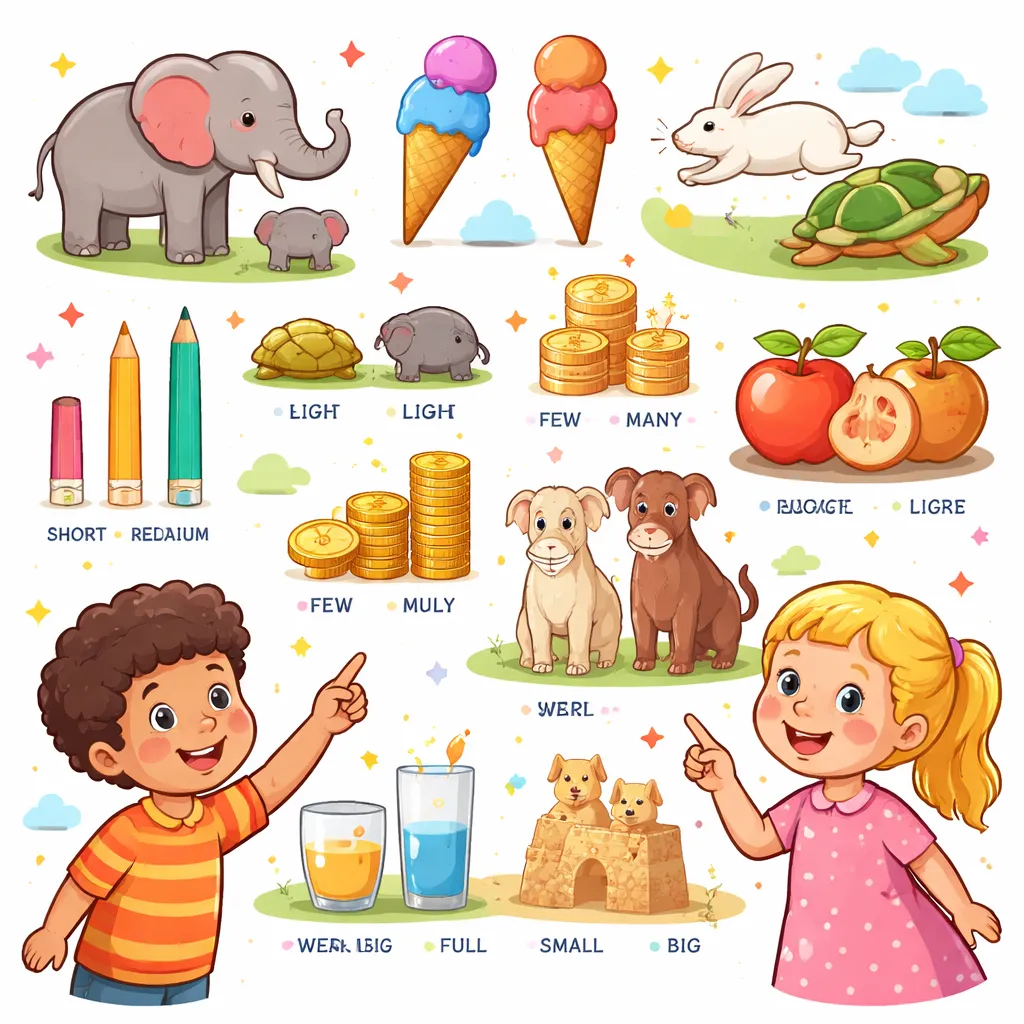

Children constantly compare things. They want the bigger cookie, the fastest runner, or the best toy. Comparing words help them express these ideas. Comparatives compare two things using -er or more. Superlatives compare three or more things using -est or most. Today we explore the 70 most common comparatives and superlatives for 6-year-old children and how these words help them describe differences.
Comparing is a natural part of childhood. Who has more? Who is faster? Which is best? These questions matter deeply to young children. Learning to express comparisons accurately helps them navigate social situations and describe their world precisely.
What Are Comparatives and Superlatives?
Let us begin with a clear definition we can share with our children. Comparatives are words we use to compare two things. They often end in -er or use the word more. Superlatives compare three or more things. They often end in -est or use the word most.
Think of comparatives as the -er words. Bigger, smaller, faster, slower. They tell how one thing is different from another. "My cookie is bigger than your cookie." That compares two cookies.
Think of superlatives as the -est words. Biggest, smallest, fastest, slowest. They tell how one thing is different from all the others. "My cookie is the biggest of all." That compares many cookies.
Some long words use more and most instead of -er and -est. More beautiful, most beautiful. More interesting, most interesting. Children learn both patterns.
For young children, we can explain it simply. When we want to say one thing has more of something than another, we use comparing words. Bigger, smaller, faster. When we want to say one thing has the most of all, we use the-est words. Biggest, smallest, fastest. The 70 most common comparatives and superlatives for 6-year-old learners are the ones children use every day.
Meaning and Explanation for Young Learners
How do we explain comparatives and superlatives to a six-year-old in ways they understand? We use examples from their world and show how these words show differences.
Tell your child that we have special words to talk about how things are different. If one cookie is big and another is bigger, the second has more bigness. If one runner is fast and another is faster, the second has more speed. These -er words compare two things.
Here are some comparatives children use. "My tower is taller than yours." Compares height. "I am older than my brother." Compares age. "This juice is sweeter than that one." Compares taste. Each -er word compares two things.
Now for superlatives. If you have many cookies and one is the biggest, that one has the most bigness of all. If many runners race and one is the fastest, that one has the most speed. These -est words compare many things.
Here are some superlatives children use. "I am the tallest in my class." Compares many children. "This is the yummiest cookie ever." Compares many cookies. "That was the funniest joke." Compares many jokes. Each -est word shows the one with the most.
Some words change in special ways. Good becomes better and best. Bad becomes worse and worst. Many becomes more and most. Children learn these as special cases.
These explanations help children understand the 70 most common comparatives and superlatives for 6-year-old speakers. They see that these words help compare and contrast.
Categories of Comparatives and Superlatives
These words fall into patterns based on how they are formed. Understanding these patterns helps children use them correctly.
Short words add -er and -est. Big, bigger, biggest. Small, smaller, smallest. Fast, faster, fastest. Tall, taller, tallest. Old, older, oldest. Young, younger, youngest. These are one-syllable words.
Words ending in y change y to i and add -er/-est. Happy, happier, happiest. Funny, funnier, funniest. Pretty, prettier, prettiest. Yummy, yummier, yummiest. The y changes before adding.
Long words use more and most. Beautiful, more beautiful, most beautiful. Interesting, more interesting, most interesting. Careful, more careful, most careful. These are words with two or more syllables.
Irregular words don't follow rules. Good, better, best. Bad, worse, worst. Many, more, most. Little, less, least. Far, farther, farthest. These must be learned individually.
Words that compare qualities. Hot, hotter, hottest for temperature. Cold, colder, coldest. Loud, louder, loudest for sound. Bright, brighter, brightest for light. Each describes a different quality.
These categories make up the 70 most common comparatives and superlatives for 6-year-old learners. Each helps children express different kinds of comparison.
Daily Life Examples
Comparatives and superlatives appear constantly in family conversations. Here are examples from a typical day with a six-year-old.
Morning time brings many comparisons. "I want the bigger bowl." Compares two bowls. "You are faster than me today." Compares speed. "This is the yummiest cereal." Compares many cereals. "My shirt is brighter than yours." Compares color. "I am the hungriest person here." Compares hunger levels.
During play, comparisons multiply. "My tower is taller." Compares two towers. "I can jump higher than you." Compares ability. "This is the best game ever." Compares many games. "Your drawing is prettier than mine." Compares artwork. "I am the fastest runner." Compares many runners.
Mealtime produces many comparisons. "I want the biggest piece." Compares many pieces. "This milk is colder than yesterday's." Compares temperature. "These are the yummiest pancakes." Compares many pancakes. "I am hungrier than my brother." Compares hunger. "This is better than last time." Compares experiences.
Bedtime brings its own comparisons. "I am the tiredest." Compares tiredness. "This is the coziest blanket." Compares blankets. "Read the longer story." Compares two stories. "I love you more than anything." Compares love amounts. "This is the best part of the day." Compares moments.
Throughout the day, children use comparatives and superlatives without thinking about it. The 70 most common comparatives and superlatives for 6-year-old children appear again and again in these everyday moments.
Forming Comparatives Correctly
Children need to learn the rules for forming comparatives. Practice helps them internalize these patterns.
For short words, add -er. Tall becomes taller. "He is taller than me." Fast becomes faster. "I am faster than you." Small becomes smaller. "My toy is smaller than yours." Add -er directly.
For words ending in e, just add -r. Large becomes larger. "My room is larger." Nice becomes nicer. "You are nicer." Cute becomes cuter. "My puppy is cuter." No extra e needed.
For words ending in y, change y to i and add -er. Happy becomes happier. "I am happier now." Funny becomes funnier. "That joke is funnier." Pretty becomes prettier. "Your dress is prettier." The y changes.
For words with a short vowel and one consonant, double the last letter. Big becomes bigger. "My cookie is bigger." Hot becomes hotter. "Today is hotter." Sad becomes sadder. "I am sadder than you." Double the consonant.
For long words, use more. Beautiful becomes more beautiful. "You are more beautiful." Interesting becomes more interesting. "That book is more interesting." Careful becomes more careful. "Be more careful next time."
These formation rules appear in the 70 most common comparatives for 6-year-old speakers. Practice makes them automatic.
Forming Superlatives Correctly
Superlatives follow similar patterns but use -est or most.
For short words, add -est. Tall becomes tallest. "I am the tallest." Fast becomes fastest. "I am the fastest." Small becomes smallest. "This is the smallest." Add -est directly.
For words ending in e, add -st. Large becomes largest. "This is the largest." Nice becomes nicest. "You are the nicest." Cute becomes cutest. "This is the cutest." Just add -st.
For words ending in y, change y to i and add -est. Happy becomes happiest. "I am the happiest." Funny becomes funniest. "That is the funniest." Pretty becomes prettiest. "She is the prettiest." Change y to i.
For words with a short vowel and one consonant, double the last letter. Big becomes biggest. "This is the biggest." Hot becomes hottest. "Today is the hottest." Sad becomes saddest. "That is the saddest story." Double the consonant.
For long words, use most. Beautiful becomes most beautiful. "She is the most beautiful." Interesting becomes most interesting. "That is the most interesting book." Careful becomes most careful. "Be the most careful you can be."
These formation rules appear in the 70 most common superlatives for 6-year-old learners. They help children identify the one with the most.
Irregular Comparatives and Superlatives
Some very common words are irregular. Children need extra practice with these.
Good, better, best. "This cookie is good." "That cookie is better." "My cookie is the best." These are probably the most used comparatives and superlatives.
Bad, worse, worst. "This movie is bad." "That movie is worse." "That movie is the worst ever." Children use these to express strong opinions.
Many, more, most. "I have many toys." "You have more toys." "She has the most toys." These compare quantities.
Little, less, least. "I have little time." "You have less time." "He has the least time." These compare small amounts.
Far, farther, farthest. "I can throw far." "You can throw farther." "She can throw the farthest." These compare distance.
Old can be older/oldest or elder/eldest for people in families. "My older brother." "My eldest sister." Elder is more formal.
These irregular forms appear in the 70 most common comparatives and superlatives for 6-year-old speakers. They are essential for accurate comparison.
Questions with Comparatives and Superlatives
Questions often contain comparatives and superlatives. Children ask about differences and extremes using these forms.
Questions with comparatives compare two things. "Which is bigger?" Asks about size comparison. "Who is faster?" Asks about speed. "Which cookie is better?" Asks about quality. "Is yours bigger than mine?" Asks for specific comparison.
Questions with superlatives ask about extremes. "Who is the tallest?" Asks for extreme height. "What is the best part?" Asks for top quality. "Which is the yummiest?" Asks for best taste. "Who ran the fastest?" Asks for top speed.
Questions about preferences often use superlatives. "What is your favorite color?" Favorite is a superlative idea. "Who is your best friend?" Best friend is the top friend. "What is the funniest movie?" Asks for top comedy.
Questions with how compare amounts. "How bigger is yours?" Asks for difference size. "How much better is this?" Asks for improvement amount. "How much more do you want?" Asks for additional quantity.
Children ask questions like "Who is older, me or Sarah?" "Which is bigger, the sun or the moon?" "What is the best thing about today?" "Who ran the fastest in the race?" These questions use comparatives and superlatives naturally.
These question patterns appear in the 70 most common comparatives and superlatives for 6-year-old learners. They help children understand differences.
Other Uses of Comparatives and Superlatives
Comparatives and superlatives serve many purposes beyond simple comparison. Children use them in varied ways.
Expressing preferences uses comparatives and superlatives. "I like this better." Preference stated. "This is my favorite." Top preference. "I want the biggest piece." Desire for most.
Making choices uses comparatives. "I'll take the bigger one." Choice between two. "This one is better." Decision rationale. "That one is too small." Rejection reason.
Describing changes uses comparatives. "I am getting taller." Growth over time. "It is getting colder." Weather change. "You are better at reading now." Improvement.
Exaggerating uses superlatives. "This is the best day ever!" Extreme enthusiasm. "That was the worst!" Extreme disappointment. "You are the nicest person!" Extreme compliment.
Comparing groups uses superlatives. "She is the tallest in our class." Within group. "This is the fastest car in the race." Among competitors. "That was the funniest joke of all." Overall winner.
These varied uses appear throughout the 70 most common comparatives and superlatives for 6-year-old children. Each adds nuance to communication.
Learning Tips for Parents
Supporting your child's use of comparatives and superlatives happens naturally through conversation. Here are gentle ways to encourage this growth.
Model comparatives and superlatives clearly in your own speech. Use a variety of comparing words naturally. "This cookie is bigger than that one." "You are getting taller every day." "That was the best game ever." "This is the yummiest soup." Your child hears these patterns constantly.
Notice comparisons during read-aloud time. When you encounter a comparative or superlative in a book, point it out casually. "Listen, the book says the elephant is bigger than the mouse. That compares them." Simple observations build awareness.
Ask questions that invite comparative responses. "Which tower is taller?" Invites comparison. "Who is faster, you or your friend?" Invites comparison. "What was the best part of your day?" Invites superlative.
Play the comparison game with everyday objects. Hold up two cookies. "Which cookie is bigger?" Hold up three crayons. "Which crayon is the longest?" Make comparing a fun game.
Correct gently by modeling. If your child says "gooder," you can respond with "Yes, it is better, isn't it?" This models the correct irregular form without direct correction.
These tips support mastery of the 70 most common comparatives and superlatives for 6-year-old children through natural, positive interaction.
Printable Flashcards for Practice
Flashcards can help children practice comparatives and superlatives. Here are ideas for making your own set.
Create adjective cards with base words. big, small, tall, short, fast, slow, happy, sad, funny, pretty, good, bad, many, little.
Create comparative cards. bigger, smaller, taller, shorter, faster, slower, happier, sadder, funnier, prettier, better, worse, more, less.
Create superlative cards. biggest, smallest, tallest, shortest, fastest, slowest, happiest, saddest, funniest, prettiest, best, worst, most, least.
Create picture cards showing comparisons. Draw two towers, one taller. Draw three children, one tallest. Draw two cookies, one bigger. Pictures make comparisons visual.
How to play with the cards. Lay out adjective cards. Ask your child to find the matching comparative and superlative for each. For big, find bigger and biggest. For good, find better and best. Practice the patterns.
Try the sentence building game. Use picture cards to inspire sentences. Show two towers. Child says "The first tower is taller than the second." Show three children. Child says "The middle child is the tallest."
Create matching games for irregular forms. Match good with better and best. Match bad with worse and worst. Match many with more and most. Practice these special cases.
These flashcards make the 70 most common comparatives and superlatives for 6-year-old learners tangible and fun. Children see how words change to compare.
Learning Activities and Games
Games make learning about comparatives and superlatives playful and memorable. Here are some activities to enjoy together.
The Comparison Hunt Game practices comparatives. Go through the house finding things to compare. "This pillow is softer than that one." "My shoe is bigger than your shoe." "This book is heavier than that one." Compare everything you see.
The Superlative Search Game practices superlatives. Find the extreme examples of things. "This is the softest blanket." "This is the brightest lamp." "This is the tallest plant." "This is the smallest toy." Celebrate the winners.
The Three Bears Game practices all three forms. Like Goldilocks, find things that are too big, too small, and just right. "This bowl is bigger than that one." "This bed is the biggest." "This chair is too small." Act out the story.
The Growing Up Game practices comparatives for change. Talk about how things have changed. "You are taller than last year." "You can run faster now." "You are better at reading." Celebrate growth and improvement.
The Best and Worst Game practices opinions. Take turns naming the best and worst of things. "What is the best food?" "What is the worst weather?" "Who is the funniest person?" "What is the scariest movie?" Share opinions and reasons.
The Race Game practices comparatives and superlatives with movement. Have races and describe results. "You are faster than me." "She is the fastest of all." "He ran faster than last time." Physical activity makes learning stick.
These games turn learning the 70 most common comparatives and superlatives for 6-year-old children into active family fun. No pressure, just playful language exploration.
Comparatives and superlatives help children navigate a world of differences. They let children express preferences, understand rankings, and describe changes. Every "bigger" and "best" and "faster" represents growing ability to analyze and evaluate the world. The irregular forms take time to master. Children will say "gooder" and "badder" as they learn. Gentle modeling over time will help them internalize the correct forms. The next time your child uses a comparative or superlative correctly, recognize the sophisticated thinking behind that word. They are learning to measure, compare, and evaluate. They are learning that things can be more or less, better or worse, best or worst. This skill will serve them well in all their future learning, from math to science to relationships.