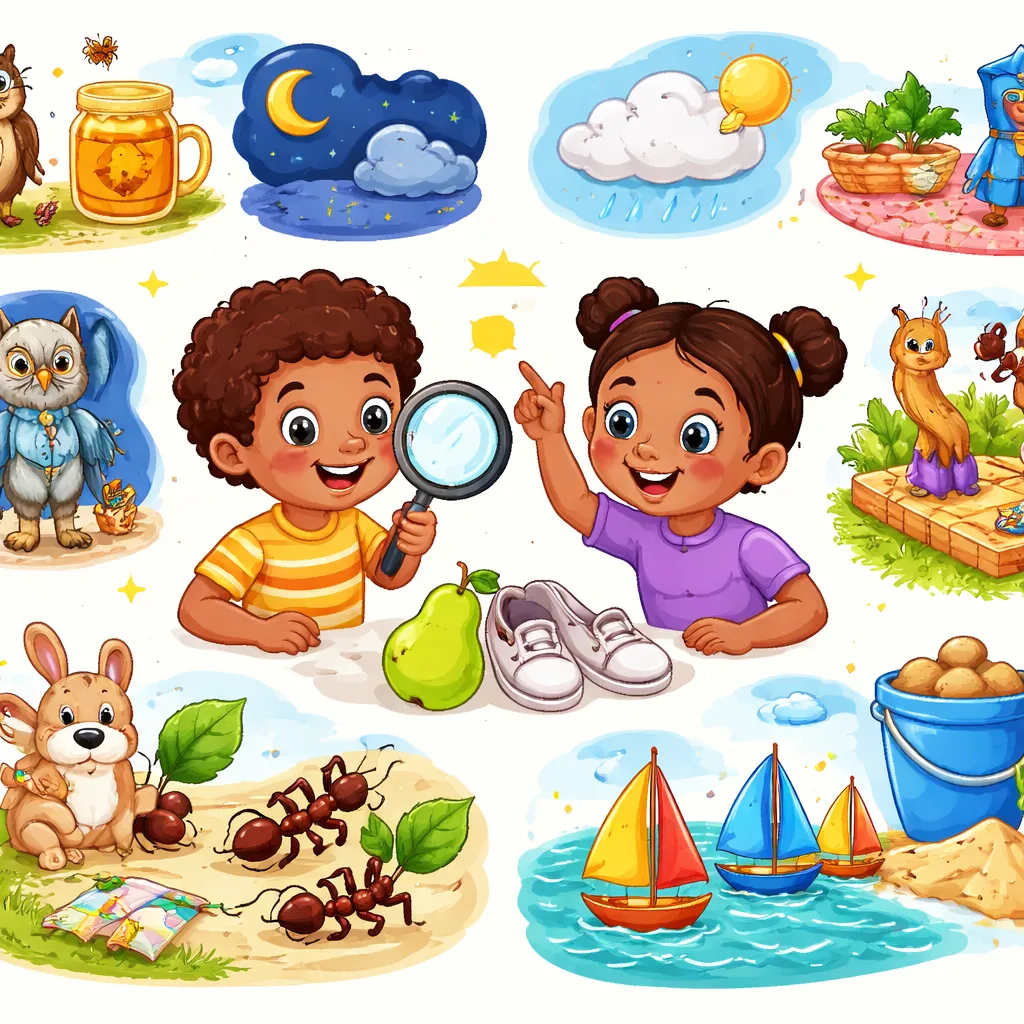

Words can be like twins. Some twins look exactly alike. Some twins sound exactly alike but look different. In the word world, we call these homophones. They are your "Word Twins." Knowing about them helps you become a word expert. Let's meet these interesting twins.
What Are 'Word Twins'?
Homophones are words that sound the same but have different meanings. Sometimes they are spelled the same, sometimes they are spelled differently. The key is their sound. They are pronounced the same way. At home, you might talk about a 'bear' (the animal) and 'bare' (to show). They sound the same. At the playground, you 'see' your friend and the sun is bright. 'See' and 'sea' sound the same. In school, you write with a 'pen' and keep animals in a 'pen'. They are spelled the same but mean different things. In nature, a 'deer' runs in the forest and we hold something 'dear'. They sound the same. These twins can be tricky but fun.
Why Are These Word Twins So Valuable?
Knowing about homophones makes you a careful listener and a precise writer. It helps your ears, your voice, your reading eyes, and your writing hand.
First, it helps your listening. You hear a joke: "Why was the math book sad? It had too many problems." You understand the play on words. 'Problems' can mean math exercises or troubles. You catch the humor. You can enjoy puns and word games in shows and books. Your listening becomes more attentive.
Next, it makes your speaking clear and your writing accurate. You can choose the right word. You can say, "I have a new pair of shoes." Not 'pare' or 'pear'. Your instructions are clear. "Meet me at the gate." Not 'meat'. People understand you exactly. You avoid silly mistakes.
Then, it gives you a reading superpower. You read a sentence. You use the context to know which 'Word Twin' is being used. "The knight fought bravely." You know it's the warrior, not 'night'. This helps you understand stories and texts quickly. Your reading comprehension gets better.
Finally, it makes your writing correct and clever. Your stories won't have confusing errors. You won't write "Their going to the park" when you mean "They're going." Your schoolwork looks professional. You can even write your own puns and jokes. Your writing shows skill and attention to detail.
Meet the Different Types of Word Twins
Not all Word Twins are identical. Let's meet the different families.
First, the Identical Twins: Homonyms. These words sound the same AND are spelled the same, but have different meanings. They are true look-alikes. Look at these examples. At home: A 'bat' is an animal. A 'bat' is used in baseball. At the playground: You can 'play' a game. You can watch a 'play' at the theater. In school: You have a 'test' in class. A scientist does a 'test' in a lab. In nature: The 'light' from the sun is bright. A feather is 'light' in weight.
Now, the Non-Identical Twins: Homophones. These words sound the same but are spelled differently and have different meanings. This is the most common type. Look at these examples. At home: 'Flour' for baking and a 'flower' in a vase. 'Meat' to eat and 'meet' a friend. At the playground: 'See' with your eyes and the 'sea' with water. 'Hour' of time and 'our' team. In school: 'Write' a story and the 'right' answer. 'Peace' and quiet and a 'piece' of pie. In nature: A 'deer' animal and 'dear' friend. The 'sun' in the sky and a 'son' child.
Next, the Cousins: Homographs. These words are spelled the same but can sound different and have different meanings. They are like cousins who look alike but act differently. Look at these examples. At home: You can 'record' a song (re-CORD). You can break a 'record' (REC-ord). At the playground: A 'tear' in your eye (teer) and a 'tear' in your paper (tare). In school: A 'present' you give (PREZ-ent) and to be 'present' in class (pri-ZENT). In nature: A 'bass' fish (bass) and a 'bass' voice (base).
Your Detective Tool: How to Tell Them Apart
Telling Word Twins apart is a context clue game. You can't tell by sound alone. You must look at the other words in the sentence. Ask yourself: "What makes sense here?" The sentence will give you hints. For 'flower' and 'flour': "She picked a beautiful red flower." vs. "We need flour to make bread." The words around them solve the mystery. The pattern is: Sound + Context = Correct Meaning.
How to Use Your Word Twins Correctly
Using the right twin is about thinking of the meaning. Before you write a word, think: "What do I want to say?" If you mean belonging to them, use 'their'. If you mean "they are," use 'they're'. If you mean a place, use 'there'. The formula is: Meaning First, Spelling Second. Make a mental picture. For 'sea', think of water. For 'see', think of eyes. Creating a picture in your mind helps you remember.
Oops! Let's Fix Common Mistakes
Everyone mixes up Word Twins. Let's fix the most common errors. The biggest mistake is with 'there', 'their', and 'they're'. A child might write: "Their going to the park over their." This is wrong. Correct: "They're going to the park over there." 'They're' = they are. 'Their' shows possession. 'There' is a place.
Another mistake is with 'your' and 'you're'. Do not write: "Your my best friend." Correct: "You're my best friend." 'You're' = you are. 'Your' shows possession: "Your book."
A third mistake is with 'its' and 'it's'. Do not write: "The dog wagged it's tail." Correct: "The dog wagged its tail." 'It's' always means 'it is' or 'it has'. 'Its' shows possession, like 'his' or 'her'.
A fourth mistake is with 'to', 'too', and 'two'. "I want to go too." 'To' is for direction. 'Too' means also or excessively. 'Two' is the number.
Are You Ready for a Word Twin Challenge?
Test your skills. Write a sentence using 'peace' and 'piece' correctly. Now, write a sentence with 'allowed' and 'aloud'. Think of a funny joke using homophones. Example: "I used to be a baker, but I couldn't make enough dough." Finally, write a short, silly story about a knight named 'Sir See' who fights near the sea. Use at least five different pairs of homophones. Be a word wizard!
You Are Now a Word Twin Expert
You have learned all about homophones. You know they are Word Twins that sound the same. You met Identical Twins (homonyms), Non-Identical Twins (homophones), and Cousins (homographs). You have detective skills to use context clues. You can avoid the most common mistakes. Your speaking and writing are now clearer and more accurate.
You can learn many things from this article. You now know that homophones are words that sound the same but have different meanings and often different spellings. You understand the different types: homonyms (same sound and spelling), homophones (same sound, different spelling), and homographs (same spelling, different sound/meaning). You learned to use context clues to figure out which word is being used. You saw how to avoid common mix-ups with words like 'there/their/they're' and 'your/you're'. You also know that paying attention to these Word Twins makes you a better reader, writer, and listener.
Now, try using your new knowledge in real life. Here are two fun ideas. First, play the "Homophone Hunt" game. With a friend, take turns saying a word (like 'blue'). The other person has to say its homophone twin ('blew'). See how many pairs you can list. Second, be a "Homophone Detective" in your favorite comic or magazine. Find three sentences that use homophones. Write them down and explain the different meanings. Share what you find. Have fun with words!