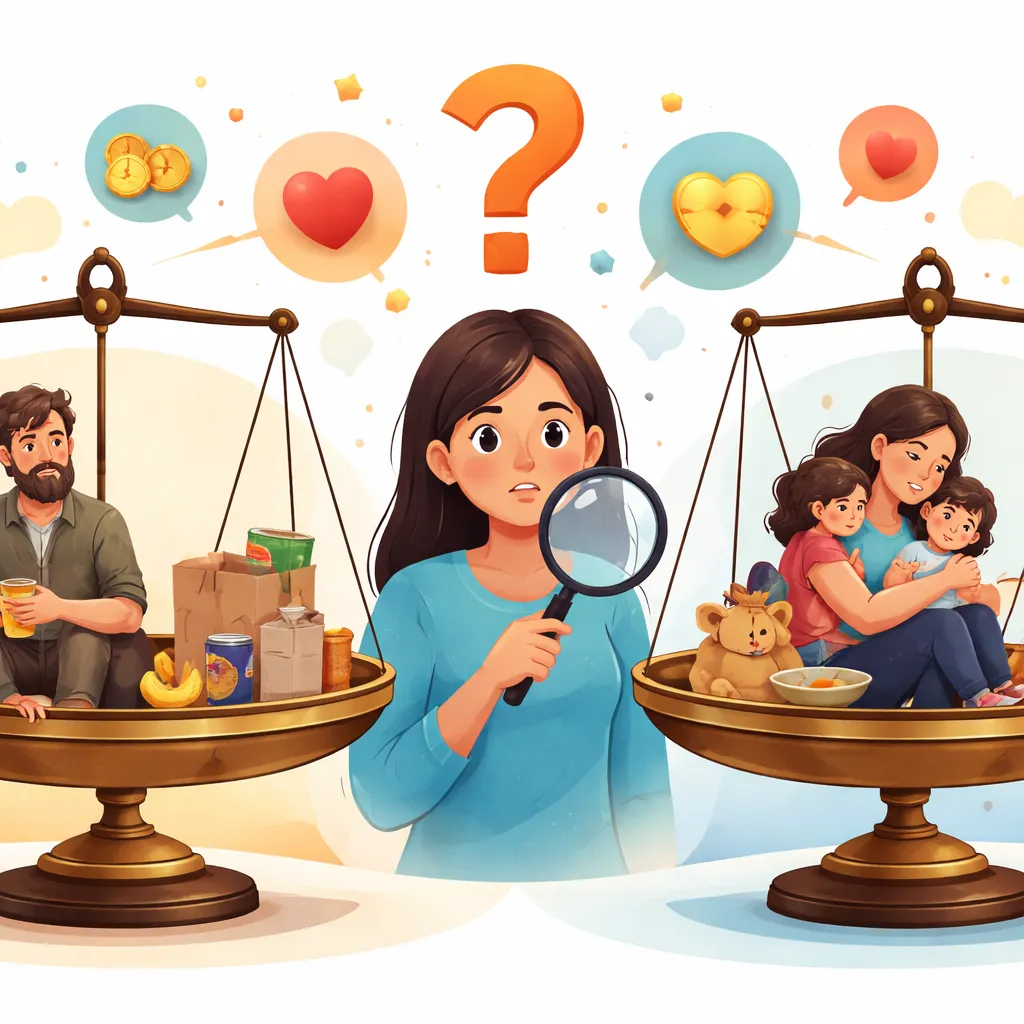

Hello, caring word explorer! Have you ever heard about people who don't have much? Maybe in a story, or on the news. How do we talk about them? Do we say they are poor? Or do we say they are needy? They both seem to mean lacking something. But are they saying the same thing? They are like two different kinds of empty cups. One cup is simply empty. The other cup is empty and asking to be filled. Let's find out! Today, we explore the word friends "poor" and "needy". Knowing their secret is a superpower of kindness and clarity. It helps you understand and describe situations with care. Let's start our thoughtful adventure!
First, let's be Caring Detectives. Listen at home. Here are two sentences. "The poor kitten had no home in the cold rain." "The local charity helps needy families with food and clothes." They both talk about lacking something. A kitten. Families. Do they sound the same? One describes a condition. One describes a condition that requires help. Can you sense it? Great observation! Now, let's look closer with our word heart-scope.
Adventure! Inside the World of Lacking
Welcome to the world of lacking. "Poor" and "needy" are two different lenses. Think of "poor" as a simple, factual camera. It takes a picture of a situation. Think of "needy" as a camera with a call to action. The picture asks for help. Both show a lack. But they show it in different ways. Let's learn about each lens.
The Factual Picture vs. The Call for Help Think about the word "poor". "Poor" feels like a simple, factual picture. It describes the state of having very little money or few possessions. It is a neutral, descriptive word. A poor country. A poor neighborhood. It can also mean "unfortunate" or "deserving pity". Oh, you poor thing! Now, think about "needy". "Needy" feels like a picture with a call for help. It describes people who lack the necessities of life and require assistance. It often implies they need help from others. A needy child. Donations for the needy. "Poor" is the fact of having little. "Needy" is the state of requiring aid. One shows a condition. The other shows a requirement.
The General Condition vs. The Specific Lack Let's compare their focus. "Poor" is a very general word. It can describe a lack of money, quality, or even skill. He is poor at math. The poor quality of the sound. It is widely used. "Needy" is more specific. It almost always describes people (or sometimes animals) who lack the basic things for survival: food, clothing, shelter, care. It is used in social and charitable contexts. The fund helps the needy. "Poor" can be permanent or temporary. "Needy" is often about an immediate, critical lack. One is broad. The other is specific and urgent.
Their Special Word Partners and Common Uses Words have best friends. "Poor" loves to team up with many nouns. It is very flexible. A poor man. Poor health. Poor grades. In stories: "a poor woodcutter". It is used in many common phrases. "Needy" has a more specific team. It often works with words about aid and support. Needy people. Needy families. Needy students (who need financial help). Note: We say "the poor" to refer to poor people as a group. We say "the needy" to refer to people in need of help. They are different teams.
Let's visit a school scene. In a history lesson, you learn about times when many people had no jobs and little food. That was a time of great poverty. The people were poor. This describes their economic condition. Now, imagine your school has a food drive. The announcement says, "Let's collect cans for needy people in our community." This specifically calls for help for those who lack food right now. Using "needy" for the historical context is okay, but "poor" is more common. Using "poor" for the food drive is fine, but "needy" highlights the need for assistance.
Now, let's go to the playground. You see a rusty, broken swing that doesn't work. You could say it's in poor condition. Later, you hear about a community project to build a new playground for children who don't have a safe place to play. These children are needy for safe play spaces. The word "poor" paints the broken swing's state. The word "needy" paints the children's lack and need.
Our Little Discovery So, what did we find? "Poor" and "needy" are related but distinct. "Poor" is a general adjective for having little money or low quality. It can describe things, situations, and people. "Needy" is a more specific adjective for people (or animals) who lack basic life necessities and require help. A person can be poor but not needy (if they have enough to get by). A person can be needy even if not traditionally poor (if they face a sudden crisis). Knowing this helps you use these words with care and precision.
Challenge! Become a Word Choice Champion
Ready for a thoughtful test? Let's try your new skills!
"The郔槽恁寁" Challenge Let's imagine a nature scene. A small bird has a damaged wing. It cannot fly well to gather food. It is struggling to survive. This bird is... what? Poor or needy? The bird is needy. It has a specific, urgent need for help due to its injury. Now, imagine a thin fox in the winter. It is not finding much food, but it is still managing. The fox is poor in resources, but not necessarily calling for human aid. "Needy" wins for the injured bird requiring help. "Poor" is the choice for the fox in a tough situation.
"My Sentence Show" Your turn to create! Here is your scene: A community food bank. Can you make two sentences? Use "poor" in one. Use "needy" in the other. Try it! Here is an example: "The poor economy made it hard for many people to find work." This describes a general financial condition. "The food bank provides meals for needy families every week." This describes families requiring assistance. Your sentences will show two different perspectives!
"Eagle Eyes" Search Look at this sentence. Can you find the word that could be better? Let's check a home context. "My little brother is so needy at video games; he always loses in the first level." Hmm. Being bad at a video game is a lack of skill, not a lack of life's necessities. The word "poor" is the correct choice for describing low skill. "My little brother is so poor at video games..." is the right way to say it. "Needy" is not used for a lack of skill. Did you spot it? Excellent and caring word work!
Harvest and Action! Turn Knowledge Into Your Superpower
Great exploring! We started thinking "poor" and "needy" were the same. Now we know they look at lack from different angles. We can see the factual picture of "poor". We can hear the call for help in "needy". You can now describe difficult situations with more accuracy and empathy. This is a powerful skill for your heart and mind.
What you can learn from this article: You can now feel that "poor" is a general word for having very little money, low quality, or bad skill. You can feel that "needy" is a specific word for people who lack basic necessities like food and shelter and require help. You know that a "poor" grade describes a score, but a "needy" student might need financial aid. You learned to match the word to the situation: "poor" for a condition, "needy" for a requirement for aid.
Life practice application: Try your new skill with kindness. Read a news article about a community project. Does it help the "poor" or the "needy"? Listen to stories about people helping others. How are the words used? If you are involved in a charity drive, you can now describe its purpose accurately. Remember to use these words with respect and care for others. You are now a more thoughtful and precise communicator