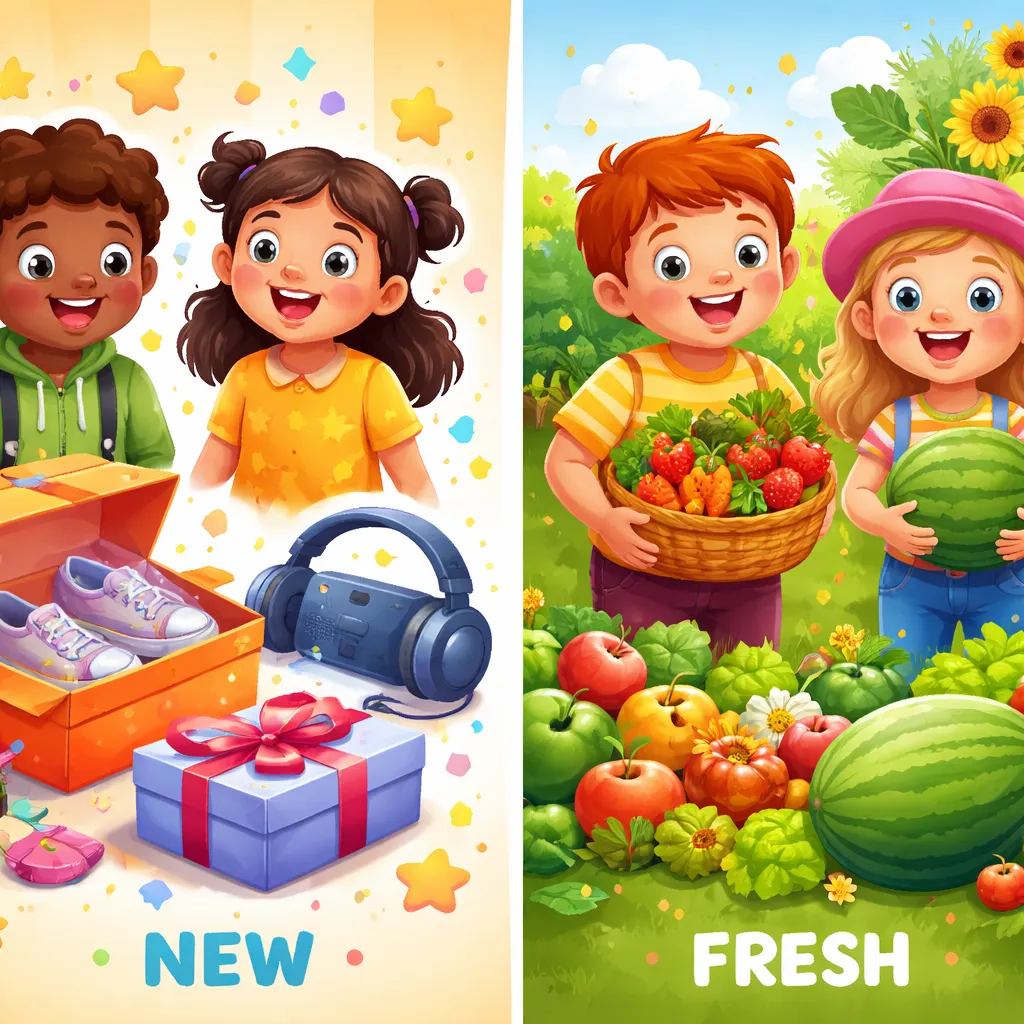

Hello, word explorer! Have you ever opened a present? Or bitten into a juicy apple? How do you describe that feeling? The present is new. The apple is fresh. They both seem to mean "not old". But are they the same? They are like two different kinds of morning. One is the first day of the year. One is the cool air after rain. Let's find out! Today, we explore the word friends "new" and "fresh". Knowing their secret is a superpower. It helps you describe the world perfectly. Let's start our adventure!
First, let's be Word Detectives. Listen at home. Here are two sentences. "I got a new video game for my birthday." "We baked fresh cookies this morning." They both talk about something recent. A game. Cookies. Do they sound the same? One feels like it just exists. One feels like it was just made. Can you sense it? Great observation! Now, let's look closer with our word microscope.
Adventure! Inside the World of "Not Old"
Welcome to the world of "not old"! "New" and "fresh" are two different beginnings. Think of "new" as a blank, white page. Nothing is written on it yet. Think of "fresh" as a clean, clear window. You can see right through it. Both are about recentness. But they focus on different things. Let's learn about each one.
The Blank Page vs. The Clear Window Think about the word "new". "New" feels like a blank, white page. It is about time. It means something that has just been made, bought, or discovered. A new car. A new friend. A new country. It is the opposite of old. Now, think about "fresh". "Fresh" feels like a clean, clear window. It is about quality and condition. It means something that is recently made or gathered and is still in good shape. Fresh milk. Fresh flowers. Fresh air. "New" is the start of existence. "Fresh" is the peak of quality. One is about age. The other is about state.
The Start of Life vs. The Peak of Goodness Let's compare their use. "New" is a very general word. It can describe almost anything that is recent. A new day. A new idea. A new phone. It doesn't say much about the quality, just that it is recent. "Fresh" is more specific. It often describes things that can go bad or lose quality. Food, air, plants. It means it is still good, not stale or spoiled. It can also mean feeling energized. I feel fresh after a shower. "New" is the beginning. "Fresh" is the best condition at the beginning. One is a fact. The other is a feeling of goodness.
Their Special Word Partners and Common Phrases Words have best friends. "New" loves to team up with words about creation and discovery. A new beginning. The new year. A new species. It is used in many common phrases. "Fresh" has its own special teams. It often pairs with words about nature and sensation. Fresh produce. Fresh paint. A fresh perspective. A fresh start (like a new beginning, but with a clean feeling). Note: We say "brand new" (very new). We say "freshly baked" (recently baked and good). They are different teams.
Let's visit a school scene. Your teacher gives you a notebook on the first day. It has never been used. It is a new notebook. This is a fact about its age. Now, imagine your class plants seeds. After a week, you see small green shoots. They are fresh new plants. Here, "fresh" describes their young, vibrant condition. Using "fresh" for the unused notebook is odd. Using "new" for the plants is fine, but "fresh" adds the idea of vibrant life.
Now, let's go to the playground. The city just installed a new climbing frame. It wasn't there before. Later, after a morning rain, you take a deep breath. The air smells fresh and clean. The word "new" paints the recently installed frame. The word "fresh" paints the clean, pleasant air.
Our Little Discovery So, what did we find? "New" and "fresh" both describe recent things. But they highlight different aspects. "New" is about time. It means recently made, invented, or acquired. It is the opposite of old. "Fresh" is about condition. It means recently made or gathered and still in its best state. It is the opposite of stale or old. A "new" loaf of bread just came from the store. A "fresh" loaf of bread was baked today and is soft. Knowing this helps you choose the right word.
Challenge! Become a Word Choice Champion
Ready for a fun test? Let's try your new skills!
"The Best Choice" Challenge Let's imagine a nature scene. A butterfly just came out of its cocoon. Its wings are still soft. It has never flown before. This butterfly is... what? New or fresh? The butterfly is new. It is newly born. Now, imagine you pick a strawberry from the garden. It is plump, red, and juicy. You eat it right away. The strawberry is fresh. It is in perfect condition, just picked. "New" wins for the newborn butterfly. "Fresh" is the champion for the just-picked strawberry.
"My Sentence Show" Your turn to create! Here is your scene: Helping in the kitchen. Can you make two sentences? Use "new" in one. Use "fresh" in the other. Try it! Here is an example: "My mom bought a new blender." This focuses on the recent purchase. "We made a smoothie with fresh bananas." This focuses on the good condition of the fruit. Your sentences will show two different ideas!
"Eagle Eyes" Search Look at this sentence. Can you find the word that could be better? Let's check a home context. "The fresh baby was born at the hospital last night, and everyone is very happy." Hmm. We don't usually describe a baby as "fresh". The word "new" is the standard and loving term for a recently born baby. "The new baby was born at the hospital last night..." is the correct and natural phrase. Did you spot it? Excellent word work!
Harvest and Action! Turn Knowledge Into Your Superpower
Great exploring! We started thinking "new" and "fresh" were the same. Now we know they are two sides of recentness. We can see the blank page of "new". We can feel the clear window of "fresh". You can now describe recent things with perfect accuracy. This is a great skill for daily life.
What you can learn from this article: You can now feel that "new" describes something that is recent in time, like a new toy or a new friend. You can feel that "fresh" describes something that is in its best, just-made condition, like fresh food or fresh air. You know that a "new" car might be fresh from the factory, but a "fresh" salad is newly made and crisp. You learned to match the word to what you mean: "new" for time, "fresh" for quality.
Life practice application: Try your new skill today! Look at your clothes. Are any of them new? Check the fruit in your kitchen. Is it fresh? Tell a family member about one new thing you learned. Describe the smell of fresh grass after rain. Listen to how people use these words. You are now a master of descriptive words! Keep exploring the wonderful world of language.