
Opening Introduction
Mia woke up on Easter morning. The sun was shining. She ran to the living room. Her dad smiled. "Happy Easter, Mia! Look, the Easter Bunny came. He left a basket for you. And he hid some eggs in the garden! It's time for an Easter egg hunt!" Mia saw her basket. It was empty. "What do I do?" she asked. "You go and find the eggs!" said Dad. "But to play the game, you need to know the special words. Let's learn the Easter egg hunt vocabulary and phrases. Then you can be the best egg hunter ever!" Mia was excited. A game with its own language? She was ready. Let's learn the words and get hunting.
Core Knowledge Explanation
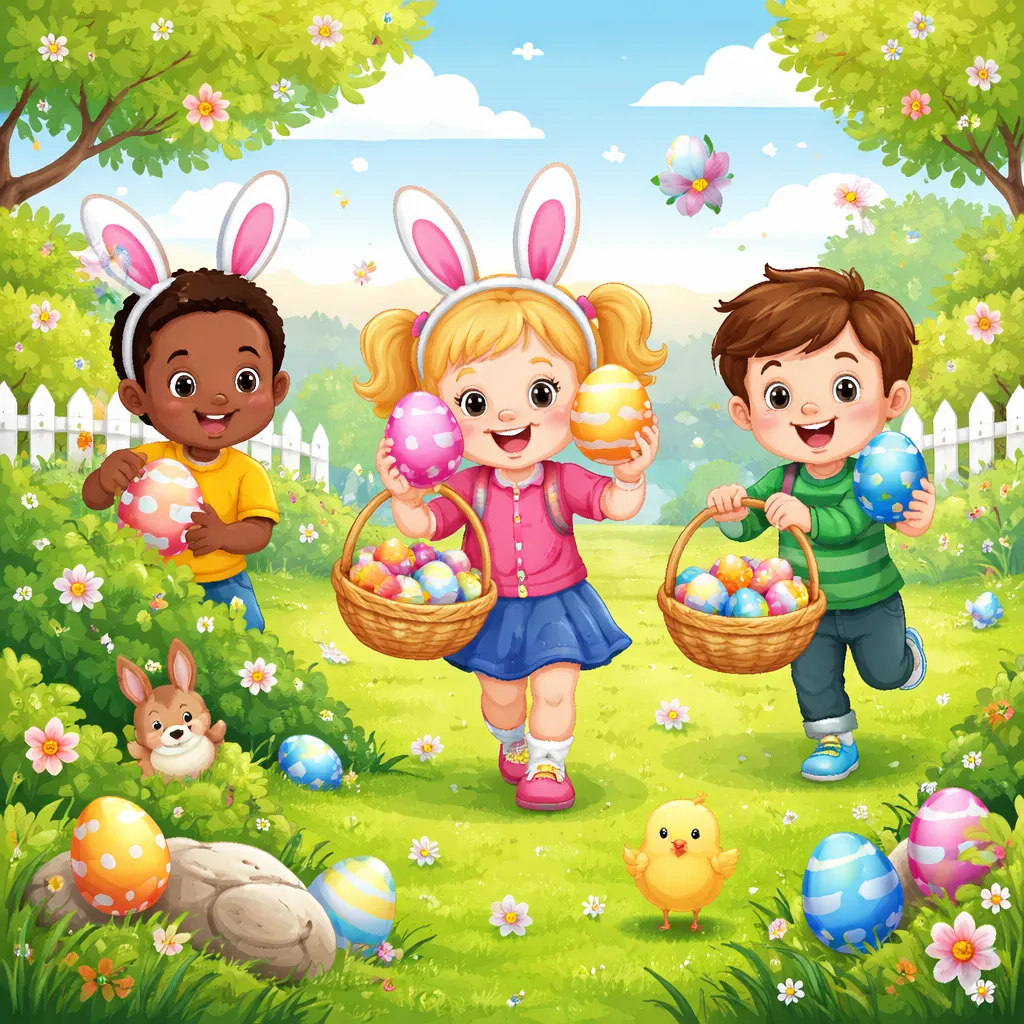
An Easter egg hunt is a fun game. It happens on Easter. Someone hides special eggs. Children look for them. They try to find as many as they can. To play, you need to know the Easter egg hunt vocabulary and phrases. Let's learn the important words. First, the egg. In an Easter egg hunt, eggs are not just from chickens. We have plastic eggs. They are colorful. You can open them. Often, they have a surprise inside, like a small toy or candy. We also have chocolate eggs. They are made of yummy chocolate. The Easter Bunny is a character. He is a big, friendly rabbit. The story says he brings the eggs and hides them.
Now, the tools. You need a basket. A basket is a container, often made of straw. You carry your basket to collect the eggs you find. Some people use a bag. Now, the action words. To hide means to put something where it is hard to see. The Easter Bunny hides the eggs. To hunt or to search means to look for something carefully. You hunt for the eggs. To find means to see or get something you are looking for. "I found an egg!" To pick up means to take something from the ground. "I will pick up that blue egg."
Let's learn some useful phrases. When you start, you can say, "Let's hunt for eggs!" or "Ready, set, go!" When you are looking, you can say, "Where are the eggs?" or "I see one over there!" When you find one, shout, "I found one!" or "Look what I found!" You can help a friend by saying, "There's a yellow egg behind the tree." If you are having trouble, ask, "Can you give me a hint?" When the hunt is over, you can say, "How many eggs did you get?" or "Let's count our eggs." These are the Easter egg hunt vocabulary and phrases that make the game fun and friendly. Knowing them helps you play, share, and celebrate in English.
Fun Interactive Learning
Let's play a pretend Easter egg hunt inside. It is called "Practice Hunt." You need a few small objects, like colored pom-poms or blocks, to be your eggs. Ask a family member to hide them in a room. Now, take a bowl as your basket. Use the phrases. Say, "Let's hunt for eggs!" Start searching. When you see one, say, "I see a red egg under the chair!" Pick it up and say, "I found one!" Put it in your bowl. Count them at the end. "I found three eggs!" This game helps you practice the Easter egg hunt vocabulary and phrases before the real hunt.
Another fun activity is "Draw and Label." Draw a big picture of a garden. Draw a tree, a flower, and a bush. Now, draw eggs hiding in different places. Draw one egg behind the tree. Draw one egg in the flower. Now, write sentences about your picture. "The yellow egg is behind the tree. The pink egg is in the flower." This helps you learn the words for places. You can also play "Egg Hunt Charades." One person acts out a word: hunting, finding, picking up, or looking. The others guess. This is a fun, active way to remember the Easter egg hunt vocabulary and phrases.
Expanded Learning
The Easter egg hunt is a tradition in many countries. In the United States and Canada, it is very popular. In England, they have egg rolling competitions. In Australia, sometimes the Easter Bilby brings eggs instead of a bunny. The Easter egg hunt vocabulary and phrases are similar, but the celebrations can be a little different. The egg is an old symbol of new life, which is why it is used for spring and Easter.
Long ago, people gave each other real eggs, painted in bright colors. Today, we use plastic and chocolate. The idea of a hunt makes it a game for children. Learning about the Easter egg hunt vocabulary and phrases connects you to a happy tradition that celebrates spring, fun, and sharing. Let's make an Easter egg hunt chant. Chants are bouncy and fun, like a bunny.
Hop, hop, hunt, and hop, looking for eggs, non-stop! Basket ready, eyes so bright, finding eggs with all your might! "Look, I found a blue one here!" "Pick it up and give a cheer!" Count them all, one, two, three, how many eggs for you and me? Hunting eggs is so much fun, in the springtime sun!
What You Will Learn
You are learning about a fun tradition and how to talk about it. You are learning the Easter egg hunt vocabulary and phrases: Easter egg, plastic egg, chocolate egg, Easter Bunny, basket, to hide, to hunt/search, to find, to pick up, "Let's hunt for eggs!", "I found one!", "Can you give me a hint?", "Let's count our eggs." You are also learning words like tradition and symbol.
You are learning action sentences and questions. You can say, "I am hunting for eggs." You can ask, "Where is the Easter Bunny?" You can exclaim, "I found a chocolate egg!" You are using English to participate in a lively, social game. This builds confidence in speaking and listening.
You are building great skills. You are building vocabulary about a specific activity. You are building observation skills. You look carefully for eggs. You are building counting skills. You count your eggs. You are building social skills. You play fairly and share hints. You are building coordination. You pick up eggs and carry a basket. You are building memory. You remember the phrases.
You are forming a joyful and social habit. The habit of playing games in English. You see that language is part of the fun. Learning the Easter egg hunt vocabulary and phrases prepares you to join in a wonderful spring tradition and make friends while you play.
Using What You Learned in Life
Use your new words on Easter morning. When you get your basket, say, "My basket is empty. Let's hunt for eggs!" As you search, use the phrases. Call out to your family, "I found a purple egg!" If you are with friends, help them. "There's an egg near your foot!" After the hunt, sit with your family and count your eggs. "I have ten eggs. How many do you have?" You can also use these words for other treasure hunts. Any time you play a searching game, you can use the same Easter egg hunt vocabulary and phrases. "Let's hunt for hidden toys!"
At school, you can share your experience. "On Easter, I hunted for eggs. I found twelve!" You can also draw a picture of your hunt and label it with the new words. The more you use the Easter egg hunt vocabulary and phrases, the more they will be a part of your springtime fun. You are becoming a master of the hunt.
Closing Encouragement
You are an egg hunt expert. You are a word collector. You are a cheerful and observant friend. I am so proud of you. Learning all these Easter words and phrases shows you are ready for springtime fun.
Happy hunting! May your basket be full of eggs and your heart full of joy. Remember, the best part of the hunt is playing together and sharing the excitement. You have the words to do just that.
You are quick, you are sharp-eyed, and you are learning the language of spring fun. Great work, my wonderful Easter explorer.