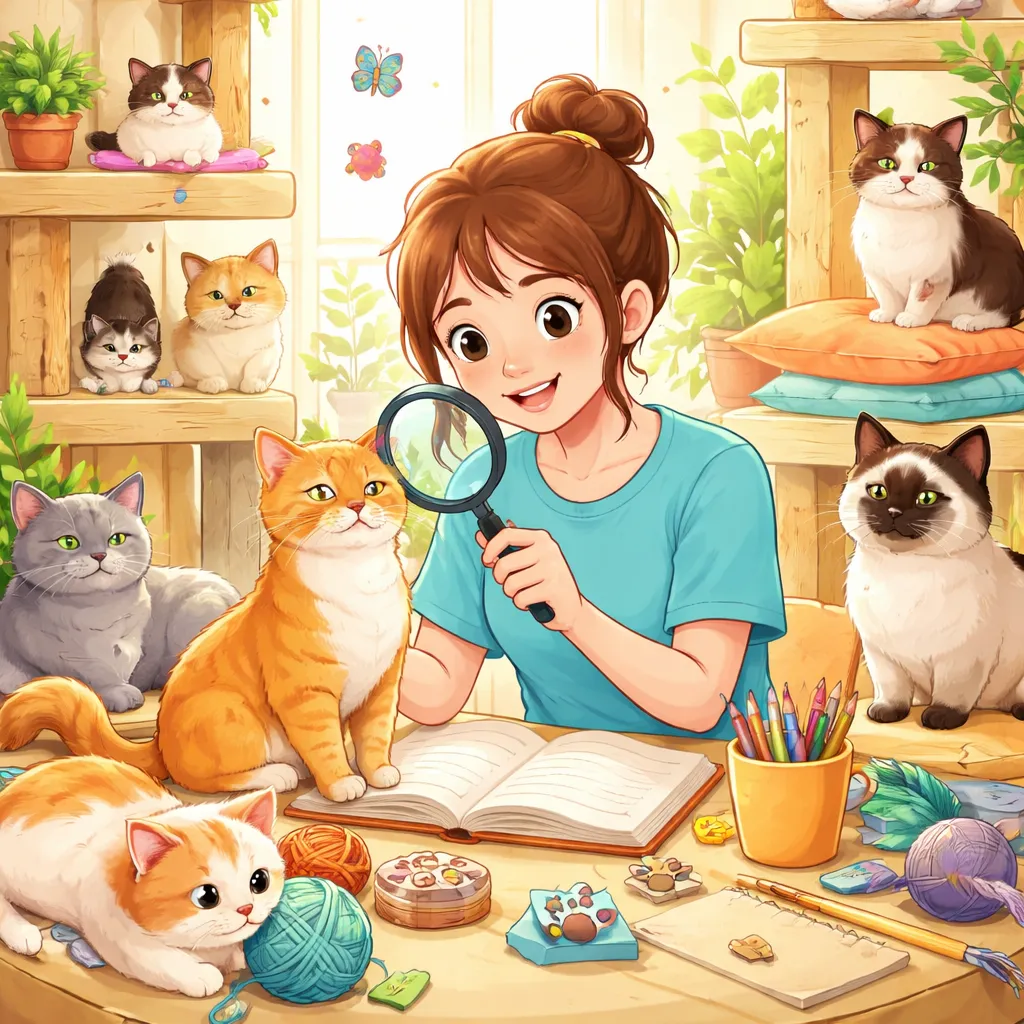

Have you ever watched a cat stretch in a sunny spot? Maybe you have a soft, purring friend at home, or you’ve seen a clever cat in a cartoon or a story. Cats can be cuddly pets, mysterious garden visitors, or brave storybook characters. Learning about cats opens a door to a world of quiet paws and bright eyes. Let’s begin our adventure of learning about cat companions right now!
English Language Learning
Vocabulary and Spelling The most important word for our furry friend is cat. The word "cat" is a noun. A noun names a person, place, or thing. So, "cat" is the name for this amazing animal. Spelling "cat" is short and sweet: C-A-T. Look at the letter 'C'. It is curved like a cat’s curling tail or its curved back. The letter 'A' is pointy at the top, like a cat’s alert ears. The letter 'T' stands tall and straight, like a cat’s tail when it walks proudly. C-A-T spells cat!
Sound and Pronunciation Let’s make the correct sound. The word "cat" sounds like this: /kæt/. Let’s say it in a fun, easy way. First, make the sound "k". It’s the sound at the start of "kite" or "key". Feel the sound at the back of your mouth. Next, say the short "a" sound like in "apple" or "ant". Open your mouth a little. Last, say the sound "t". It’s the crisp sound at the end of "hat" or "sit". Now, blend the sounds together quickly! Say "k" "a" "t". Cat! Wonderful! The word "cat" has just one syllable. Clap your hands once for this word: Cat! It’s a quick, smart-sounding word, just like a cat.
Related Words Learning about cat friends gets better with more words! Here are some simple, useful words. Body Parts: Those long, sensitive hairs on a cat’s face are whiskers. They help a cat feel its way in the dark. A cat’s soft feet are called paws. Sound: The happy, rumbling sound a cat makes is a purr. The sound it makes to say hello or ask for something is a meow. Actions/Habits: Cats love to pounce. This means they jump on something quickly, like a toy! They also groom themselves by licking their fur to keep it clean. Home: A soft, cozy bed for a cat is often called a basket or a cat bed.
A Famous Saying People have a fun saying about cats: "Curiosity killed the cat." This old saying reminds us to be careful. It means being too curious or snooping into everything can sometimes lead to trouble. But curiosity is also a wonderful thing! It helps us learn and discover. Just like a cat, we should be curious but also safe and smart. You can say it with me: "Curiosity killed the cat." Remember, it’s just a saying. Having curiosity is good for learning about cat friends and everything else!
Knowing the word "cat" and other fun words is a great start. Are you ready to discover the secret world of these graceful animals? Let’s move from words to wonderful facts!
Animal Knowledge
Who Are They? – Family and Group What kind of creature is a cat? Cats are mammals. Mammals have fur or hair, and mother mammals feed their babies with milk. You are a mammal too! Cats belong to a special family called felids. This is the "cat family". Big cousins in this family include lions, tigers, and leopards. Your pet house cat is a small, friendly member of the same mighty family!
What Do They Look Like? – Amazing Bodies Cats come in many sizes, from tiny kittens to big, fluffy adults. Some cats are as small as a loaf of bread, and some are as big as a toddler! Their fur can be long or short, and come in so many colors and patterns like black, white, orange, gray, striped, or spotted. All cats have special tools. They have sharp claws that can hide inside their paws. This keeps the claws sharp for climbing! Their eyes are very big to see well in dim light. Their tails help them balance when they walk on narrow fences. Cats have fantastic superpowers! Their best superpower is amazing balance. They can walk on very thin ledges and almost always land on their feet if they fall. They also can see very well in the dark, much better than we can. Their whiskers are like feelers that tell them about the world around them.
Where Do They Live and How? – Home and Habits Pet cats live in homes all over the world. Some cats live outside as community cats. Their wild cousins live in forests, grasslands, and deserts. Cats are carnivores. This means they are meat-eaters. Their bodies are made to eat meat. Pet cats eat special cat food that gives them all the nutrients they need. Cats are most active at dawn and dusk. We call this being crepuscular. They love to climb, jump, and explore high places. Cats can be both social and independent. They like their own space but also enjoy company. A group of cats is called a clowder.
A Cat’s Life Story – Growing Up Baby cats are called kittens. What a cute name! Cats are mammals, so kittens are born live from their mother. A mother cat can have a group of kittens, called a litter. Mother cats are very caring. They feed the kittens milk, keep them warm, and clean them by licking. They teach kittens how to hunt, play, and use the litter box. Kittens grow up so fast! They are born with their eyes closed. After about a week, they open their little blue eyes. They learn to walk, then run, and play. Their playful pounces help them learn to hunt. In about a year, they become adult cats.
How Do They "Talk"? – Communication Cats are quiet talkers. They use soft sounds, body language, and scents to communicate. They meow, purr, hiss, and chirp. A purr usually means "I'm happy and content." A meow is often for talking to people. They also talk with their bodies. A tail held high means "I'm friendly and confident." Rubbing their head on you is a loving way to say "You are mine." Their sense of hearing is super sharp. They can hear a tiny mouse squeak from far away. Their ears can turn like little satellite dishes to catch every sound.
Are They Okay? – Taking Care of Them Pet cats that live indoors with loving families usually have long, happy, and safe lives. But some cats, called stray or feral cats, live outside without a home. The main problems for cats are traffic, bad weather, or not having enough food. Some people forget that cats need care and a safe home for their whole life, which can be 15 years or more! You can be a hero for cats! You can choose to adopt a cat from a shelter if your family is ready. You can always be gentle and kind to every cat you meet. You can remind others that pets are a lifelong promise. Spaying or neutering pet cats helps prevent too many kittens without homes.
Life Connections and Inspiration
How to Be With Them – Safety and Love Cats are wonderful pets, so let's learn how to be their best friend. Having a cat is a joyful, long-term promise. It means providing love, care, and a safe home for many, many years. You promise to help with food, fresh water, a clean litter box, playtime, and vet visits. Always move slowly and let a cat come to you. Hold out your hand slowly and let the cat sniff you first. Pet a cat gently on its head, chin, or back. Most cats do not like their belly rubbed. Never pull a cat’s tail or ears. Never disturb a cat that is eating, sleeping, or hiding. If a cat’s ears are flat or it swishes its tail hard, it wants to be left alone. A happy cat has a safe home, good food, water, toys, a clean litter box, and lots of gentle love. Your quiet friendship means the world to them.
Super Qualities We Learn from Them Cats teach us wonderful things. One super quality is independence. Cats can do many things on their own. They show us how to be confident and content in our own company. It’s good to be a good friend and also be strong on your own. Another quality is curiosity and grace. Cats explore the world with quiet attention. They move with such smooth, graceful steps. They remind us to be curious about our world and to move through it with care and elegance. Think about it: How can you be bravely independent? How can you explore your world with gentle curiosity and grace, just like a cat?
Take Action! – Your "Curious Cat" Project Let’s do a fun activity! Your project is to create a Curious Cat Observation Diary. Find a notebook and some crayons. If you have a friendly pet cat or know a neighbor’s calm cat (with permission and an adult!), you can be a quiet scientist. Sit still and watch. Does the cat purr? How does it walk? How does it play? Draw or write what you see. What is it curious about? If you don’t have a cat to watch, you can make one! Create a paper cat puppet. Draw a cat face on paper, cut it out, and attach it to a stick. Make up a story about your cat’s adventure. What is it curious to discover today? Use your puppet to tell the tale.
Closing Learning about cat friends is a fantastic journey! We learned the word "cat" and how to say its sharp, clear sound. We discovered cool secrets about their balancing tails, their night vision, and their gentle purrs. We know that cats are graceful and independent friends. We also learned how to be a kind and respectful friend to every cat we meet. You can use your new words to talk about these amazing animals. You can use your knowledge to care for them with love. The animal world is full of gentle teachers like the cat. Always remember to be a safe and caring friend to all creatures. Keep watching, keep wondering, and keep learning! Your curiosity makes the world a more wonderful place.