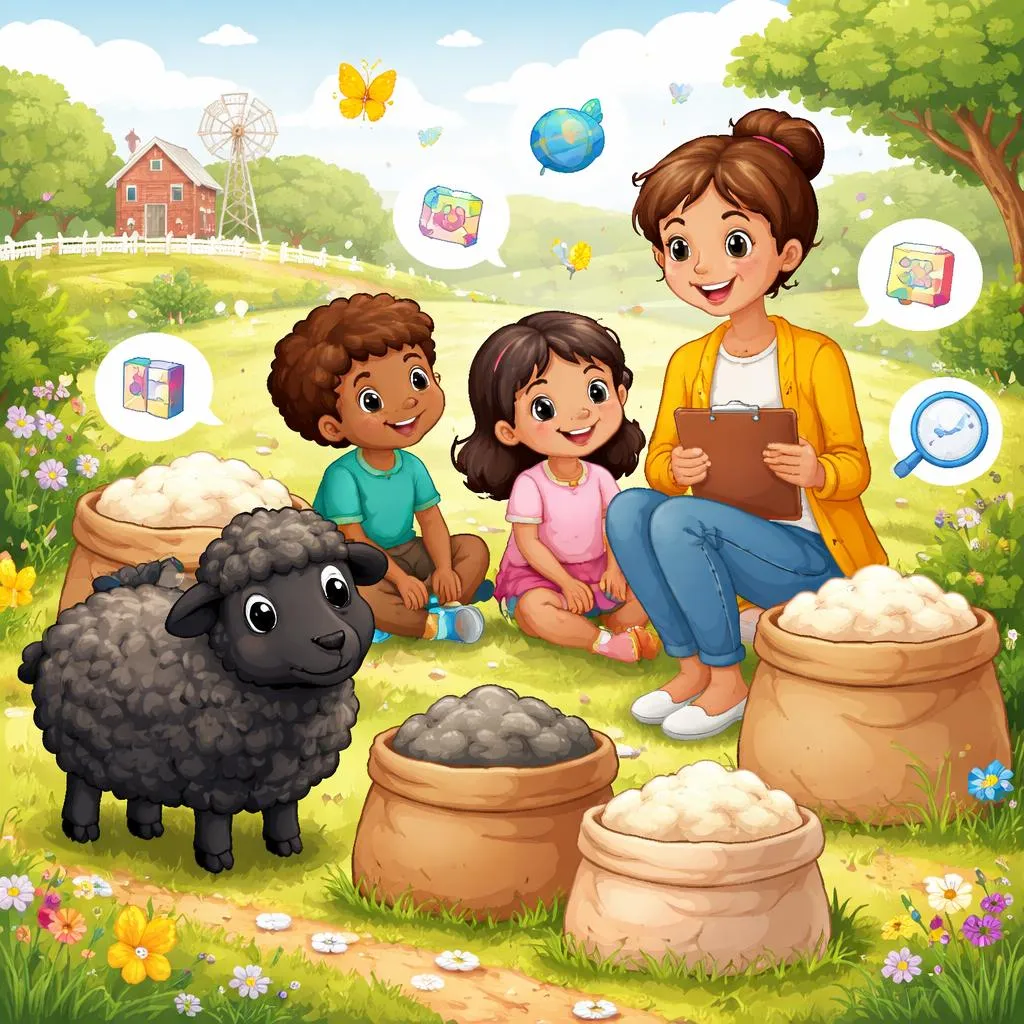

What Is the Rhyme “Baa Baa Black Sheep”?
Baa Baa Black Sheep is a famous English nursery rhyme. It has been sung by children for many generations. Teachers often use it to introduce English sounds and simple sentences.
This rhyme uses clear rhythm and repetition. That makes it easy to remember. It also helps young learners feel confident when speaking English.
The keyword baa baa black sheep lyrics “ often appears in search results because many families and teachers want the full song for learning. This guide explains the rhyme step by step in a classroom-friendly way.
The Lyrics of Baa Baa Black Sheep
Here are the traditional lyrics of the rhyme.
Baa, baa, black sheep, Have you any wool? Yes sir, yes sir, Three bags full.
One for the master, One for the dame, And one for the little boy Who lives down the lane.
This short song tells a simple story. A sheep shares wool with different people. The rhythm makes it fun to chant or sing.
Vocabulary Learning with Baa Baa Black Sheep Lyrics “
This rhyme introduces many useful words. Each word connects with daily life and simple concepts.
The word “sheep” names an animal. The word “wool” names a material from sheep. The word “bag” refers to a container. The word “master” means an adult or owner. The word “dame” refers to a woman in old English. The phrase “down the lane” describes a small road.
Teachers can read each line slowly. Then repeat key words with gestures. This approach supports comprehension and memory.
Phonics Points in the Rhyme
Phonics helps children connect letters with sounds. This rhyme includes many clear phonics patterns.
The sound /b/ appears in “baa” and “bag.” The sound /sh/ appears in “sheep.” The long vowel sound /ee/ appears in “sheep.” The short vowel sound /a/ appears in “bag.” The long vowel sound /oo/ appears in “wool.”
Repeating these sounds improves pronunciation. Clapping on each syllable supports rhythm awareness.
Grammar Patterns in Baa Baa Black Sheep Lyrics “
This rhyme includes simple English grammar structures. These patterns are ideal for early learners.
The question “Have you any wool?” introduces question form. The answer “Yes sir, yes sir” models polite responses. The phrase “Three bags full” shows numbers with nouns. The structure “One for the master” shows prepositions and purpose.
Teachers can highlight these patterns during reading. Short repetition helps internalize sentence structure.
Meaning and Story Explanation
The rhyme describes a black sheep with wool to share. Three bags of wool go to three people. This theme introduces sharing and community.
The language is simple. The story is easy to visualize. That supports imagination and comprehension.
Daily Life Connections
Sheep and wool connect to real-world objects like sweaters and blankets. Bags connect to school bags and shopping bags. Lanes connect to streets and roads.
Teachers can show pictures of sheep and wool products. This visual support builds real-world understanding.
Printable Flashcards for Baa Baa Black Sheep Lyrics “
Flashcards help reinforce vocabulary. Each card can show a word and a picture.
Cards can include sheep, wool, bag, master, dame, lane, and numbers. Teachers can print cards for classroom use or home practice.
Students can match words to pictures. This strengthens word recognition and memory.
Learning Activities Based on the Rhyme
Singing the rhyme with actions builds engagement. Students can pretend to be sheep and hand out imaginary wool.
Drawing activities can follow the rhyme. Children can draw the sheep and three bags of wool.
Story retelling supports speaking skills. Students can describe who receives each bag.
Educational Games for Classroom or Home
A role-play game can assign roles like sheep, master, dame, and boy. Students act out the story while singing.
A phonics game can focus on /b/ and /sh/ sounds. Students can find objects that start with these sounds.
A counting game can use “three bags full.” Students count objects and say the number in English.
How Parents Can Use Baa Baa Black Sheep Lyrics “ at Home
Parents can sing the rhyme during daily routines. Bath time and bedtime are ideal moments.
Pointing to pictures while singing builds comprehension. Repeating key words supports vocabulary growth.
Parents can ask simple questions like “What animal is this?” This encourages speaking in English.
Why Teachers Use Nursery Rhymes in English Learning
Nursery rhymes combine music, language, and rhythm. They improve listening, speaking, and memory skills.
Repetition builds confidence. Predictable patterns support early literacy.
Baa Baa Black Sheep is short and easy to teach. That makes it a common choice in early English education.
Cultural Background of Baa Baa Black Sheep
This rhyme originated in England many centuries ago. It reflects farming life and wool production.
Understanding cultural context adds depth to language learning. It also sparks curiosity about history and daily life in other countries.
Creative Extensions for the Classroom
Teachers can create a mini-book with the lyrics and illustrations. Students can color and read the book.
A puppet show can bring the rhyme to life. Simple puppets can represent the sheep and characters.
A music lesson can include rhythm instruments like tambourines. Students can keep the beat while singing.
Language Skills Developed Through the Rhyme
Listening skills develop through repeated singing. Speaking skills improve through repetition and role-play. Reading skills develop when lyrics appear in print. Writing skills develop when students label pictures or write short sentences.
This rhyme supports holistic language development.
Tips for Teaching Baa Baa Black Sheep Lyrics “
Use clear pronunciation and slow pace. Repeat lines several times.
Use gestures for key words like sheep and bags. Encourage choral reading and singing.
Praise effort to build motivation and confidence.
Printable Materials and Worksheets
Worksheets can include matching words and pictures. Fill-in-the-blank sentences can practice grammar patterns.
Coloring sheets with sheep and wool support creativity. Tracing words helps with writing practice.
These materials can be printed for classroom or home use.
Integrating Technology in Learning
Animated videos of the rhyme can support visual learners. Interactive apps can reinforce phonics and vocabulary.
Teachers can use digital flashcards on smartboards. Parents can play songs on tablets or phones.
Technology makes the learning process engaging and modern.
Cross-Curricular Connections
Math skills connect through counting bags of wool. Art skills connect through drawing and crafts. Social studies connects through farming and community roles.
Integrating subjects makes learning meaningful and memorable.
Encouraging Creative Language Use
Students can change the rhyme with new animals or objects. For example, “Baa Baa White Sheep” or “Meow Meow Black Cat.”
This activity encourages creativity and sentence building. It also reinforces grammar patterns and vocabulary.
Building Confidence Through Singing
Singing reduces anxiety in language learning. Children feel less pressure when singing together.
This supports fluency and pronunciation. Confidence grows with each repetition.
Long-Term Benefits of Nursery Rhymes
Early exposure to rhymes supports phonemic awareness. This skill is essential for reading development.
Memory and rhythm skills also improve. These benefits extend beyond language learning.
Using Baa Baa Black Sheep in a Structured Lesson
A lesson can start with listening to the rhyme. Then introduce key vocabulary with pictures.
Next, practice phonics sounds. Then sing together with actions.
Finally, use a simple worksheet or drawing activity.
This structure keeps the lesson organized and effective.
Adapting the Rhyme for Different Age Groups
Younger learners focus on listening and singing. Older learners can analyze grammar and vocabulary.
Teachers can adjust speed and complexity. This makes the rhyme suitable for many levels.
Encouraging Family Participation
Families can sing together at home. This strengthens bonds and language exposure.
Parents can record singing and share with teachers. This supports communication and progress tracking.
This nursery rhyme offers rich language input in a short form. It combines vocabulary, phonics, grammar, rhythm, and storytelling. Teachers, parents, and learners can use it as a foundation for joyful English learning.