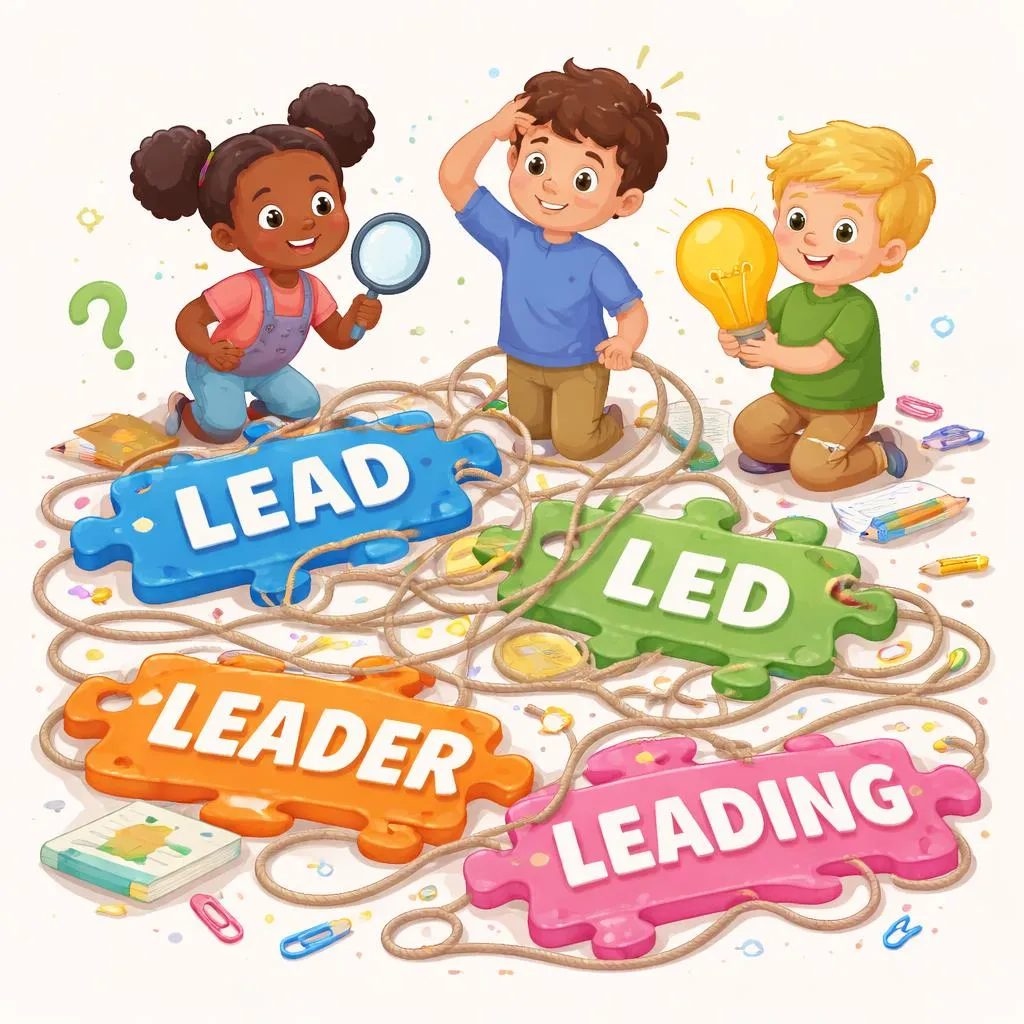

Life’s Little Embarrassment
Meet Sam the squirrel. He loves guiding his friends. Last Monday, Sam wanted to say he guided the way. He shouted, “I am leader!” Everyone laughed. They thought he meant a person. Sam felt silly. This happens to many kids. Today, we learn a word family. Think of them as tools in a box. Each tool has a special job. We call them lead, leader, leading, and led. They look alike but work differently. After reading this, you will understand them perfectly.
Core Comparison Zone: Deep Analysis
Sam’s day continues. We follow him everywhere. First, meet the members.
Lead is the guide star. It does the action of showing the way. We call it “Guide Star”. Leader is the chief painter. It names someone who guides others. We call it “Chief Painter”. Leading is the guiding action. It shows the act of showing the way now. We call it “Guiding Action”. Led is the past marker. It shows guidance that happened before. We call it “Past Marker”.
Now, let’s explore five ways they differ.
Time Dimension
Clocks tick. Calendars flip. Words show when things happen.
At home, Sam likes to lead games daily. He is a good leader often. He is leading the way now. He led his sister yesterday.
At the playground, Sam sees kids lead races. He meets a strong leader there. He is leading the team. He led the line last week.
At school, Sam learns to lead projects. He knows a smart leader well. He is leading the group. He led the class this morning.
In nature, Sam watches geese lead flights. He spots a brave leader bird. He is leading the flock. He led the way last spring.
Each word shows time. Lead is present action. Leader names now. Leading shows action now. Led shows past action.
Role Dimension
Words have jobs. Some act. Some name. Some describe.
At home, lead acts. “Lead the game.” Leader names a person. “He is a leader.” Leading describes action. “He is leading.” Led describes past. “He led yesterday.”
At the playground, lead acts. “Lead the race.” Leader names a person. “She is a leader.” Leading describes action. “She is leading.” Led describes past. “She led last week.”
At school, lead acts. “Lead the project.” Leader names a person. “He is a leader.” Leading describes action. “He is leading.” Led describes past. “He led this morning.”
In nature, lead acts. “Lead the flight.” Leader names a bird. “It is a leader.” Leading describes action. “It is leading.” Led describes past. “It led last spring.”
Guide Star acts. Chief Painter names people. Guiding Action shows doing. Past Marker shows done.
Partners Dimension
Some words need friends. Others stand alone.
At home, lead stands alone. “Lead game.” Leader needs “a” or “the”. “He is a leader.” Leading needs “is” or “are”. “He is leading.” Led needs “has” or “was”. “He has led.”
At the playground, lead stands alone. “Lead race.” Leader needs “a”. “She is a leader.” Leading needs “is”. “She is leading.” Led needs “has”. “She has led.”
At school, lead stands alone. “Lead project.” Leader needs “a”. “He is a leader.” Leading needs “is”. “He is leading.” Led needs “has”. “He has led.”
In nature, lead stands alone. “Lead flight.” Leader needs “a”. “It is a leader.” Leading needs “is”. “It is leading.” Led needs “has”. “It has led.”
Guide Star is independent. Chief Painter likes articles. Guiding Action likes linking verbs. Past Marker likes helpers.
Nuances Dimension
Small choices change meaning. Let’s see tiny differences.
At home, say “lead the game” for action. Say “he is a leader” for the person. Say “he is leading” for ongoing. Say “he led” for past.
At the playground, “lead the race” is the act. “she is a leader” names her role. “she is leading” shows movement. “she led” is past.
At school, “lead the project” is the skill. “he is a leader” describes him. “he is leading” shows effort. “he led” is past.
In nature, “lead the flight” is the command. “it is a leader” names the bird. “it is leading” shows flying. “it led” is past.
Use Guide Star for acting. Use Chief Painter for naming. Use Guiding Action for doing. Use Past Marker for past.
The Trap
This part is long. Many kids fall into traps. We fix them together.
Trap one: Using “leader” as a verb. Wrong: “I leader the way.” Right: “I lead the way.” Why? “Leader” is a noun. It names a person. It cannot show action. Only “lead” does that. Memory tip: “Leader names, lead acts.”
Trap two: Using “lead” as a person. Wrong: “He is a lead.” Right: “He is a leader.” Why? “Lead” is a verb. It shows action. To name a person, use “leader”. Memory tip: “Lead acts, leader names.”
Trap three: Using “leading” as a noun. Wrong: “I have a leading.” Actually “leading” can be a gerund, but in our teaching we treat it as present participle. We say: “I love leading.” But trap: using it as standalone noun without verb. Wrong: “I have a leading.” Right: “I am leading.” Why? “Leading” shows action. It cannot be a thing alone. Memory tip: “Leading acts, not a thing.”
Trap four: Using “led” as present tense verb. Wrong: “I led now.” Right: “I lead now.” Why? “Now” needs present tense. “Led” is past tense. Use “lead” for present. Memory tip: “Now needs lead, past needs led.”
Trap five: Confusing all four in one sentence. Wrong: “The lead leader leading led.” Right: “I lead the way. I am a leader. I am leading. I have led.” Clear now. Always ask: Action? Person? Doing? Past? Memory tip: “Action, person, doing, past—pick one.”
Trap six: Using “lead” for a person. Wrong: “He is a lead.” Right: “He is a leader.” Why? “Lead” shows action. It cannot name a person. Only “leader” names the person. Memory tip: “Lead acts, leader names.”
Trap seven: Using “leader” for action. Wrong: “I leader the team.” Right: “I lead the team.” Why? “Leader” names a person. It cannot show action. Only “lead” shows action. Memory tip: “Leader names, lead acts.”
Trap eight: Using “leading” for past. Wrong: “Yesterday I leading.” Right: “Yesterday I led.” Why? “Leading” is present participle. For past, use “led”. Memory tip: “Leading is now, led is past.”
Trap nine: Forgetting “led” needs helpers. Wrong: “I led yesterday.” Actually that is okay because “led” can stand alone as simple past. But trap: “I have led yesterday.” Wrong. Right: “I led yesterday.” Or “I have led.” Memory tip: “Led can stand alone.”
Trap ten: Mixing “lead” and “led” incorrectly. Wrong: “I lead yesterday.” Right: “I led yesterday.” Why? “Lead” is present. For past, use “led”. Memory tip: “Lead is now, led is past.”
These traps trip many. Practice spotting them. Soon you will dodge them easily.
Detailed Summary
Let’s tie it all together. If you talk about showing the way, use “lead”. If you name someone who guides, use “leader” with “a” or “the”. If you show the act of guiding now, use “leading” with “is” or “are”. If you talk about guidance that happened before, use “led” with helpers like “has” or alone for simple past. Remember their partners. “Lead” stands alone. “Leader” likes articles. “Leading” likes linking verbs. “Led” likes helpers or stands alone. Keep these rules in mind. You will master the word family.
Practice
Task A: Best Choice. Fill in the blank. Choose between two options.
Scene: Home. Mom says, “___ the way, please.” Options: Leader / Lead. Answer: Lead. Because it is the action.
Scene: Playground. Sam shouts, “She is a great ___!” Options: leading / leader. Answer: leader. Because it names the person.
Scene: School. Teacher says, “Stop ___ the line.” Options: led / leading. Answer: leading. Because it shows the ongoing action.
Task B: Eagle Eyes. Find and fix mistakes. Read the paragraph.
“Yesterday, I leader the group. He is a lead. She leading now. They have leading.”
Fixes: “Yesterday, I led the group. He is a leader. She is leading now. They have led.”
Task C: Be the Director. Create sentences. Use two forms.
Scene: Family dinner. Use “lead” and “leader”. Sample: Dad can lead us. He is a good leader.
Scene: Nature hike. Use “leading” and “led”. Sample: Birds are leading. They led us home.
What You Learned
You learned to tell lead, leader, leading, and led apart. You practiced using them in real scenes. You spotted common mistakes and fixed them. You gained confidence in choosing the right word.
Your Action Step
Lead a small game at home today. Say one sentence with “leader” at dinner. Draw a picture of birds leading a flock this afternoon. Keep practicing every day.