
Life’s Little Embarrassment
Meet Sam the squirrel. He loves big things. Last Friday, Sam wanted to say something was huge. He shouted, “I am largeness!” Everyone laughed. They thought he meant a size. Sam felt silly. This happens to many kids. Today, we learn a word family. Think of them as tools in a box. Each tool has a special job. We call them large, largely, largeness, and larger. They look alike but work differently. After reading this, you will understand them perfectly.
Core Comparison Zone: Deep Analysis
Sam’s day continues. We follow him everywhere. First, meet the members.
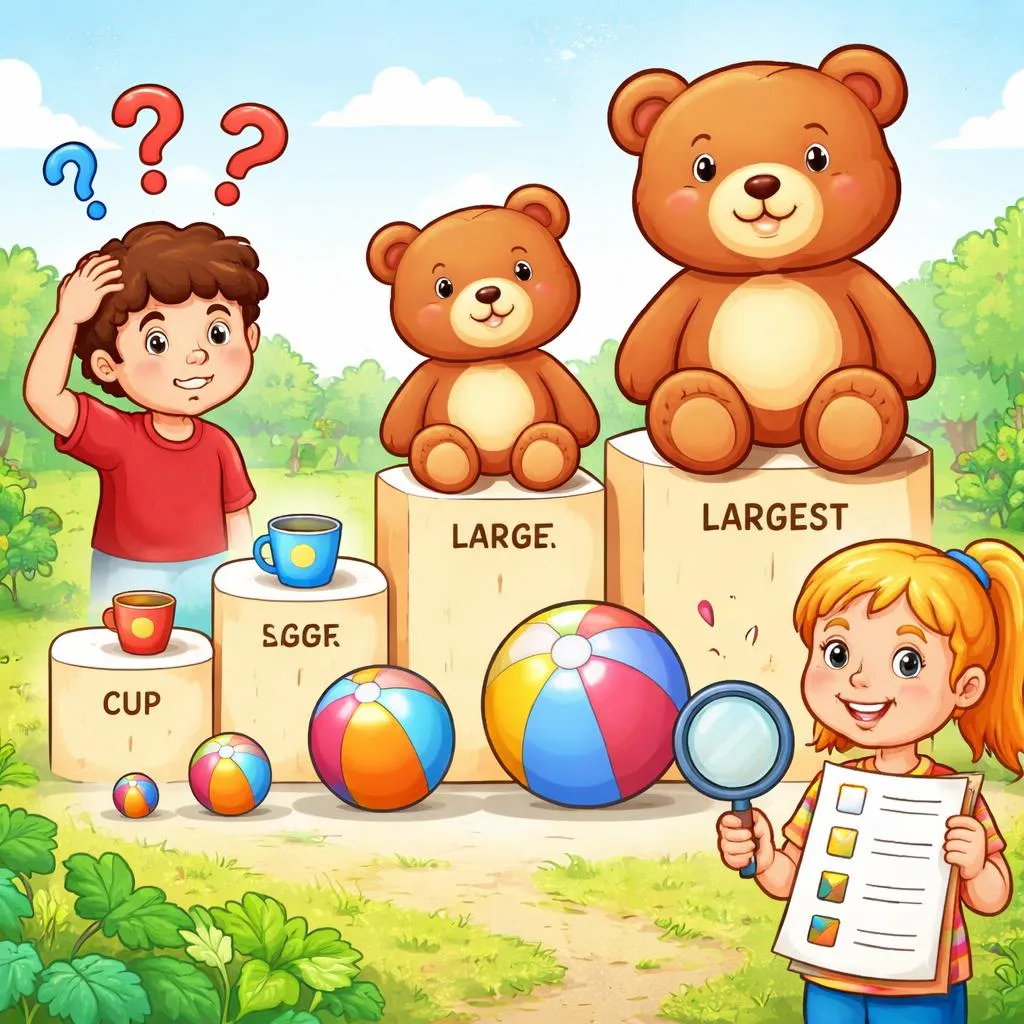
Large is the size star. It describes something big in size. We call it “Size Star”. Largely is the mostly helper. It shows something happens to a great degree. We call it “Mostly Helper”. Largeness is the bigness namer. It names the quality of being large. We call it “Bigness Namer”. Larger is the bigger painter. It compares two things and shows which is bigger. We call it “Bigger Painter”.
Now, let’s explore five ways they differ.
Time Dimension
Clocks tick. Calendars flip. Words show when things happen.
At home, Sam sees a large toy daily. He is largely happy now. He feels largeness often. He chose a larger box yesterday.
At the playground, Sam climbs a large slide. He is largely excited there. He talks about largeness. He picked a larger swing last week.
At school, Sam studies a large map. He is largely interested in facts. He learns about largeness. He selected a larger book this morning.
In nature, Sam spots a large tree. He is largely amazed by growth. He observes largeness in roots. He found a larger leaf once.
Each word shows time. Large describes now. Largely describes now. Largeness names now. Larger describes now or past.
Role Dimension
Words have jobs. Some describe. Some name.
At home, large describes a toy. “See the large toy.” Largely describes degree. “He is largely happy.” Largeness names a quality. “Feel the largeness.” Larger describes a box. “Choose a larger box.”
At the playground, large describes a slide. “Climb the large slide.” Largely describes excitement. “He is largely excited.” Largeness names a topic. “Talk about largeness.” Larger describes a swing. “Pick a larger swing.”
At school, large describes a map. “Study the large map.” Largely describes interest. “He is largely interested.” Largeness names a concept. “Learn about largeness.” Larger describes a book. “Select a larger book.”
In nature, large describes a tree. “Spot the large tree.” Largely describes amazement. “He is largely amazed.” Largeness names a quality. “Observe largeness in roots.” Larger describes a leaf. “Find a larger leaf.”
Size Star describes size. Mostly Helper describes degree. Bigness Namer names quality. Bigger Painter compares sizes.
Partners Dimension
Some words need friends. Others stand alone.
At home, large stands alone. “See large toy.” Largely needs “is” or “are”. “He is largely happy.” Largeness needs a verb. “Feel largeness.” Larger needs “a” or “the”. “Choose a larger box.”
At the playground, large stands alone. “Climb large slide.” Largely needs “is”. “He is largely excited.” Largeness needs a verb. “Talk about largeness.” Larger needs “a”. “Pick a larger swing.”
At school, large stands alone. “Study large map.” Largely needs “is”. “He is largely interested.” Largeness needs a verb. “Learn about largeness.” Larger needs “a”. “Select a larger book.”
In nature, large stands alone. “Spot large tree.” Largely needs “is”. “He is largely amazed.” Largeness needs a verb. “Observe largeness.” Larger needs “a”. “Find a larger leaf.”
Size Star is independent. Mostly Helper likes linking verbs. Bigness Namer likes action verbs. Bigger Painter likes articles.
Nuances Dimension
Small choices change meaning. Let’s see tiny differences.
At home, say “see large toy” for size. Say “he is largely happy” for degree. Say “feel largeness” for quality. Say “choose a larger box” for comparison.
At the playground, “climb large slide” describes size. “he is largely excited” shows degree. “talk about largeness” names quality. “pick a larger swing” compares.
At school, “study large map” focuses on size. “he is largely interested” shows degree. “learn about largeness” names concept. “select a larger book” compares.
In nature, “spot large tree” describes size. “he is largely amazed” shows degree. “observe largeness” names quality. “find a larger leaf” compares.
Use Size Star for describing size. Use Mostly Helper for describing degree. Use Bigness Namer for naming quality. Use Bigger Painter for comparing.
The Trap
This part is long. Many kids fall into traps. We fix them together.
Trap one: Using “largeness” as an adjective. Wrong: “I have a largeness toy.” Right: “I have a large toy.” Why? “Largeness” is a noun. It names the quality of being large. It cannot describe a toy. Only “large” describes size. Memory tip: “Largeness names, large describes.”
Trap two: Using “large” as a noun. Wrong: “I have a large.” Right: “I have largeness.” Why? “Large” is an adjective. It describes size. It cannot name a thing alone. Only “largeness” names the quality. Memory tip: “Large describes, largeness names.”
Trap three: Using “largely” as a noun. Wrong: “I love largely.” Actually “largely” is an adverb. It modifies verbs. It cannot be a thing. Right: “I love large things.” Or “I am largely happy.” Memory tip: “Largely modifies verbs, not things.”
Trap four: Using “larger” as a noun. Wrong: “I want a larger.” Right: “I want a larger box.” Why? “Larger” is an adjective. It compares sizes. It needs a noun to modify. Memory tip: “Larger needs a noun to compare.”
Trap five: Confusing all four in one sentence. Wrong: “The large largely largeness larger.” Right: “I see a large toy. I am largely happy. I feel largeness. I choose a larger box.” Clear now. Always ask: Size? Degree? Quality? Comparison? Memory tip: “Size, degree, quality, compare—pick one.”
Trap six: Using “largely” without linking verb. Wrong: “He largely happy.” Right: “He is largely happy.” Why? “Largely” is an adverb. It needs a linking verb like “is”. Memory tip: “Largely needs is or are.”
Trap seven: Using “largeness” without verb. Wrong: “The largeness is big.” Right: “The toy has largeness.” Why? “Largeness” names quality. It needs a verb like “has” or “feel”. Memory tip: “Largeness needs a verb.”
Trap eight: Using “large” for comparison. Wrong: “This is large than that.” Right: “This is larger than that.” Why? “Large” describes size. To compare two, use “larger”. Memory tip: “Large describes, larger compares.”
Trap nine: Using “larger” for single item. Wrong: “I have a larger toy.” Actually okay if comparing implied. But trap: “The toy is larger.” Needs comparison context. Right: “This toy is larger than that.” Memory tip: “Larger needs comparison.”
Trap ten: Mixing “largely” and “large”. Wrong: “He is large happy.” Right: “He is largely happy.” Why? “Large” describes size, not degree. Use “largely” for degree. Memory tip: “Large for size, largely for degree.”
These traps trip many. Practice spotting them. Soon you will dodge them easily.
Detailed Summary
Let’s tie it all together. If you describe something big, use “large”. If you show something happens to a great degree, use “largely” with “is” or “are”. If you name the quality of being large, use “largeness” with a verb like “feel”. If you compare two things and show which is bigger, use “larger” with “a” or “the”. Remember their partners. “Large” stands alone. “Largely” likes linking verbs. “Largeness” likes action verbs. “Larger” likes articles. Keep these rules in mind. You will master the word family.
Practice
Task A: Best Choice. Fill in the blank. Choose between two options.
Scene: Home. Mom says, “See the ___ toy.” Options: largeness / large. Answer: large. Because it describes size.
Scene: Playground. Sam shouts, “I am ___ happy!” Options: larger / largely. Answer: largely. Because it shows degree.
Scene: School. Teacher says, “Learn about ___.” Options: large / largeness. Answer: largeness. Because it names quality.
Task B: Eagle Eyes. Find and fix mistakes. Read the paragraph.
“Yesterday, I largeness a box. He is a large. She largely now. They have larger.”
Fixes: “Yesterday, I chose a large box. He has largeness. She is largely happy now. They have a larger box.”
Task C: Be the Director. Create sentences. Use two forms.
Scene: Family dinner. Use “large” and “largeness”. Sample: We see a large pizza. We feel largeness.
Scene: Nature hike. Use “largely” and “larger”. Sample: Trees are largely tall. One leaf is larger.
What You Learned
You learned to tell large, largely, largeness, and larger apart. You practiced using them in real scenes. You spotted common mistakes and fixed them. You gained confidence in choosing the right word.
Your Action Step
Point to a large object at home today. Say one sentence with “largely” at dinner. Draw a picture of a larger leaf this afternoon. Keep practicing every day.