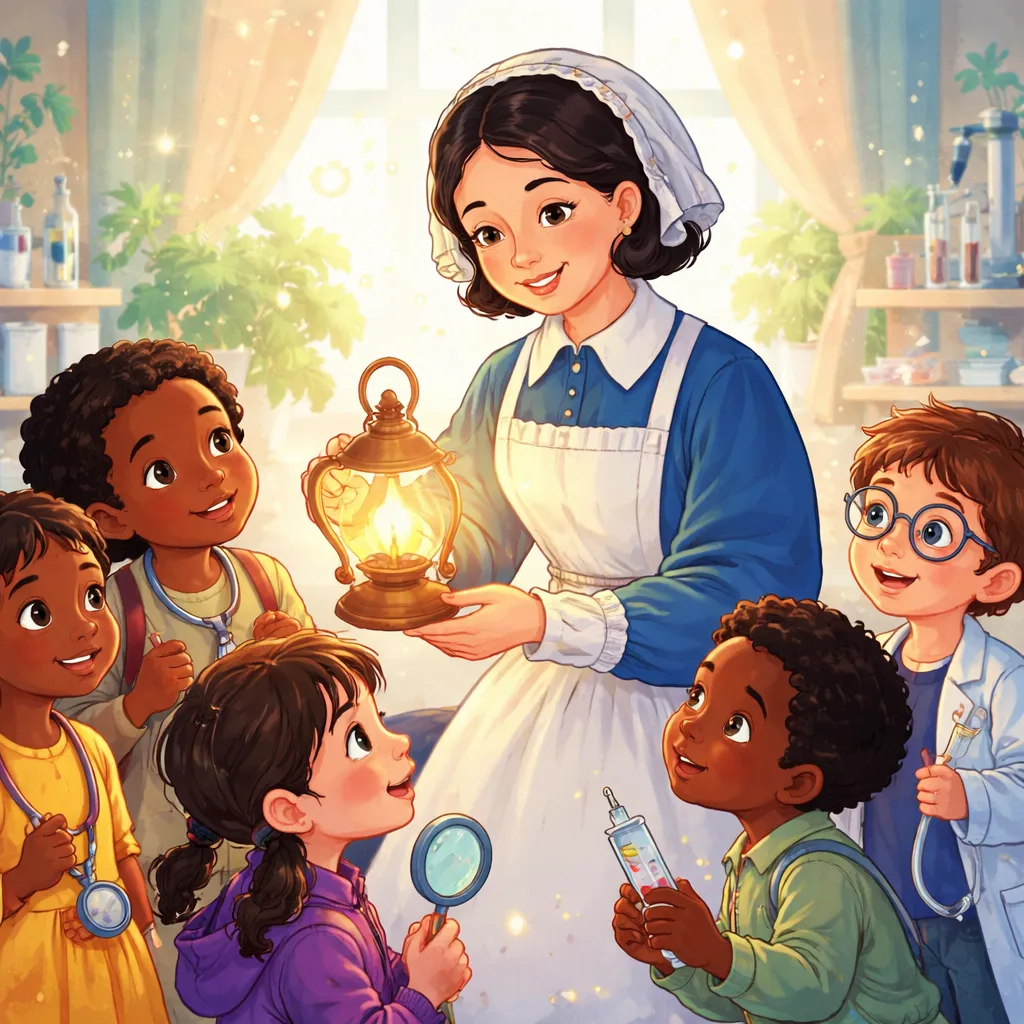

Introduction to Florence Nightingale
Florence Nightingale was a British nurse, statistician, and social reformer. She became famous for improving hospital care during a terrible war. This celebrity story: Florence Nightingale shows how one person can save thousands of lives. She did not use medicine or surgery. She used clean water, fresh air, and careful records. Children can learn that science and kindness work together. Parents can use her story to teach about courage and helping the sick. Florence Nightingale did not follow what others expected. She chose a difficult path. Her work changed hospitals forever. Today, nurses around the world remember her name. She proves that smart, caring people can fix big problems.
Early Life and Background
Florence Nightingale was born on May 12, 1820, in Florence, Italy. Her parents named her after the city of her birth. Her family was rich and well connected in England. Her father, William Nightingale, believed daughters should learn mathematics, history, and philosophy. Florence studied Greek, Latin, French, German, and Italian. She loved solving math problems and analyzing data. From a young age, she felt a strong call to help sick people. She visited poor families in nearby villages. She cared for injured animals and sick servants. At age sixteen, she wrote in her diary that God spoke to her. She believed God wanted her to become a nurse. But her parents refused. At that time, nursing was not a respectable job for wealthy women. Florence cried and argued for many years. Finally, at age thirty-one, her father gave permission. She traveled to Germany and France to train as a nurse. That decision took extraordinary patience and strength.
Career Highlights and Achievements
Florence Nightingale became famous during the Crimean War. The war started in 1853 between Russia and an alliance including Britain. British newspapers reported that wounded soldiers were dying in filthy hospitals. The government asked Florence to lead a team of nurses to Turkey. She arrived in November 1854 at the Scutari hospital. What she found shocked her. The hospital sat on top of a cesspool. Sewage flowed into the water supply. Rats ran everywhere. There were no bandages, soap, or clean towels. More soldiers died from infections than from battle wounds. Florence acted immediately. She scrubbed the floors. She opened windows for fresh air. She washed linens and instruments. She also wrote letters to London demanding supplies. Within six months, the death rate fell from 42 percent to 2 percent. The soldiers called her “the Lady with the Lamp” because she walked the wards at night. After the war, she used statistics to prove that clean hospitals save lives. She became the first woman to receive the British Order of Merit.
Famous Works or Performances
Florence Nightingale did not paint or sing. Her most famous “work” was her statistical data. She created a new kind of chart called the polar area diagram. This chart showed how many soldiers died from preventable diseases. The diagram looked like a beautiful flower. But the message was powerful and clear. She used these charts to convince government leaders to change hospital rules. Another famous work was her book “Notes on Nursing.” She wrote it for ordinary people caring for sick family members at home. The book explained simple but life-saving ideas. Wash your hands. Open windows. Keep the room clean. Give patients small, nutritious meals. “Notes on Nursing” sold very well and remains in print today. Florence also wrote hundreds of letters and reports. She often wrote from her bed because she became ill herself. Still, she continued working. Her writings changed how the world thinks about health and hygiene.
Personal Life and Fun Facts
Florence Nightingale had many interesting personal habits. She loved cats and owned several as pets. She named one cat “Mr. Buff” and another “Plym.” She often let her pet owl sit on her shoulder while she wrote. The owl’s name was Athena. Florence also suffered from a mysterious illness that began after the Crimean War. She spent much of her later life lying on a couch. Some people think she had chronic fatigue syndrome or brucellosis. Even from her couch, she ran her nursing school and advised world leaders. She refused many marriage proposals. One suitor, Richard Monckton Milnes, waited for nine years. But Florence chose nursing over marriage. She once said, “I have no personal life except my work.” Another fun fact is that she loved mathematics so much. She called statistics “the most important science in the world.” Children might enjoy knowing that Florence designed her own hospital wards. She drew floor plans with wide windows and plenty of space between beds.
Legacy and Influence
Florence Nightingale changed nursing from a low-paid job into a respected profession. In 1860, she opened the Nightingale Training School for Nurses at St. Thomas’ Hospital in London. Her graduates went on to run hospitals in England, America, Australia, and India. Modern nursing follows her core ideas. Keep patients clean. Watch for small changes in their health. Record everything carefully. The International Nurses Day takes place on her birthday, May 12, every year. The Nightingale Pledge is a promise that new nurses recite. It is like the Hippocratic Oath for doctors. Her influence also reaches into public health. She helped create better sanitation systems in India. She advised the British government on health for the army. Hospitals today still use her design principles. She proved that one woman with a lamp and a brain can light the way for millions.
Quotes or Famous Sayings
Florence Nightingale wrote many powerful words. One famous quote is, “I attribute my success to this: I never gave or took any excuse.” Another wise saying is, “The very first requirement in a hospital is that it should do the sick no harm.” She also said, “Nursing is an art. If it is to be made an art, it requires as exclusive a devotion, as hard a preparation, as any painter’s or sculptor’s work.” Children might like this one: “Live life when you have it. Life is a splendid gift. There is nothing small in it.” Families can read these quotes together. Ask children, “What does it mean to never give an excuse?” These sentences help young readers understand Florence’s strong character. Her words also show that nursing is both science and love. Parents can write a quote on a card and put it near a child’s study desk.
How to Learn from Florence Nightingale
Children can learn many lessons from Florence Nightingale. First, do not let others decide your future. Her family told her no for fifteen years. She waited and worked until they said yes. Second, use numbers to tell the truth. She did not just say hospitals were dirty. She showed the data. Third, clean habits save lives. Washing hands and opening windows seem small. But they make a huge difference. Parents can encourage young children to practice Nightingale habits. Wash hands before eating. Tidy up toys. Help a sick family member by bringing water or a blanket. Older children can learn basic first aid or make a “home hospital kit” with bandages and soap. Families can also start a “Nightingale chart” for one week. Write down how many times each person washed hands or opened a window. See who improves the most. Another idea is to read a children’s book about Florence together. Then draw a picture of a clean hospital room. Florence Nightingale showed that courage comes in quiet forms. She did not fight in the war. She fought dirt and ignorance. Every child can be a little Nightingale by caring for others with smart, gentle hands. Her lamp still burns in every nurse who works through the night.