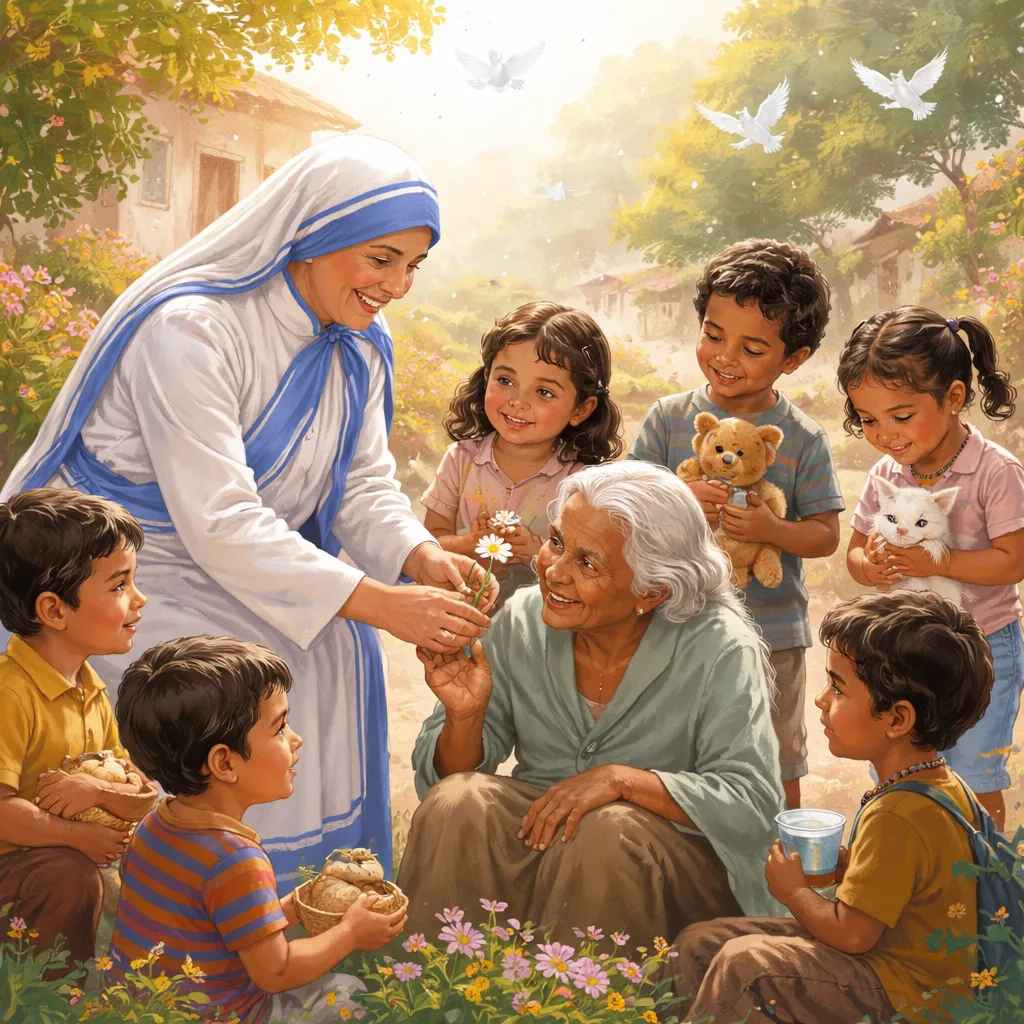

Introduction to Mother Teresa
Mother Teresa was a Catholic nun and missionary from North Macedonia. She spent most of her life in India helping poor and sick people. This celebrity story: Mother Teresa shows how one woman changed the world without money or power. She built homes for dying people. She fed hungry children. She held hands with those whom others forgot. Children can learn that small acts of love matter. Parents can use her story to teach service and empathy. Mother Teresa did not write books or give speeches for fame. She simply saw a need and acted. Her life proves that kindness is a universal language. Every family can find inspiration in her gentle strength.
Early Life and Background
Mother Teresa was born on August 26, 1910, in Skopje. At that time, Skopje was part of the Ottoman Empire. Today it is the capital of North Macedonia. Her birth name was Anjez? Gonxhe Bojaxhiu. Her father, Nikola, was a successful businessman. Her mother, Drana, took care of the children and taught them faith. Anjez? had an older sister, Aga, and a brother, Lazar. The family prayed together and helped poor neighbors. When Anjez? was eight years old, her father died suddenly. This loss made her very sad. But her mother stayed strong and worked hard. Young Anjez? loved reading missionary stories. She also enjoyed singing in the church choir. By age twelve, she felt God calling her to serve others. She decided to become a nun. At eighteen, she left home and joined the Sisters of Loreto in Ireland. She never saw her mother or sister again. That decision took great courage for a young woman.
Career Highlights and Achievements
Mother Teresa began her work as a teacher in Calcutta, India. She taught geography and history to young girls. But she saw extreme poverty outside the school walls. In 1946, she received a “call within a call.” She believed God asked her to leave the convent and help the poor. She started by opening a small school in the slums. Later she founded the Missionaries of Charity. This group of nuns grew to over 4,000 members worldwide. They ran homes for people dying of AIDS, leprosy, and tuberculosis. Mother Teresa also opened orphanages and soup kitchens. In 1979, she received the Nobel Peace Prize. She asked the committee to cancel the expensive award dinner. Instead, she used the money to feed 40,000 poor people in India. Governments and world leaders respected her. But she always called herself “God’s pencil.” Her achievements show that dedication matters more than fame.
Famous Works or Performances
Mother Teresa did not paint, sing, or act. Her “works” were acts of service. One of her most famous projects was the Home for the Dying in Calcutta. She called it Nirmal Hriday, meaning “Pure Heart.” People brought dying strangers from the streets. The sisters cleaned their wounds and gave them a bed. They let people die with dignity and love. Another famous work was Shanti Nagar, a leprosy colony. At that time, leprosy patients faced extreme fear and isolation. Mother Teresa gave them medical care and respect. She also opened children’s homes like Shishu Bhavan. These places saved thousands of abandoned babies. Her work did not require fancy buildings or technology. It required presence and love. Families can explain that helping one person is also a “great work.” Children do not need to be famous to change lives. They can start by sharing a sandwich or drawing a picture for a lonely neighbor.
Personal Life and Fun Facts
Mother Teresa had a very simple life. She owned only three cotton saris. She wore the famous blue-and-white sari every day. She slept on a thin mattress. She ate rice and lentils for most meals. A fun fact is that she loved to smile and tell jokes. Many people thought she was serious all the time. But children who met her said she laughed easily. Another interesting fact is that she kept her Nobel Prize medal. She later sold it to raise money for the poor. Mother Teresa also experienced deep spiritual doubt for nearly 50 years. She felt distant from God but continued her work. This honesty makes her more human, not less. She enjoyed simple pleasures like tea and walking outdoors. She also loved receiving letters from children around the world. She answered many of them by hand. These small moments show her warm heart.
Legacy and Influence
Mother Teresa died on September 5, 1997. The world mourned her passing. India gave her a state funeral, an honor usually for presidents. The Missionaries of Charity continues her work in over 130 countries. Her influence reaches far beyond religion. People of all faiths respect her dedication to the poor. Schools name buildings after her. Hospitals and shelters follow her model of care. In 2016, the Catholic Church declared her a saint. That means she is a holy example for millions of believers. But her legacy also lives in small ways. A child who shares lunch is carrying Mother Teresa’s spirit. A family who volunteers at a shelter is continuing her mission. She once said, “Not all of us can do great things. But we can do small things with great love.” That sentence now guides parents and teachers worldwide. Her legacy proves that love is the most powerful force.
Quotes or Famous Sayings
Mother Teresa spoke many memorable words. One famous quote is, “Spread love everywhere you go. Let no one ever come to you without leaving happier.” Another powerful saying is, “If you judge people, you have no time to love them.” She also said, “Kind words can be short and easy to speak, but their echoes are truly endless.” Children love this one: “We can do no great things, only small things with great love.” Families can pick one quote each week. Write it on paper and put it on the refrigerator. Ask children, “What small thing can you do today with great love?” These quotes open conversations about feelings and actions. They also help young readers remember Mother Teresa’s message. Her words are simple, but they stay in the heart for a long time.
How to Learn from Mother Teresa
Children can learn three main lessons from Mother Teresa. First, notice needs around you. She did not look far away. She helped the person right in front of her. Second, use what you have. She started with only five rupees. She did not wait for more money or help. Third, do not expect thanks. Many people she helped could not say thank you. She served anyway. Parents can encourage young children to practice small kindnesses. Hold the door for someone. Share a toy. Draw a picture for a grandparent. Older children can volunteer one hour a month. Help at an animal shelter or food bank. Families can also read one short story about Mother Teresa each week. Talk about how her actions connect to daily life. Another idea is to start a “kindness jar.” Every time someone does a small good deed, put a marble inside. Watch the jar fill up. That visual shows how small acts add up. Mother Teresa lived a long, hard life. But she never stopped loving. Every child can carry a piece of her heart into the world.