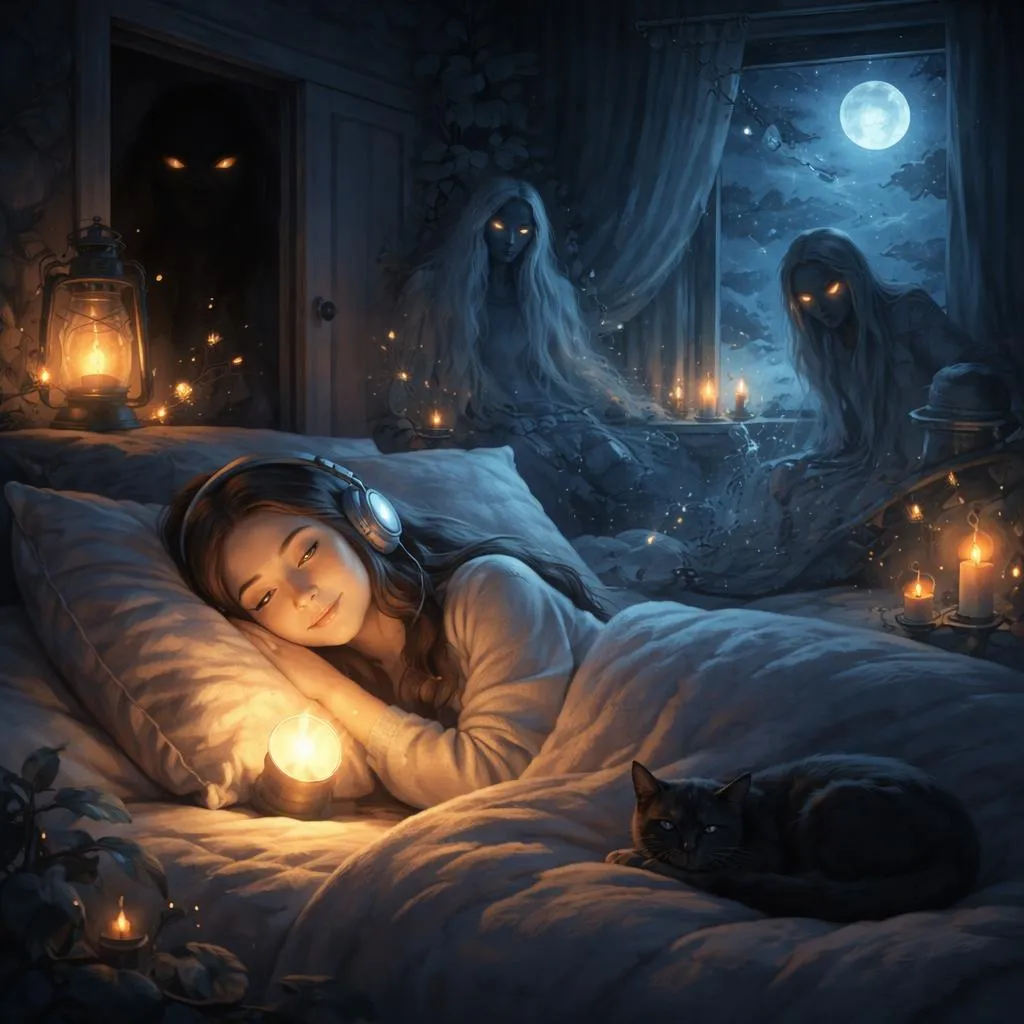

The word “horror” evokes a primal chill—the sudden gasp, the accelerated heart, the wide-eyed stare into the dark. It seems the absolute opposite of what we seek as we prepare for rest. Yet, consider the nature of what often keeps us awake. It is rarely a monster under the bed, but the shadowy shapes of our own making: the anxiety that clenches in the gut like a cold fist, the dread of tomorrow’s unknown, the echoing fear of things left undone. What if we could approach these feelings not as enemies to fight in the dark, but as familiar, if uncomfortable, guests? What if a bedtime story could gently personify that inner “horror,” sit with it, and in doing so, completely disarm its power? This is not a tale of external fright, but an internal journey. It is a guided narrative that uses the language and atmosphere often associated with unsettling tales to create a container—a safe, metaphorical space—where you can meet your own shadowy thoughts, offer them a cup of tea, and watch them dissolve into the peaceful night. This approach to bedtime stories horror themes is not about fear, but about profound acceptance and release.
First, settle into your bed. Feel the weight of your body, a solid anchor in the quiet room. Acknowledge the day’s residue—the tightness in your shoulders, the faint buzz behind your eyes. Now, take a breath that is deeper and slower than the last. As you exhale, imagine you are not pushing anything away, but simply making a little more space inside. We are not running from the feeling; we are creating a quiet room within to welcome it, observe it, and understand it. In this space, we will tell a different kind of story. We will give the vague sense of dread a form, a name, and a voice, and in doing so, we will see it for what it often is: a lonely, misunderstood part of ourselves asking for attention.
Begin by imagining a place that feels both ancient and deeply still. You are standing at the edge of a vast, mist-shrouded moor at twilight. The sky is the color of a fading bruise, purples and deep blues bleeding into the black of the horizon. The air is cool and damp, carrying the rich, peaty scent of wet earth and heather. In the distance, the silhouette of a single, gnarled oak tree stands against the sky. There is no sound but the low, mournful sigh of a breeze through the grass and the distant, lonely cry of a curlew. This landscape is not meant to frighten you, but to match your inner weather. It is solemn, beautiful, and vast. It can hold whatever you bring to it. This setting is the first step in redefining bedtime stories horror—it uses atmospheric depth not to scare, but to validate and hold the full spectrum of human feeling.
You begin to walk along a faint, sheep-trodden path, the damp moss soft and silent underfoot. The mist curls around your ankles like cool, living smoke. With each step, you feel a heaviness in your chest—that familiar, amorphous dread. Instead of resisting, you invite it to take shape. In your mind’s eye, you see it coalescing from the mist ahead. It is not a monster. It is a figure, cloaked in shadows the color of the deepening night. It stands still, about twenty paces ahead, its back to you. It is the embodiment of your unnamed anxiety, your quiet fear. This is the “horror” in our bedtime stories horror narrative: not an external threat, but the internal one made visible. And you are not its victim; you are its witness, and ultimately, its guide.
You feel no urge to run. A strange calm settles over you. You continue walking until you are a few steps behind the figure. You stop. The figure does not turn, but you sense its awareness of you. The moor is utterly silent now, even the wind holding its breath.
“I hear you,” you say, not with your voice, but with your mind. The words are not an accusation, but a simple acknowledgment. “You feel heavy today.”
The figure gives a slow, almost imperceptible nod. A feeling washes over you—not of terror, but of immense, weary sadness. It is the weight of a hundred small worries, the pressure of expectations, the grief for lost time. This is the core of the feeling. The “horror” is just profound sadness wearing a dark cloak.
“Will you walk with me?” you ask.
The figure turns its head slightly. You see no face, only a deeper shadow within the hood. But the intention is clear. It turns and begins to walk beside you, matching your slow, deliberate pace. You walk in silence for a time, the mist parting before you. This act of companionship, of not fleeing from your fear but inviting it alongside you, is the transformative heart of this narrative. It neutralizes the horror by removing its loneliness.
As you walk, you begin to speak to the feeling. Not with words, but with images. You picture the individual worries as objects. That tight deadline is a smooth, cold stone in your pocket. The unresolved argument is a tangled knot of black thread. The general anxiety about the future is a handful of dry, dead leaves. One by one, you take these imagined objects from within yourself. You don’t throw them away. You simply lay them gently on the ground beside the path as you walk. The cloaked figure beside you observes. With each item you set down, the figure seems to grow slightly less dense, a little more transparent.
You come to the gnarled oak tree. Its trunk is massive, twisted by centuries of wind. At its base, between great roots that look like knuckled fingers, there is a small, still pool of black water, perfectly reflecting the first emerging stars. You and the figure sit, your backs against the tremendous, supportive trunk. The presence beside you is no longer menacing. It feels like a tired traveler, same as you.
You look into the dark pool. The reflection shows the sky, the tree, and the two of you—a person and a soft, greyish silhouette. You take a final, deep breath, and as you exhale, you release the very need to name or define this feeling anymore. You simply let it be. And as you do, the cloaked figure in the reflection begins to change. The shadows that form it start to drift apart, like smoke in a gentle breeze. They don’t vanish violently; they dissipate, rising slowly, merging with the mist that now glows with a soft, silver moonlight that has broken through the clouds.
The “horror” is gone. In its place is a vast, hollowed-out peace. The feeling was never a monster; it was a knot of unexpressed emotion. By walking with it, giving it space, and symbolically laying down its components, you allowed it to unravel. This process is the ultimate goal of therapeutic bedtime stories horror—to use the narrative framework to safely deconstruct and dispel the very anxieties that haunt us.
You are alone by the tree, but you do not feel lonely. You feel cleansed. The moor, once haunting, is now breathtakingly beautiful. The mist shines under the moonlight like a sea of pearls. The stars are brilliant pinpricks in the velvet sky. The only sound is the gentle, rhythmic lapping of a tiny spring feeding the black pool. The atmosphere of the horror bedtime story has been alchemized, through your courage and stillness, into one of profound serenity. The setting didn’t change; your relationship to what it represented did.
The tiredness you feel now is a good tiredness, the fatigue that comes after completing important, if quiet, emotional work. Your breathing is deep and even, synced with the soft lap of the water. The solid, ancient bulk of the tree at your back feels like the support of the earth itself. The story has done its work. It provided the dark, beautiful landscape and the silent companion necessary for you to perform your own gentle exorcism.
Now, let the moor soften. Let the starry sky become the darkness behind your eyelids. The sound of the spring becomes the sound of your own steady pulse. The feeling of the tree’s bark against your back becomes the feel of your pillow and mattress supporting you. The narrative, having served as a faithful guide, is receding. What it leaves behind is the gift it helped you uncover: a deep, empty, and profoundly quiet peace.
The figure is gone because it was never truly separate from you. It was a feeling, and the feeling has been acknowledged, companioned, and released. The chill of the moor has been replaced by the gentle warmth of your blankets. The horror bedtime stories concept has been fulfilled not by a scare, but by the courage to face the shadow and discover it was only ever made of mist and starlight.
There is nothing more to face, nothing more to do. Allow the last image—the silver mist, the star-reflecting pool—to fade into a soft, gray nothingness. Your mind is clear. Your body is heavy. Sleep is no longer an escape from something, but a natural, welcoming descent into the very peace you have just cultivated. The story is over. The quiet is yours. Let it fill you, and carry you gently down into the deepest, most restorative rest. You are safe. All is well.