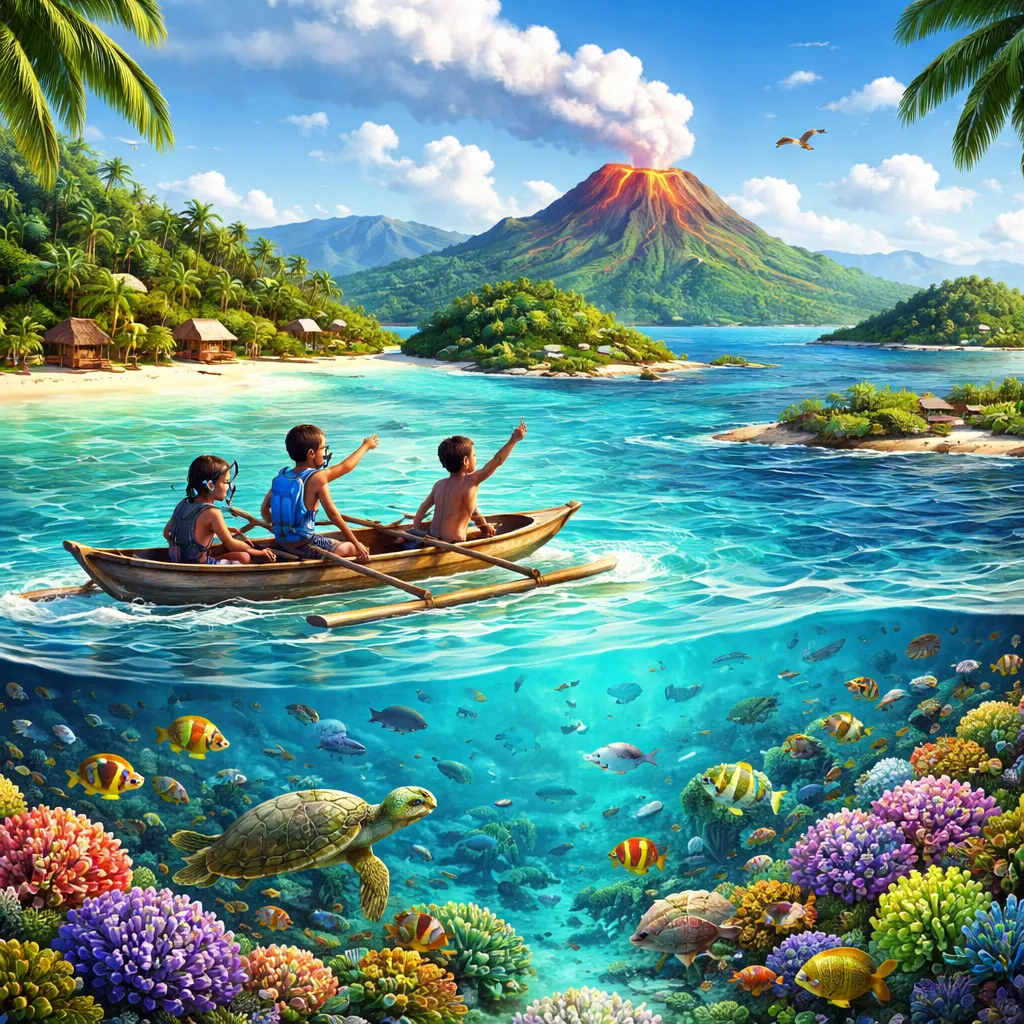

Introduction to Solomon Islands Solomon Islands is a country of many islands in the Pacific Ocean. It has nearly 1,000 islands. Children there learn English as their official language. They also speak over 70 local languages. Learning reading: Solomon Islands offers a journey to a remote world of volcanoes, dolphins, and tropical forests. Kids on these islands read stories about shipwrecks from World War II. They also learn about giant clams and flying foxes. Reading about Solomon Islands feels like exploring a secret ocean kingdom. Your child can visit this faraway nation from your reading corner. Each new word becomes a shell on a white sand beach. Let us walk along that beach together.
Where Is Solomon Islands? Solomon Islands sits in the South Pacific Ocean. It lies east of Papua New Guinea. It lies north of Vanuatu. The country has no land neighbors. The ocean surrounds every island. The capital city is Honiara. Honiara sits on the island of Guadalcanal. Guadalcanal is the largest island in the country. The whole country covers 28,400 square kilometers. That is about the size of Maryland. But the ocean around the islands is very large. The country controls over 1.6 million square kilometers of ocean. Most of the nearly 1,000 islands have no people. Only about 350 islands have villages and schools. Learning reading: Solomon Islands becomes real when you look at a map of the Pacific. Find Australia. Look northeast. You will see a chain of islands stretching like stepping stones. That is Solomon Islands. Point to the largest island called Guadalcanal. Say the name. "Sol-o-mon Is-lands." You just found one of the most remote countries on Earth.
Interesting Facts About Solomon Islands Solomon Islands has many fascinating facts. First, the islands have active volcanoes. One volcano builds a new island every few years. Second, the country has the largest saltwater lagoon in the world. It is called Marovo Lagoon. Third, dolphins live in large groups near the islands. You can see hundreds swimming together. Fourth, the islands have giant clams. These clams can weigh over 200 kilograms. Fifth, many ships and planes from World War II rest on the ocean floor. Divers visit these underwater wrecks. Sixth, the islands have a special currency. People use dolphin teeth for traditional payments. Learning reading: Solomon Islands teaches words like "lagoon," "volcano," "dolphin," and "clam." Each fact gives your child a new picture. Imagine a lagoon so big you cannot see the other side. Imagine a clam bigger than your bathtub. Imagine a plane resting on the ocean floor with fish swimming through it. These pictures make words stay in your mind. Parents can ask: "Would you like to swim with hundreds of dolphins?" "What would you see inside a giant clam?" Your child will feel amazed by these remote islands.
Key Vocabulary About Solomon Islands Let us learn six important words from Solomon Islands.
First is "lagoon." A lagoon is shallow water separated from the ocean by a reef. Marovo Lagoon is the largest in the world.
Second is "volcano." A volcano is a mountain that can erupt hot lava and ash. Some Solomon Islands volcanoes are still active.
Third is "dolphin." A dolphin is a smart sea mammal that jumps out of the water. Many dolphins live near the islands.
Fourth is "clam." A clam is a sea animal with two hard shells. Giant clams can be very large.
Fifth is "coral reef." A coral reef is an underwater structure made by tiny animals. Reefs shelter many fish.
Sixth is "wreck." A wreck is a ship or plane that has been destroyed. Underwater wrecks from World War II lie off the islands.
Learning reading: Solomon Islands gives you these six words. Make a sound or movement for each word. For lagoon, make a gentle splashing sound. For volcano, make a rumbling "grrr" sound and raise your hands. For dolphin, jump up and say "eek eek!" For clam, put your hands together like two shells and open them slowly. For coral reef, wiggle your fingers like many tiny animals. For wreck, pretend to swim down and point at something. Say each word while you make the sound or movement. Your child will remember because their whole body joins the lesson. Practice these during breakfast. Practice them in the car. Soon your child will say "dolphin" and jump without thinking.
The Famous People About Solomon Islands Solomon Islands is a small country. It has produced a few famous people. One is Sir Peter Kenilorea. He became the first prime minister after independence in 1978. Another famous person is John Moffat. He was a pilot in World War II. He flew missions over the Solomon Islands. There is also a singer named Sharzy. He sings reggae and pop music. His songs talk about island life. Another important person is Vika Manesia. She works to protect the ocean. She teaches people about coral reefs. There is also an athlete named Rose Wete. She competes in weightlifting. She represented her country in the Commonwealth Games. These people show that Solomon Islands has leaders, pilots, singers, and athletes. Learning reading: Solomon Islands becomes inspiring through these names. Say each name. "Sir Pe-ter Ke-ni-lo-re-a." "John Mof-fat." "Shar-zy." "Vi-ka Ma-ne-si-a." "Ro-se We-te." Talk about what each person did. "What did Peter do?" "He led the country." "What does Sharzy do?" "He sings." "What does Vika do?" "She protects the ocean." "What does Rose do?" "She lifts weights." Your child can imagine singing on a beach or protecting the ocean. These famous people prove that remote islands produce strong people.
Simple Sentences for Reading Practice Here are easy sentences about Solomon Islands. Read each one aloud.
Solomon Islands has nearly 1,000 islands in the South Pacific Ocean.
The capital city Honiara sits on the large island of Guadalcanal.
Marovo Lagoon is the largest saltwater lagoon in the entire world.
Active volcanoes on the islands sometimes build new land.
Groups of hundreds of dolphins swim together near the coast.
Giant clams on the reefs can weigh more than 200 kilograms.
Coral reefs around the islands shelter colorful fish and sea turtles.
Underwater wrecks from World War II rest on the ocean floor.
Sir Peter Kenilorea became the first prime minister of the country.
Vika Manesia teaches people to protect the coral reefs and ocean.
Learning reading: Solomon Islands makes these sentences easy to practice. Read a sentence. Then ask your child to find something in the room that matches the feeling. For sentence three, find something very large like a sofa. For sentence four, find something that builds or grows. For sentence five, find a group of something like a bunch of crayons. For sentence eight, find something old. The matching game connects words to real objects. You can also make a whisper chain. Whisper a sentence to your child. They whisper it to a stuffed animal. The stuffed animal whispers it back to you. See if the sentence stays the same.
Short Reading Passage About Solomon Islands Read this passage together. It uses all the words we learned.
Solomon Islands hides in the vast blue Pacific Ocean. Nearly one thousand islands make up this country. The largest island is Guadalcanal. Its capital Honiara hugs the coast. Across the water, Marovo Lagoon stretches farther than the eye can see. The lagoon protects a world of coral reefs and giant clams. Some clams grow as big as a small car. Dolphins leap from the water in large groups. They seem to smile as they jump. On land, volcanoes rumble. One volcano sometimes builds a whole new island. Under the ocean, history sleeps. Wrecks from World War II lie on the sandy floor. Airplanes and ships have become homes for fish. Famous Solomon Islanders include Sir Peter Kenilorea, the first prime minister, and Vika Manesia, who defends the reefs. Their names remind everyone that these islands matter. Learning reading: Solomon Islands invites you to a world of blue water and green islands. A world of jumping dolphins and sleeping wrecks. Now close your eyes. Imagine you float in Marovo Lagoon. The water is warm and clear. Below you, a giant clam opens its shell. A dolphin jumps nearby. You hear the splash. What color is the clam's inside? What would you name the dolphin?
This passage has 190 words. Read it slowly. After each sentence, ask your child to tap their foot once. The tapping keeps a steady beat. Children learn well with rhythm. After the passage, ask your child to close the book and tell you one thing that lives in the ocean around Solomon Islands. "Dolphin." "Clam." "Fish." "Coral." Celebrate every answer. "Yes, dolphins live there! You remembered!"
Fun Questions About Solomon Islands Use these questions to talk about this remote island nation.
Would you rather swim in Marovo Lagoon or explore an active volcano? Why?
How would you feel swimming next to a giant clam that is bigger than you?
Why do you think dolphins like to swim near the Solomon Islands?
Would you like to dive down to see a World War II wreck? What would you hope to see?
What would you name a new island that a volcano just built?
Would you rather live on an island with 1,000 neighbors or an island with no neighbors? Why?
Why is it important to protect coral reefs like the ones in Solomon Islands?
If you met Vika Manesia, what would you ask her about saving the ocean?
What would you sing about if you were a singer like Sharzy?
Would you like to try lifting weights like Rose Wete? Why or why not?
Learning reading: Solomon Islands turns every question into an ocean adventure. Parents answer first. "I would swim in the lagoon because I want to see the giant clams up close." Then your child answers. Let them be wild. If they say "I would name the new island Pizza Paradise," say "That is a delicious name. What food grows there?" Keep asking. Keep imagining. You can also act out the answers. Pretend to swim like a dolphin. Pretend to be a giant clam opening and closing. Pretend to dive to a shipwreck. Ask one question during a bath. Ask another question while walking to school. Solomon Islands will become a magical place in your home.
Tips for Learning English with This Topic Now let us bring Solomon Islands into your home. First, draw a lagoon. Make a big blue oval. Add a reef around the edge. Say "lagoon" as you draw. Second, build a volcano with clay or playdough. Make a cone shape. Poke a hole in the top. Say "volcano" when you finish. Third, draw a dolphin. Give it a curved fin and a smiling face. Say "dolphin" as you draw. Fourth, make a giant clam. Open your hands like two shells. Put them together and open slowly. Say "clam" each time you open. Fifth, watch a short video of coral reefs. See the colorful fish. Say "coral reef" as you watch. Sixth, eat something from the ocean. Tuna from a can works. Say "ocean food" as you eat. Learning reading: Solomon Islands gives you these six tips. Do one tip each day. Do not rush. Let the ocean sounds and images settle. Learning English is like exploring a coral reef. You swim slowly. You look carefully. You discover one new thing at a time. So swim slowly. One word. One tip. One small discovery at a time.
Your child will remember Solomon Islands. They will remember the lagoon and the dolphins and the giant clams. But most of all, they will remember reading with you. That quiet time together builds an ocean of its own. An ocean of love and learning. So keep this article on your phone. Read one sentence tonight. Ask one question tomorrow. Try one tip this weekend. Solomon Islands is not a faraway mystery. It is right here every time you learn a new word together. Say one now. "Lagoon." Wonderful. Say another. "Dolphin." Beautiful. You are already swimming in clear blue water. Keep swimming. The reef is full of wonders.