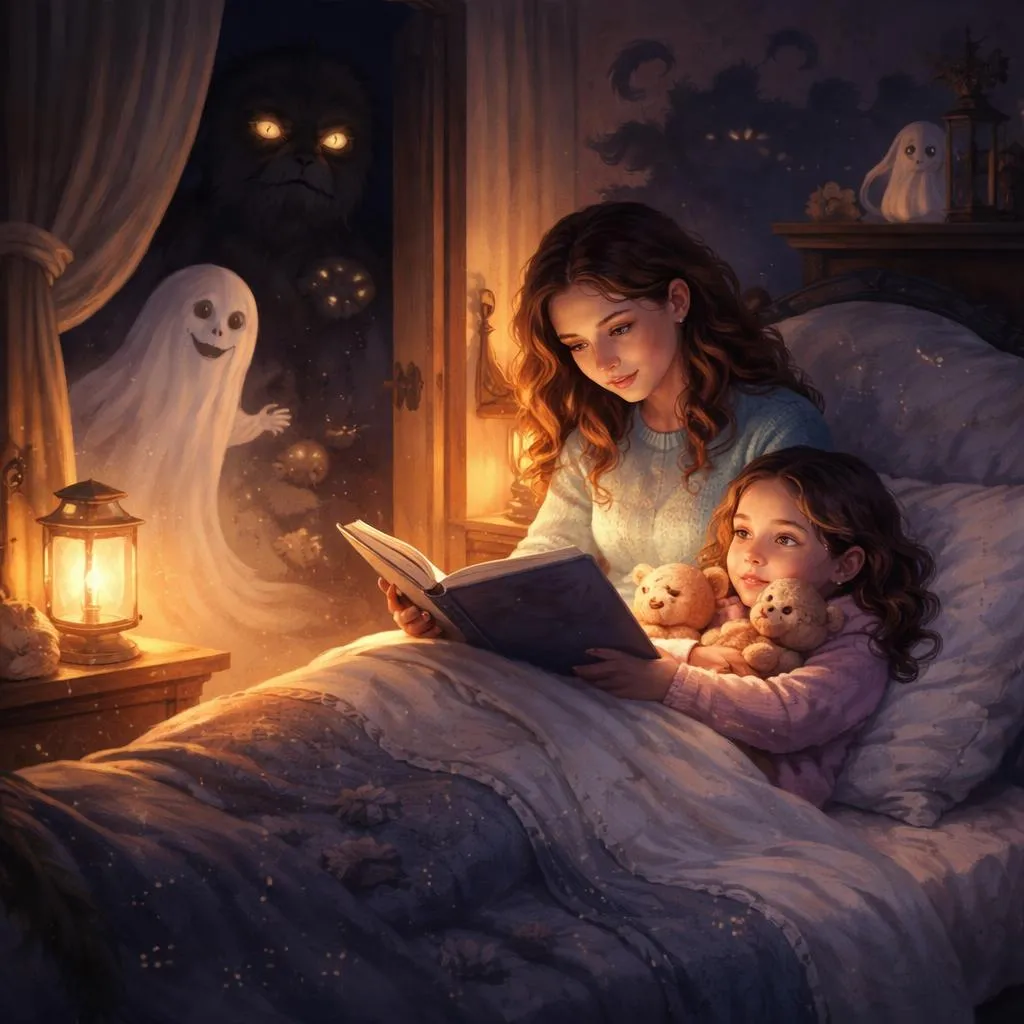

We often think of scary bedtime stories as tales of the supernatural, designed to send a thrilling chill down the spine. But what if we reimagined the concept? What if the only “scary” thing in our story is the weight of our own thoughts—the gnawing worries, the unfinished tasks, the low hum of anxiety that sometimes accompanies us to bed? Tonight’s story is an invitation to transform that feeling. It is a gentle, guided narrative that acknowledges the shadows of the mind, not to frighten you, but to help you gently usher them out the door, making room for profound peace. This is a different kind of tale, one where the only monster is restlessness, and the hero is your own capacity for calm. So, let us begin this quiet journey, using the framework of a story to safely unpack and release what may feel unsettling, turning it into a lullaby for the soul.
Find your most comfortable position. Feel the support beneath you, and let your body grow heavy, sinking into the comfort of your bed. Take a slow, deep breath in through your nose, and as you exhale through your mouth, imagine releasing the very idea of “scary” as something external. For this next little while, we will simply be observers of an inner landscape. We will visit a metaphorical place where our worries take shape, not to battle them, but to understand them, and then to let them go with kindness. This is the true purpose of this adult narrative: a compassionate clearing of the mental attic.
Begin by visualizing a space. It is not a dark forest or a haunted house. Instead, picture an old, quiet attic in a house you know is safe and sturdy. It is late evening, and the only light comes from the soft, blue-tinged dusk filtering through a single round window. You are not frightened to be here. You are curious, and gentle with yourself. This attic is your own mind at the end of the day, filled with the assorted thoughts and feelings you’ve collected. Some are bundled neatly in the corner, covered in dust sheets. Others seem to sit out in the open. The air is still, a little dusty, and filled with the scent of aged paper, dried lavender, and old wood. It is a peaceful, if somewhat crowded, space.
Your attention is drawn to a particular corner. There, you see shapes that aren’t quite furniture. They are vague, shadowy forms. One might look like a softly writhing pile of tangled yarn—that’s tomorrow’s looming deadline. Another might resemble a gently spinning, faintly buzzing orb—that’s the unresolved conversation from earlier. A third might be a cool, gray mist hovering near the rafters—the general, nameless worry about things you cannot control. In the context of our safe scary bedtime stories, these are our “creatures.” They are not malevolent; they are simply the embodied forms of your day’s mental energy, waiting to be acknowledged.
You take a soft, deep breath. With each inhale, you draw in the calm, dusty air of the attic. With each exhale, you send a wave of soft, warm light from your heart, illuminating the space not with a harsh glare, but with the gentle glow of a dozen candle flames. The shadows of the forms don’t vanish, but they soften. Their edges become clearer, less threatening. You are not here to fight them. You are merely here to see them clearly, to give them form, and in doing so, to take away their vague, unsettling power.
You approach the first form, the tangled yarn of tomorrow’s tasks. In a traditional scary story, this might leap out. Here, it simply sits. You kneel beside it. You see the individual strands—the emails to send, the decisions to make, the journey to plan. You pick up the end of one strand. It feels familiar, almost cozy in your hands. You begin, slowly and with no urgency, to wind it into a neat, small ball. As you wind, you whisper to yourself, “There is time for this tomorrow. For now, it is just a ball of yarn.” The act of winding is rhythmic, soothing. The tangled mess transforms into a compact, manageable sphere. You place it gently inside a small, beautiful wooden box on a nearby shelf and close the lid. It is contained. It is safe. It is not gone, but it is no longer sprawling across the floor of your mind.
Next, you turn to the softly buzzing orb—the unresolved conversation. You hold out your hands near it, not to grab it, but to feel its energy. The buzz is just vibration, a residue of emotion. You breathe onto it, a long, slow, cool breath. As you do, the orb begins to crystallize. The buzzing softens into a faint, musical hum, and the orb itself transforms into a intricate, fragile snowflake made of glass. It is beautiful in its complexity. You see the facets of misunderstanding, the angles of different perspectives, all frozen in a moment of quiet beauty. You carefully place it on a velvet cushion. It will be there in the morning, perhaps to be revisited with clearer eyes, but for now, its sharp edges are blunted, its noise turned to silent art.
Finally, you look at the cool, gray mist of general anxiety. This one has no shape, so it is the easiest to disperse. You walk to the round window of the attic. The latch is old but smooth. You unlatch it and push the window open. The night air that flows in is fresh, clean, and cool, smelling of dew and distant rain. You turn to the mist. “It is time to go now,” you think, with no anger, only a kind firmness. You gently sweep your arms, creating a soft breeze that guides the mist toward the open window. It hesitates for a moment, then, drawn by the fresh air, it flows out in silvery tendrils, dissolving into the vast, starry night sky. The outside night is infinite; it absorbs your small mist without notice, transforming it into nothing.
The space in the attic now feels different. The air is clearer. The soft candlelight from your being glows warmly on the polished wood of the beams and the tops of the quiet, covered furniture. The only sounds are the peaceful, distant call of an owl and the gentle sigh of the night breeze through the window. You are not alone in a scary place; you are the tender caretaker of a now-peaceful space. This process of gentle confrontation and release is the heart of therapeutic scary bedtime stories for adults. We name the shadows to dispel their fear.
You sit down in the center of the attic, on a soft, woven rug. The floorboards are solid beneath you. You look up and see that the round window frames a perfect view of the night sky. A crescent moon, like a silver smile, hangs amid a dusting of stars. Its calm, constant light fills the room. You realize that the “scary” elements were just unfinished business, and by attending to them with a narrative’s gentle structure, you have turned them into artifacts of peace. The box on the shelf, the glass snowflake on the cushion, the empty space where the mist once was—they are testaments to your own calming power.
Now, let the image of the attic itself begin to soften. The walls become vague, the ceiling seems to melt away, merging with the starry sky. You are no longer in a room, but under the open night, still feeling protected, still feeling that deep, inner cleanliness. The story has served its purpose. It provided a container, a safe stage upon which to play out the quiet drama of releasing the day. The best scary bedtime stories are not about external ghosts; they are about making friends with our internal weather, and learning to let the storms pass through.
Feel the solid ground of your own bed beneath you once more. The attic was a thought, a useful, kind metaphor. The peace you feel now is tangible. It is a quiet hum in your veins, a softening in your muscles, a deep, spacious stillness in your chest. The narrative voice, having guided you through this symbolic clearing, now grows softer, ready to recede. Your own breath is the only rhythm that matters. In, and out. Slow, and deep.
The images—the window, the moon, the soft light—they fade like a pleasant dream upon waking, leaving only their essence: safety, clarity, and quiet. The story is over. The so-called “scary” elements have been transformed, not by force, but by gentle attention, the way morning sun transforms dew into harmless, rising vapor. You are here, in the dark, under your own ceiling or canopy of stars. The work is done. The mind is tidy. The soul is ready for rest.
There is nothing more to visualize, nothing more to resolve. Allow the last whispers of the story to blur into the sound of your own breathing, or the distant, comforting white noise of the night. Sleep is no longer a distant shore, but the very ocean you are floating on. It holds you, rocks you, in its deep, silent, welcoming embrace. The tale ends here, its final word a soft sigh of release. You can let go completely now, drifting into the quiet, knowing all is well, and all was always well, beneath the gentle light of your own understanding.