
Opening Introduction
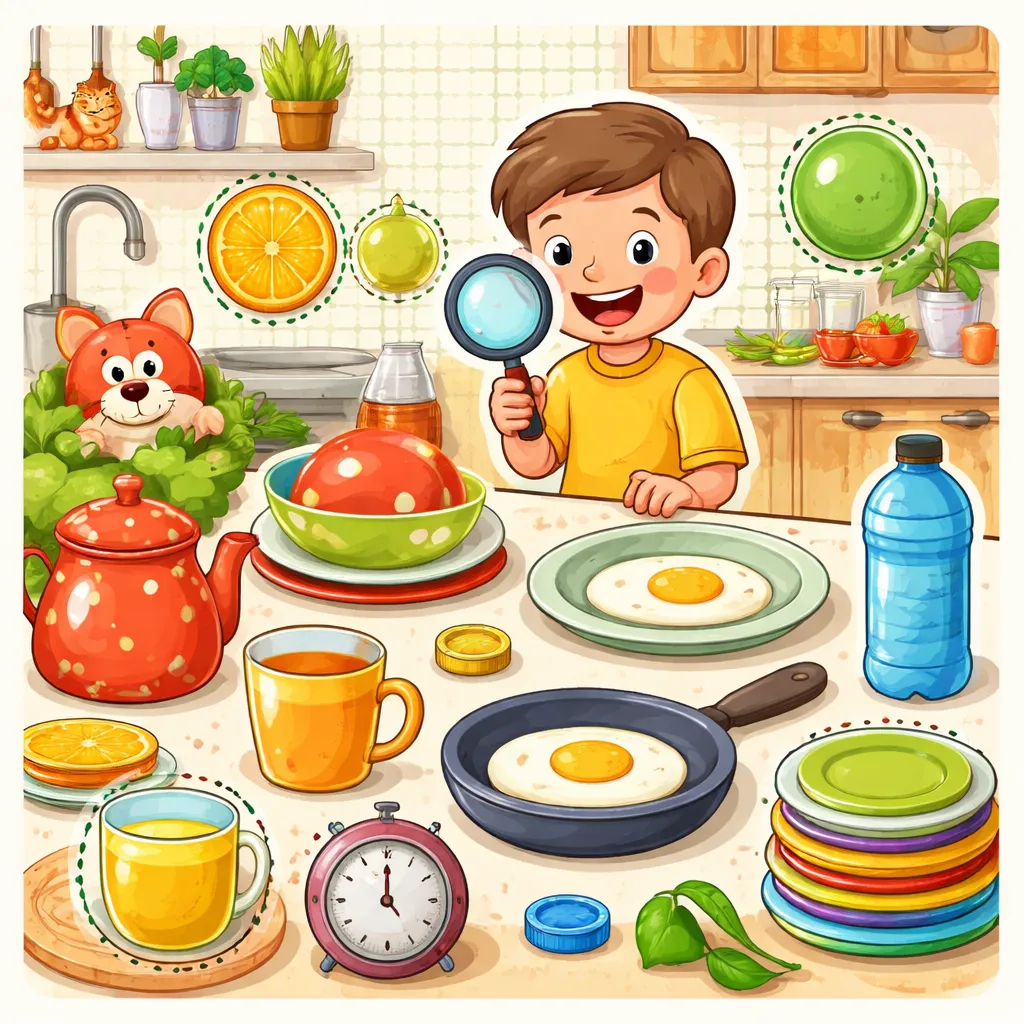
Mia was drawing with her crayons. She drew a house. It had a square window and a triangle roof. Her little brother, Leo, pointed to the real window. "That is a rectangle!" he said. Mia looked. He was right. Their window was a tall rectangle. "Shapes are everywhere," said their mom. "Not just in books. Let's go on a shape hunt. We will look for shapes in real life objects examples. Your toy box, the kitchen, the park - they are full of shapes." Leo and Mia jumped up. A hunt for shapes? This sounded like an adventure. Let's go on a shape hunt together.
Core Knowledge Explanation
What is a shape? A shape is the form of an object. It is what you see when you look at its outline. We learn shape names like circle, square, and triangle. But these shapes are not just on paper. They are hiding in plain sight all around you. Let's look for shapes in real life objects examples.
First, the circle. A circle is round. It has no corners. Look at a clock on the wall. It is a circle. A coin is a circle. The wheels on your car or bicycle are circles. The lid of a jar is a circle. A pizza is a circle. Even your eyeball is a circle. Circles are everywhere. They are great for rolling.
Second, the square. A square has four equal sides and four corners. Look at a sticky note. It is a square. Some windows are squares. A checkerboard has many squares. A building block is often a square. A piece of toast can be a square. Squares are stable and strong.
Third, the triangle. A triangle has three sides and three corners. Look at a slice of pizza. It is a triangle. A road sign is often a triangle. The roof of a house is a triangle shape. A musical instrument called a triangle is a triangle. A sandwich cut in half can make two triangles. Triangles are pointy and strong.
Fourth, the rectangle. A rectangle has four sides and four corners. But its sides are not all equal. Two sides are longer. A door is a rectangle. A book is a rectangle. A smartphone or tablet is a rectangle. A chocolate bar is often a rectangle. Your bed is a rectangle. Rectangles are very common.
Fifth, the oval. An oval is like a stretched circle. It is round but longer. An egg is an oval. A rugby ball is an oval. Some mirrors are oval. A leaf can be oval. A plate can be oval. Ovals are smooth and elegant.
Sixth, the star. A star has five or more points. Look at a star sticker. It is a star shape. A starfish in the sea is shaped like a star. Some cookies are star-shaped. The star in the sky is not a perfect shape, but we draw it as a star. Stars are sparkly and special.
Seventh, the heart. A heart shape is a symbol of love. A heart on a card is a heart shape. Some leaves are heart-shaped. A strawberry is sometimes heart-shaped. A locket can be a heart. Hearts are lovely and warm. These are just a few shapes in real life objects examples. Once you start looking, you will see shapes in everything.
Fun Interactive Learning
Let's play the "I Spy Shapes" game. One person says, "I spy with my little eye, something that is a circle." The others look around the room and guess. "Is it the clock?" "Yes!" Then, it is the next person's turn. This game makes you look carefully at your world. You are finding shapes in real life objects examples in a fun way.
Another activity is the "Shape Scavenger Hunt." Make a list of shapes: circle, square, triangle, rectangle, oval, star, heart. Take the list and walk around your house. Find one object for each shape. Draw a picture of the object or write its name next to the shape. For example, next to "circle", draw a plate. Next to "triangle", draw a slice of pizza. This is a great way to learn.
You can also play "Shape Art." Go outside. Collect things like leaves, sticks, and stones. Use them to make big shapes on the ground. Make a giant circle with stones. Make a triangle with sticks. This uses nature to learn shapes. It is fun and creative. These games turn your home and yard into a shape classroom. You are becoming an expert at finding shapes in real life objects examples.
Expanded Learning
Shapes are the building blocks of our world. Artists use shapes to draw. Architects use shapes to build strong buildings. A triangle is very strong. That is why bridges often have triangle parts. In nature, shapes are very smart. A beehive is made of hexagons. A hexagon has six sides. This shape fits together perfectly with no wasted space. Snowflakes have six points. They are hexagons too.
Long ago, people used shapes to tell stories. They drew circles for the sun and triangles for mountains. In different cultures, shapes have meanings. In China, the circle means unity and the square means the earth. Learning about shapes in real life objects examples connects you to art, science, and history. It shows that shapes are a language everyone can understand.
Let's sing a shape song. We can use the tune of "The Wheels on the Bus."
The circle in the kitchen is round and round, round and round, round and round! The circle in the kitchen is round and round, like a pizza pie! The square in the classroom has four equal sides, four equal sides, four equal sides! The square in the classroom has four equal sides, like a window pane! The triangle on the road is pointy and strong, pointy and strong, pointy and strong! The triangle on the road is pointy and strong, like a warning sign! We see shapes in real life, yes we do!
What You Will Learn
You are learning about geometry and the world. You are learning shape names: circle, square, triangle, rectangle, oval, star, heart, hexagon. You are learning to see these shapes in real life objects examples all around you. You are also learning words like outline, stable, symbol, architecture, and unity.
You are learning descriptive sentences. You can say, "The clock is a circle." You can explain, "A door is a rectangle because it is tall." You can compare, "A coin is a circle, but a book is a rectangle." You are using English to describe objects accurately. This builds strong communication skills.
You are building wonderful abilities. You are building observation skills. You look carefully at objects. You are building vocabulary. You learn precise words for shapes. You are building spatial awareness. You understand how objects fit in space. You are building creativity. You use shapes to make art. You are building confidence. You can name the shapes you see.
You are forming a mindful habit. The habit of noticing details in your environment. You see that the world is made of shapes. Learning to find shapes in real life objects examples makes you more aware, curious, and knowledgeable about everything around you.
Using What You Learned in Life
Use your shape knowledge every day. When you eat breakfast, name the shapes. "My plate is a circle. My toast is a square." When you are in the car, play a shape game. "Find a triangle outside." When you are at the park, look for shapes. "The slide has a triangle ladder. The sandbox is a rectangle." When you draw, start with shapes. A person can be made of circles and rectangles. This makes drawing easier.
At school, you can be the shape helper. If your teacher asks for something round, you can point to the clock. You can also help sort objects by shape. Blocks can be sorted into circles, squares, and triangles. The more you practice finding shapes in real life objects examples, the faster you will see them. Soon, you will see shapes in clouds, in shadows, and in puddles. The whole world will be your shape book.
Closing Encouragement
You are a shape detective. You are a careful observer. You are a creative thinker. I am so proud of you. Learning to see shapes in real life shows you have a sharp eye and a curious mind.
Keep looking for shapes. Keep naming them. Remember, every object is a chance to practice your English and your observation skills. You are learning the secret language of the world.
You are smart, you are attentive, and you are becoming a master of shapes. Great work, my wonderful shape explorer.