
Opening Introduction
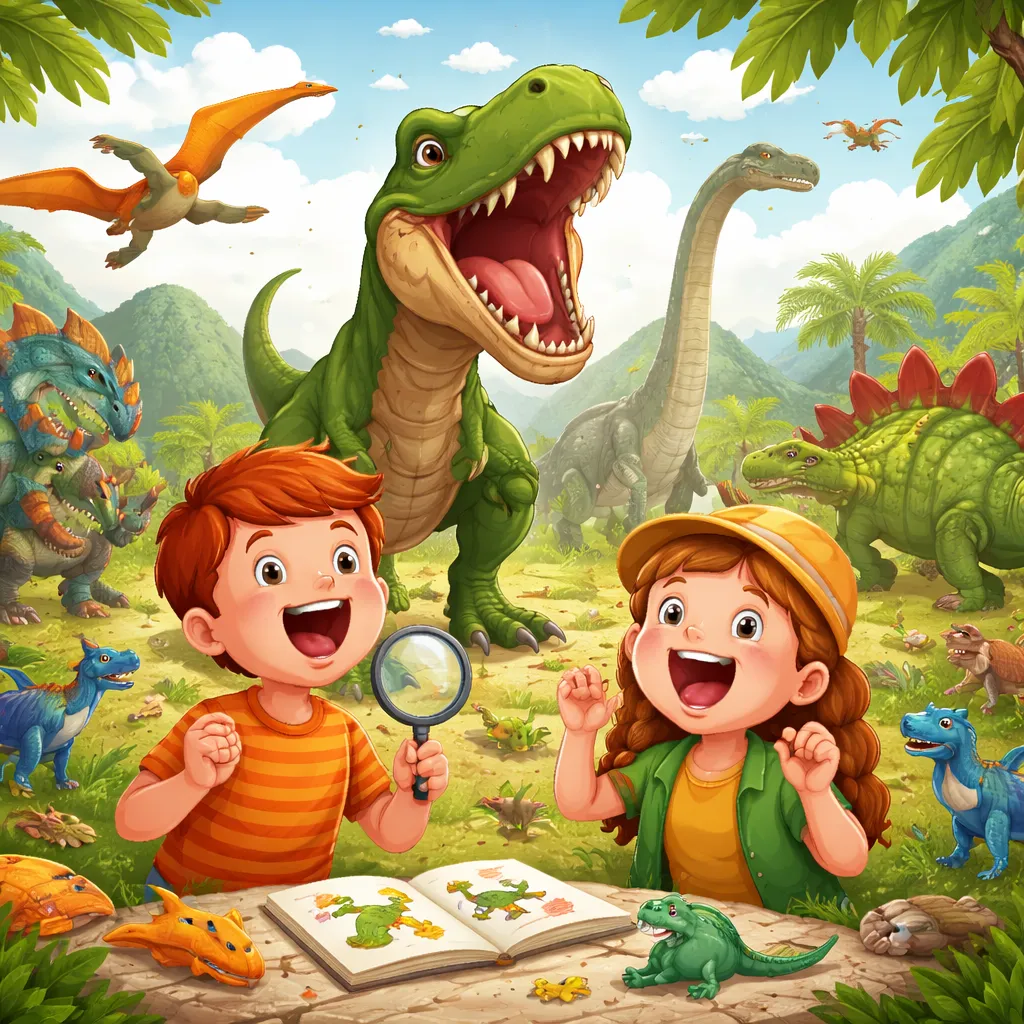
Leo is digging in the sandbox. He finds a big rock. "Look!" he shouts. "I found a dinosaur bone!" His sister Mia runs over. "That's a cool rock, Leo," she says. "But do you know what kind of dinosaur it could be from?" Leo thinks. He knows 'T-Rex'. But he is sure there are more. "There are so many names of dinosaur species in English," Mia says. "Each name is special. It tells us a story about the dinosaur. Let's be paleontologists. Paleontologists are dinosaur scientists. Let's learn their names!" Leo loves this idea. Let's go on a dig and discover these amazing names together.
Core Knowledge Explanation
Long, long ago, amazing animals lived on Earth. We call them dinosaurs. Dinosaurs are not here today. We learn about them from their bones, called fossils. Scientists find these fossils. They give each dinosaur a special name. These are the names of dinosaur species in English. The names often come from Greek or Latin words. They can tell us about the dinosaur's body, its home, or the person who found it. Learning these names is like learning a secret code.
Let's meet some famous dinosaurs. First, the Tyrannosaurus Rex. We call it T-Rex for short. Its name means "tyrant lizard king." It was a big, fierce meat-eater. It had huge teeth and small arms. Next, the Triceratops. Its name means "three-horned face." It had three horns on its head and a big bony frill. It ate plants. Another one is the Stegosaurus. Its name means "roof lizard." It had big, flat plates on its back and spikes on its tail. It was a plant-eater too.
Here is the Velociraptor. Its name means "swift thief." It was small and fast. It was a smart hunter. We have the Brachiosaurus. Its name means "arm lizard." It had very long front legs, like arms. It was a giant, tall plant-eater. It had a long neck to eat leaves from tall trees. Then there is the Pteranodon. Wait, is that a dinosaur? No! It is a flying reptile. But we often learn about it with dinosaurs. Its name means "wing without tooth." It had a big crest on its head.
These are just a few names of dinosaur species in English. There are hundreds more. Some names are long. Some are short. Let's practice saying them. Try: Tri-cer-a-tops. Ste-go-saur-us. Vel-o-ci-rap-tor. Break the name into parts. It makes it easier. When you learn these names, you are not just learning words. You are learning about history, science, and different languages. It is a fun way to grow your English brain.
Fun Interactive Learning
Let's play a dinosaur game. It is called "Dino Dig." You need some paper, scissors, and a tray of sand or rice. First, write the names of dinosaur species in English on small pieces of paper. Write: T-Rex, Triceratops, Stegosaurus, Velociraptor, Brachiosaurus. Bury the papers in the sand. Now, use a spoon or a paintbrush. Be a careful paleontologist. Dig for a "fossil" name. When you find one, pull it out. Can you read the name? Can you say it three times? Can you do an action for that dinosaur? For T-Rex, roar and show tiny arms. For Brachiosaurus, stretch your neck up high. This game mixes reading, speaking, and moving.
Another game is "Dino Match." Draw simple pictures of the dinosaurs. Or print them. On separate cards, write their names. Mix all the cards. Try to match the picture to the correct name. Say the name out loud when you make a match. You can play this with a friend or family member. You can also play "Dino Charades." One person acts out a dinosaur. The others guess the name in English. Is it a spiky dinosaur? Stegosaurus! Is it a dinosaur with three horns? Triceratops! These games make learning the names of dinosaur species in English a roaring good time.
Expanded Learning
Dinosaur names are all over the world. The same dinosaur has the same scientific name in every country. A boy in Japan and a girl in Brazil both call it "Tyrannosaurus Rex." This is because scientists use a special system. This helps them all talk about the same animal. The first part of the name is the genus, like "Tyrannosaurus." The second part is the species, like "Rex." Together, they make the full name.
Many dinosaur names describe the dinosaur. "Stegosaurus" means roof lizard. Scientists thought the plates looked like roof tiles. "Velociraptor" means swift thief. It tells us it was fast and hunted. Some dinosaurs are named after the place they were found. "Albertosaurus" was found in Alberta, Canada. Some are named after people. "Lambeosaurus" was named for a scientist named Lawrence Lambe. Learning the names of dinosaur species in English is a history and geography lesson too.
Did you know birds are dinosaurs? Yes! Scientists now believe birds are the closest relatives to small meat-eating dinosaurs like the Velociraptor. So when you see a sparrow, you are looking at a tiny dinosaur cousin. That is amazing. Let's sing a dinosaur song. We can use the tune of "The Wheels on the Bus."
The T-Rex in the forest goes roar, roar, roar! The Triceratops eats plants, more and more! The Stegosaurus has plates upon its back! The Brachiosaurus has a very long neck! The Velociraptor runs swift as can be! We're learning dino names, just wait and see!
What You Will Learn
You are learning about prehistoric life and scientific words. You are learning new names of dinosaur species in English: Tyrannosaurus Rex, Triceratops, Stegosaurus, Velociraptor, Brachiosaurus, Pteranodon. You are also learning related words: fossil, paleontologist, species, genus, crest, frill.
You are learning descriptive sentences. You can say, "The Triceratops has three horns." You can describe, "The Brachiosaurus is very tall." You can compare, "The T-Rex is big, but the Velociraptor is small and fast." You are using English to talk about science and history. This builds strong thinking and speaking skills.
You are building great abilities. You are building memory skills. You remember long, new words. You are building pronunciation skills. You practice saying tricky names. You are building observation skills. You link names to body features. You are building curiosity about science and the natural world. You are building confidence. You can say big, impressive words.
You are forming a curious habit. The habit of exploring scientific topics in English. You see that English is not just for stories. It is for discovering the world. Learning the names of dinosaur species in English opens a door to a fascinating subject and shows you that you can learn anything in English.
Using What You Learned in Life
Use your new dinosaur knowledge. At the library, find a book about dinosaurs. Read the names of dinosaur species in English in the book. At a museum, look for the dinosaur skeletons. Read their name cards. Say the names. When you are drawing, draw a dinosaur and write its name on your picture. Teach the names to your friends or a younger sibling. You can be the teacher.
When you are playing, use dinosaur names. "I am a hungry T-Rex! Roar!" "I am a gentle Brachiosaurus, eating leaves." This uses your imagination and your new words. You can even write a short story about a dinosaur adventure. Use the names you learned. The more you use the names of dinosaur species in English, the more they will become your friends. You will never forget them.
Closing Encouragement
You are now a dinosaur expert. You are a word collector. You are a brave speaker of big, fantastic words. I am so proud of you. Learning all these dinosaur names shows you have a sharp mind and a love for learning.
Keep exploring the world of dinosaurs. Keep practicing their names. Remember, every time you say "Stegosaurus" or "Velociraptor," you are speaking like a scientist. You are connecting with the ancient world.
You are smart, you are curious, and you have learned something amazing today. Great work, my wonderful paleontologist. Keep digging for knowledge.