
Opening Introduction
Leo was reading a book. It was the story of The Princess and the Pea. He read, "The princess slept on twenty mattresses and twenty eiderdowns." He stopped. "What is an eiderdown?" he asked his sister. Mia looked. "It's a soft, fluffy blanket," she said. "That's a word you often find in fairy tales. Fairy tales have their own special words. If we learn them, the stories become even more magical. Let's make a famous fairy tales vocabulary list. It's a list of wonderful words from the most famous stories." Leo loved this idea. Learning the secret words of stories sounded like a superpower. Let's unlock that power together.
Core Knowledge Explanation
Fairy tales are special stories. They often start with "Once upon a time." They have princes, princesses, talking animals, and magic. To enjoy them fully, it helps to know the special words they use. This famous fairy tales vocabulary list will help you understand and love these stories even more. Let's group the words.
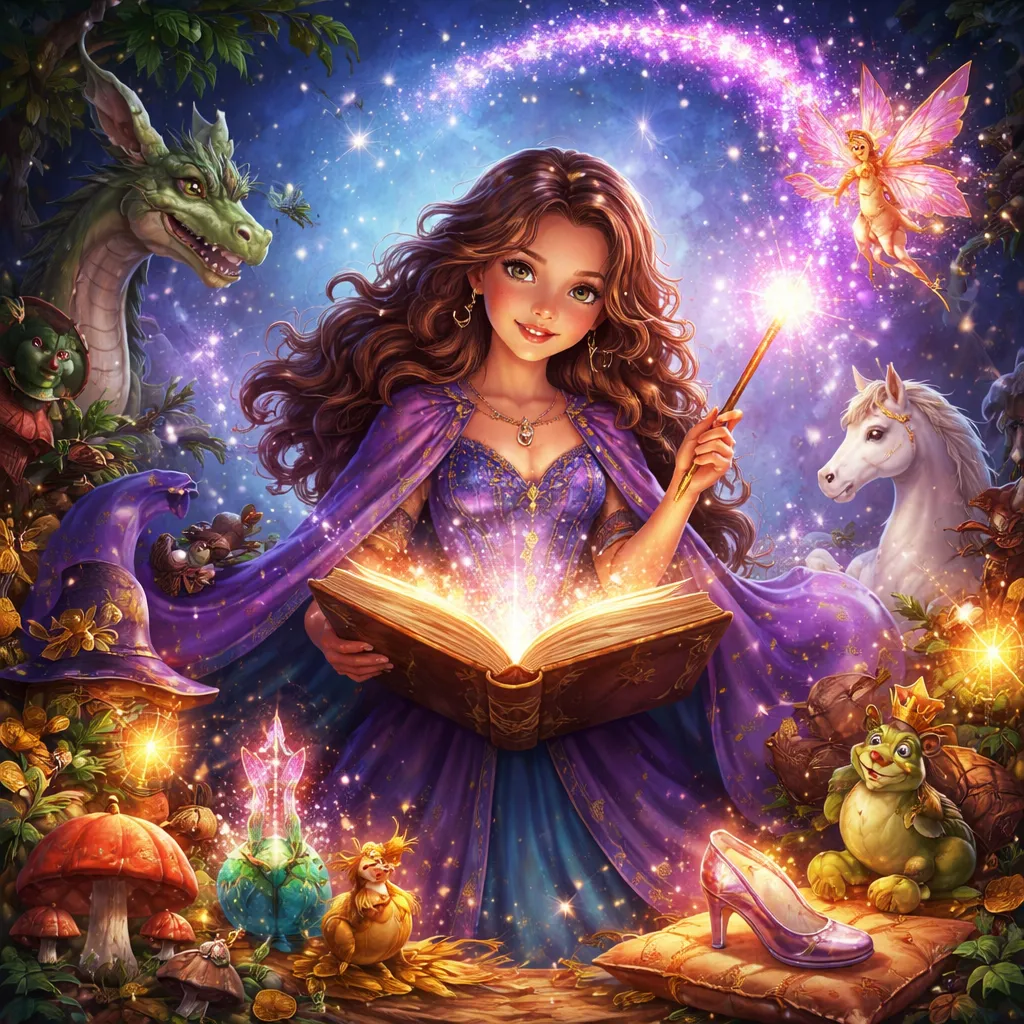
First, words for people and creatures. A princess is the daughter of a king and queen. A prince is the son of a king and queen. A king rules a country. A queen is the wife of a king or a ruler herself. A knight is a brave soldier who serves the king. A peasant is a poor farmer. A fairy is a tiny magical being with wings. A witch is a woman who does magic, often bad magic. A wizard is a man who does magic. A giant is a huge, strong person. A dwarf is a very small person. An ogre is a big, scary monster. A dragon is a big, flying, fire-breathing lizard. These characters fill the stories.
Second, words for magical things. A spell is magic words that make something happen. A curse is a bad spell. A charm is a good spell or a magical object. A potion is a magical drink. A crystal ball is a clear ball that shows the future. A wand is a stick used for magic. A cloak is a long coat, sometimes magical like an invisibility cloak. A crown is what a king or queen wears on their head. A castle is a big, strong building where a king or queen lives. A cottage is a small, simple house in the woods. A forest is a big area with many trees. These are the places and objects of magic.
Third, words for actions and events. To enchant means to put under a magic spell. To vanish means to disappear. To appear means to show up suddenly. To transform means to change shape. To grant a wish means to make a wish come true. To live happily ever after is how many fairy tales end. It means to be happy for the rest of your life. A quest is a journey to find something important. A riddle is a tricky puzzle you must solve. These words describe what happens in the tales.
Knowing this famous fairy tales vocabulary list makes you a story expert. When you read "The princess lived in a castle," you know exactly what that means. When you hear "The witch cast a spell," you understand the action. These words are the building blocks of the fairy tale world.
Fun Interactive Learning
Let's play a game with our vocabulary list. It is called "Fairy Tale Charades." Write words from our famous fairy tales vocabulary list on cards: dragon, witch, castle, spell, vanish, crown. Put them in a bowl. One player picks a card and acts it out without speaking. The others guess. "Are you a dragon? Roar!" This is a fun, active way to remember the words.
Another game is "Vocabulary Scavenger Hunt." Take a fairy tale book, like "Cinderella." Read a page with a parent. How many words from our list can you find? Can you find "prince"? Can you find "castle"? Can you find "transform"? Circle them with a pencil. This turns reading into a word hunt. You can also play "Story Builder." Get some toys or draw pictures. Pick three words from the list. "Dragon, knight, castle." Now, make up a very short story using those three words. "A brave knight lived in a castle. A scary dragon came. The knight fought the dragon." This uses your new vocabulary creatively.
Expanded Learning
Fairy tales are very old. They were told by people long before they were written down. Two famous collectors were the Brothers Grimm from Germany and Hans Christian Andersen from Denmark. They wrote down the stories we know today. The famous fairy tales vocabulary list comes from these old stories. In different countries, the stories are similar but have different details. In Germany, the witch lives in a gingerbread house. In Russia, there is a witch called Baba Yaga who lives in a hut on chicken legs. But many words, like "spell" and "princess," are the same.
Fairy tales often teach us lessons. "Be kind." "Don't talk to strangers." "Hard work is rewarded." The vocabulary helps tell these lessons. The "humble cottage" teaches about simple life. The "evil witch" teaches about danger. The "magic wand" teaches about hope and help. When you learn the words, you also learn the lessons better. Let's make a fairy tale chant. Chants are fun and easy to remember.
Once upon a time, in a land so far, we learned the words for who you are! Princess, prince, and a king with a crown, in a big tall castle, not in a town! A witch with a wand can cast a spell, a dragon in the forest where it doth dwell! A magic word, a wish come true, these are the words for me and you! So open a book and take a look, at this wonderful fairy tale vocabulary book!
What You Will Learn
You are learning about literature and imagination. You are learning a famous fairy tales vocabulary list including words like: princess, prince, king, queen, knight, peasant, fairy, witch, wizard, giant, dwarf, ogre, dragon, spell, curse, charm, potion, crystal ball, wand, cloak, crown, castle, cottage, forest, enchant, vanish, transform, quest, riddle. You are also learning about story structure and classic tales.
You are learning descriptive sentences. You can say, "The beautiful princess lived in an enormous castle." You can narrate, "The wicked witch cast a spell on the prince." You can imagine, "I wish I had a magic wand to transform this stick." You are using English to enter and describe magical worlds. This builds advanced language skills.
You are building wonderful abilities. You are building vocabulary. You learn rich, descriptive words. You are building comprehension. You understand classic stories better. You are building imagination. You picture magical scenes. You are building cultural literacy. You know stories shared across generations. You are building confidence. You can read and discuss complex tales.
You are forming a lifelong reading habit. The habit of enjoying and analyzing stories. You see that special words create special worlds. Learning this famous fairy tales vocabulary list opens the door to centuries of storytelling and enriches your own reading and writing forever.
Using What You Learned in Life
Use your new words when you read. Pick up a fairy tale book. Find the words from your list. Say them out loud. Use them when you play. Pretend you are in a fairy tale. "I am the knight on a quest!" "You are the fairy with a magic wand!" Use them when you write. Write your own short fairy tale. Try to use five words from the list. "Once upon a time, a kind peasant found a tiny cottage in the dark forest..."
At school, share your knowledge. If your class reads a fairy tale, you can explain what a "cottage" or a "spell" is. You can be the vocabulary helper. You can also listen for these words in movies and cartoons. Many films are based on fairy tales. The more you use your famous fairy tales vocabulary list, the more these magical words will become a natural part of your own word kingdom.
Closing Encouragement
You are a word wizard. You are a story explorer. You are a keeper of magical language. I am so proud of you. Learning this fairy tale vocabulary shows you have a curious mind and a love for wonderful stories.
Keep exploring the lands of "Once upon a time." Keep collecting magical words. Remember, every new word is a key to a new part of the story kingdom. You have a whole new set of keys now.
You are imaginative, you are knowledgeable, and you are learning the language of dreams and adventures. Great work, my wonderful story scholar.