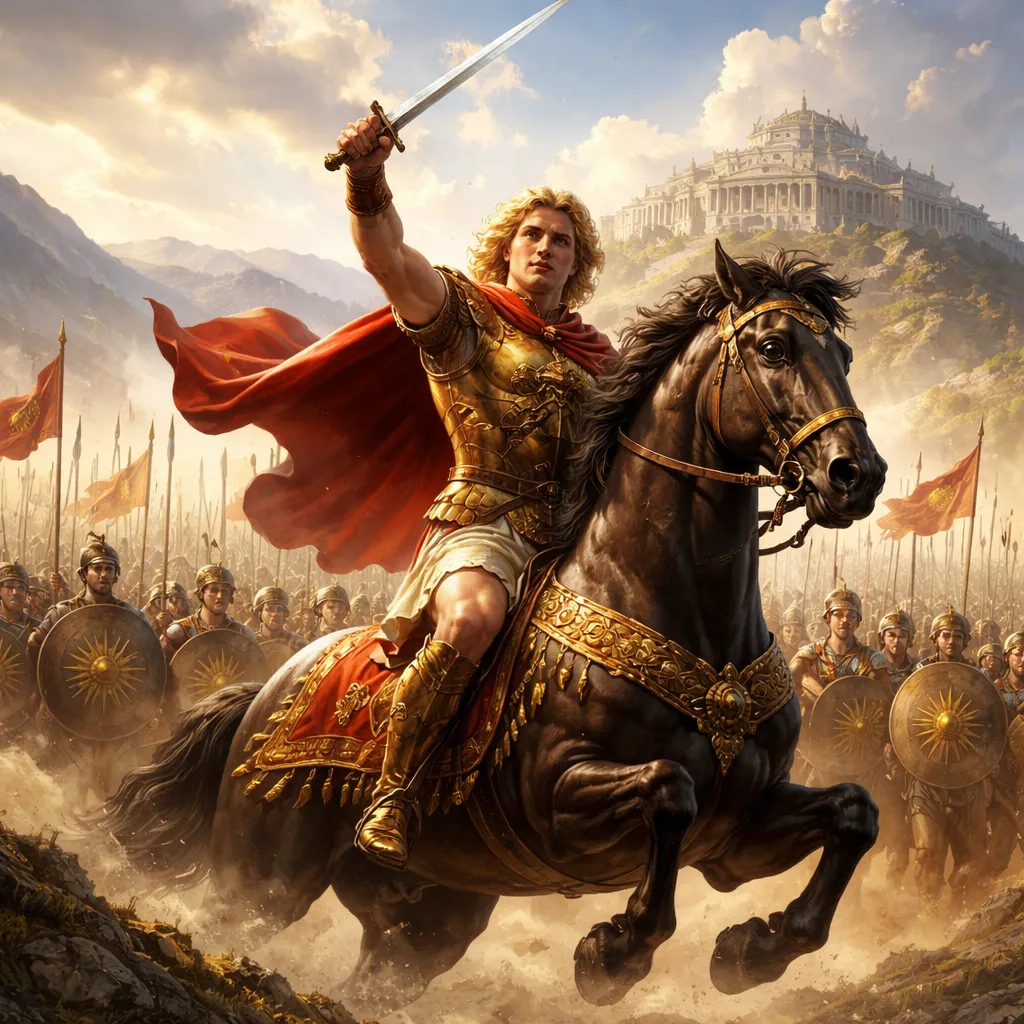

Introduction to Alexander the Great
Alexander the Great, born in 356 BCE in Pella, the ancient capital of Macedonia, was one of the most remarkable military leaders in history. By the time of his death at just 32 years old, Alexander had created one of the largest empires the world had ever seen, stretching from Greece to Egypt, Persia, and even parts of India. His legacy as a conqueror and visionary leader continues to inspire people around the world today.
Why is Alexander the Great worth learning about? His leadership, vision, and ambition changed the course of history. Not only was he a brilliant military strategist, but he also spread Greek culture across three continents, blending East and West. For children and parents alike, understanding Alexander's journey offers valuable lessons on leadership, courage, and perseverance, as well as the impact of vision on the world.
Early Life and Background
Alexander was born to King Philip II of Macedon and Queen Olympias. His family was powerful, and his father had unified most of the Greek city-states under Macedonian control. From an early age, Alexander showed signs of intelligence, determination, and ambition.
By the age of 13, he had already started his education under the guidance of the famous philosopher Aristotle. Aristotle taught Alexander a wide range of subjects, from philosophy and science to literature and politics. These teachings would have a lasting impact on Alexander's worldview and leadership style. His education made him not only a great warrior but also a thoughtful and well-rounded ruler.
When Alexander was just 16 years old, his father Philip left him in charge of Macedonia while he went to fight in Greece. During this time, Alexander led a successful military campaign against rebellious Greek cities, even founding a city that he named Alexandropolis. This early success in leadership and military strategy foreshadowed what would become his incredible military career.
Tragically, Alexander’s father was assassinated in 336 BCE, and Alexander ascended to the throne at the age of 20. However, instead of settling into the role of a conventional monarch, Alexander quickly began to assert his dominance, setting his sights on the vast Persian Empire to the east.
Career Highlights and Achievements
Alexander's military career is legendary for its boldness and success. His first major campaign was to subdue the rebellious Greek city-states. Within a few years, he solidified his control over Greece, and in 334 BCE, he launched his invasion of the Persian Empire. What followed was a series of stunning victories that cemented his place in history.
In 334 BCE, Alexander crossed the Hellespont (now the Dardanelles) into Asia Minor and defeated the Persian forces at the Battle of Granicus. His victory marked the beginning of his conquest of the Persian Empire, which included famous battles such as the Battle of Issus (333 BCE) and the Battle of Gaugamela (331 BCE). At Gaugamela, Alexander faced the Persian King Darius III and decisively defeated him, ensuring the collapse of the Persian Empire.
Alexander continued his campaign eastward, conquering Egypt, where he was hailed as a liberator and crowned Pharaoh. In 331 BCE, he founded the city of Alexandria, which would become one of the most important cultural centers of the ancient world. Alexander’s empire then stretched into Mesopotamia, Persia, and parts of India, marking the height of his power.
Despite his many military successes, Alexander was not just a conqueror; he was also a visionary. He promoted the idea of blending Greek and Eastern cultures, encouraging his soldiers to marry local women and adopting some Persian customs himself. This policy of fusion, known as Hellenization, was intended to create a unified empire, where Eastern and Western cultures could coexist and thrive.
By the time Alexander reached the Indian subcontinent in 326 BCE, he had already achieved legendary status. However, his army, weary from years of campaigning, refused to march further into India, and Alexander was forced to turn back. He died in 323 BCE in the palace of Nebuchadnezzar II in Babylon, at the age of 32, leaving behind a vast empire that would eventually fragment after his death.
Famous Works or Performances
While Alexander the Great did not produce traditional works like artists or writers, his greatest achievements were his military campaigns and the cities he founded. His conquest of the Persian Empire remains one of the most impressive military feats in history, and his influence can still be seen in the regions he conquered.
One of the most famous contributions of Alexander was his founding of over twenty cities, all named Alexandria, in various regions of his empire. The most famous of these cities, Alexandria in Egypt, became a hub of learning and culture, housing the Great Library of Alexandria, which was one of the largest and most significant libraries of the ancient world.
Additionally, Alexander's campaigns led to the spread of Greek culture, art, architecture, and philosophy throughout the vast regions of his empire. The blending of Greek and Eastern cultures created a lasting legacy, influencing art, science, and thought for centuries to come.
Personal Life and Fun Facts
Alexander’s personal life was just as fascinating as his military career. He was known for his deep bond with his horse, Bucephalus, a majestic black steed who accompanied him on many of his campaigns. The horse was so beloved by Alexander that when Bucephalus died after the Battle of the Hydaspes in 326 BCE, Alexander named a city after him in honor of his loyal companion.
Alexander's close relationship with his soldiers was another defining characteristic. He often led from the front, sharing in the hardships of his men and inspiring loyalty and admiration from them. His charisma and leadership were key factors in his ability to conquer and maintain control over such a vast empire.
Despite his intense military focus, Alexander was also known to enjoy entertainment, including music and poetry. He was deeply influenced by the Greek poet Homer, whose epic works, such as the Iliad and Odyssey, Alexander carried with him on his campaigns.
A fun fact about Alexander is his love for ambitious exploration. He is said to have been fascinated by the idea of the "ends of the world" and often sought out new lands and territories to conquer. His quest to push the boundaries of his empire into the East was not just about power but also about understanding the world beyond the known world of Greece.
Legacy and Influence
Alexander the Great’s legacy is immense, not only in terms of his military achievements but also in his cultural impact. His empire, though short-lived, profoundly influenced the course of world history. The spread of Greek culture, known as Hellenism, reached from Greece to Egypt, Persia, and India, shaping the arts, science, and philosophy for centuries.
In the centuries that followed Alexander’s death, his empire fragmented into several Hellenistic kingdoms, but the influence of Greek culture remained strong. Cities like Alexandria became centers of learning and intellectual exchange, fostering developments in mathematics, astronomy, medicine, and philosophy.
Alexander’s vision of a united empire, where East and West could coexist, left a lasting mark on the regions he conquered. Even today, many of the countries that were part of his empire still retain elements of Greek culture, including language, architecture, and governance.
In terms of leadership, Alexander’s ability to inspire and lead his troops through difficult campaigns has made him a model for military leaders throughout history. His strategic brilliance and fearlessness continue to be studied in military academies around the world.
Quotes or Famous Sayings
Alexander the Great is known for several famous quotes that highlight his boldness and vision. Some of his most notable quotes include:
“There is nothing impossible to him who will try.” “I am not afraid of an army of lions led by a sheep; I am afraid of an army of sheep led by a lion.” “Fortune favors the bold.”
These quotes reflect his confidence, courage, and the importance he placed on leadership and perseverance. They continue to inspire those who seek to achieve great things, regardless of the obstacles they may face.
How to Learn from Alexander the Great
Alexander the Great’s life offers several important lessons for children and young readers. One of the most significant lessons is the importance of leadership. Alexander's ability to inspire and lead his army, even through the toughest challenges, shows the power of determination and resilience. He also taught the value of taking risks and pushing beyond what seems possible.
Another lesson from Alexander’s life is the importance of vision. His ambition to conquer and unite vast territories was driven by a vision of a greater, more connected world. This vision not only helped him achieve his goals but also transformed the regions he conquered, leaving a lasting impact on history.
Lastly, Alexander’s story shows the importance of education and lifelong learning. Despite his military successes, Alexander was well-educated and deeply interested in knowledge, from philosophy to science. His broad education made him a better leader, and it allowed him to appreciate different cultures and ideas.
Alexander the Great's journey demonstrates that with the right mix of vision, leadership, and perseverance, great things can be achieved. His life continues to inspire those who dare to dream big and act boldly in the pursuit of their goals.