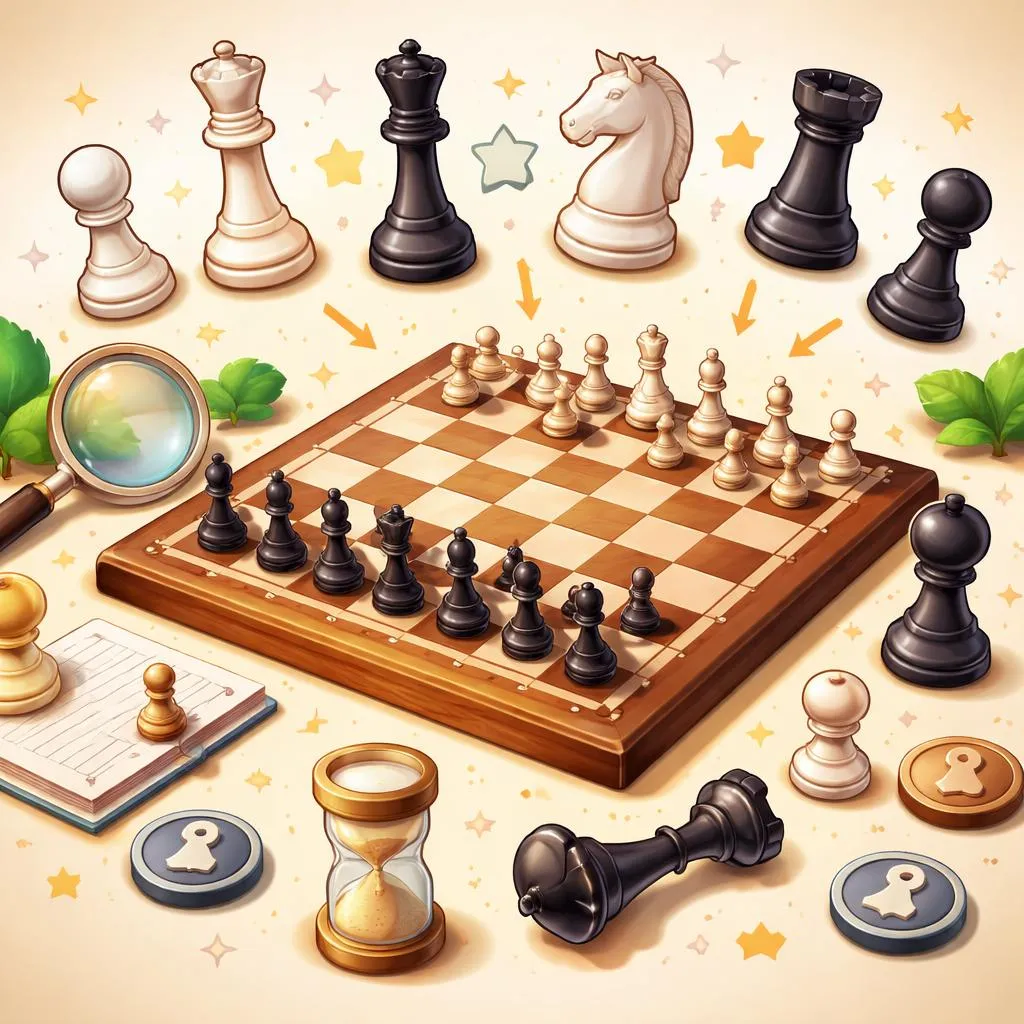

What Is a Chess Board? A chess board is a flat surface used to play the game of chess. It consists of 64 squares arranged in an 8x8 grid. The squares alternate in color, usually between light and dark colors. The chess board is the key part of the game, where all the action happens. It is where the pieces move, capture, and compete. The chess board is divided into ranks (rows) and files (columns). The squares are numbered with numbers 1 to 8 (for the rows) and letters a to h (for the columns). This grid system helps players communicate the movement of pieces clearly and efficiently. Understanding the layout of the chess board and how the pieces move is the first step in learning how to play chess. In this article, we will look at the chess board’s setup, how to use it, and how the chess pieces are placed at the beginning of the game.
The Setup of the Chess Board The chess board is set up with alternating light and dark squares. At the start of the game, the chess board should be positioned so that each player has a light square in the bottom-right corner. Chess Board Layout Here’s how the chess board looks:
The board has 8 rows (called ranks) and 8 columns (called files).
The ranks are numbered 1 to 8, starting from the side closest to the player.
The files are labeled a to h, from left to right, as seen from the player’s side.
The a1 square is always a dark square and is located in the bottom-left corner from the player’s perspective.
Chess Pieces and Their Starting Positions Each player has 16 pieces at the start of the game, and they are placed on the board in specific positions. The pieces are divided into two colors: white and black. Each player controls one color. Here’s how the pieces are placed on the chess board:
- The Rooks The rooks are placed in the corners of the chess board. For white, the rooks go on squares a1 and h1. For black, they go on a8 and h8.
Movement: Rooks move in straight lines along ranks or files. They cannot move diagonally.
- The Knights The knights are placed next to the rooks. For white, the knights go on squares b1 and g1. For black, they go on b8 and g8.
Movement: Knights move in an "L" shape: two squares in one direction and then one square at a right angle. They are the only pieces that can "jump" over other pieces.
- The Bishops The bishops are placed next to the knights. For white, the bishops go on squares c1 and f1. For black, they go on c8 and f8.
Movement: Bishops move diagonally on the board, any number of squares, but only along squares of the same color.
- The Queen The queen is placed on the d1 square for white and d8 square for black.
Movement: The queen can move any number of squares in any direction: vertically, horizontally, or diagonally.
- The King The king is placed on the e1 square for white and e8 square for black.
Movement: The king can move one square in any direction: vertically, horizontally, or diagonally. The king is the most important piece in chess; if it is attacked (check) and cannot escape, the game is over (checkmate).
- The Pawns The pawns are placed in a row in front of the other pieces. For white, they go on squares a2 through h2. For black, they go on squares a7 through h7.
Movement: Pawns move forward one square, but on their first move, they can move forward two squares. They capture pieces diagonally.
How to Read the Chess Board To communicate moves in chess, we use a system of coordinates based on the chess board's grid. The columns (files) are labeled a through h, and the rows (ranks) are numbered 1 through 8. For example:
e2 to e4 means moving the pawn from square e2 to square e4.
Ng1 to f3 means moving the knight from g1 to f3.
Using this system makes it easy to describe moves and understand the game.
How the Chess Pieces Move Each piece on the chess board has a specific way it can move. Understanding how each piece moves is essential to playing the game effectively.
- The Rook The rook can move any number of squares horizontally or vertically. It cannot move diagonally.
It is one of the most powerful pieces in chess because it can control many squares along the ranks and files.
- The Knight The knight has a unique movement. It moves in an "L" shape: two squares in one direction and then one square at a right angle. It can jump over other pieces, which makes it special compared to other pieces.
The knight is the only piece that can move over other pieces on the board.
- The Bishop The bishop moves diagonally any number of squares. The bishop stays on the same color throughout the game, meaning if it starts on a light square, it will always stay on light squares.
Bishops are strong pieces for controlling the board’s long diagonal paths.
- The Queen The queen is the most powerful piece on the board. It can move in any direction: horizontally, vertically, or diagonally. The queen can control many squares and is a key piece for attacking and defending.
The queen combines the power of both the rook and bishop, making it incredibly versatile.
- The King The king is the most important piece in chess. It can move only one square at a time in any direction: horizontally, vertically, or diagonally.
The objective of the game is to checkmate the opponent’s king, which means putting it in a position where it cannot escape being captured.
- The Pawn The pawn is the most basic piece in chess. It moves forward one square at a time, but on its first move, it can move two squares. Pawns capture pieces diagonally, one square forward to the left or right.
When a pawn reaches the opposite side of the board, it can be promoted to any piece (except the king), usually a queen.
Special Chess Moves There are some special moves in chess that players should know:
- Castling Castling is a special move involving the king and one of the rooks. The king moves two squares toward the rook, and the rook moves to the other side of the king. Castling is a defensive move that helps protect the king and bring the rook into play.
Castling can only be done if neither the king nor the rook has moved previously, if the squares between them are empty, and if the king is not in check.
- En Passant En passant is a special pawn capture that can happen when a pawn moves two squares forward from its starting position and lands next to an opponent’s pawn. The opponent can capture the pawn as if it had only moved one square forward.
This move must be made immediately after the two-square move; otherwise, the right to capture is lost.
- Pawn Promotion When a pawn reaches the opposite side of the board, it can be promoted to any other piece (except the king). Most players choose to promote a pawn to a queen, as it is the most powerful piece.
Chess Board Strategy and Tips Understanding the chess board and the movement of the pieces is just the beginning. Here are a few strategies to improve your game:
Control the center: Try to place your pieces in the center of the board. This gives them more mobility and allows for easier attacks and defenses.
Develop your pieces: Move your pieces (especially knights and bishops) out from their starting positions early in the game to control more squares.
Protect your king: Always make sure your king is safe, especially by castling early. Keeping your king safe is a priority.
Think ahead: Try to think one or two moves ahead. Plan your attacks and anticipate your opponent’s moves.
Fun Activities to Practice Using the Chess Board Here are a few activities to help you practice understanding and using the chess board:
- Chess Board Setup Challenge Set up the chess board and practice placing each piece in the correct starting position. Do this several times to memorize where each piece goes.
- Practice Movement Pick one piece, and practice moving it around the chess board according to its rules. Try to move it to different squares and see how far it can go.
- Play Chess with Friends Find a friend or family member to play chess with. As you play, focus on understanding the chess board setup and practice using the pieces correctly.