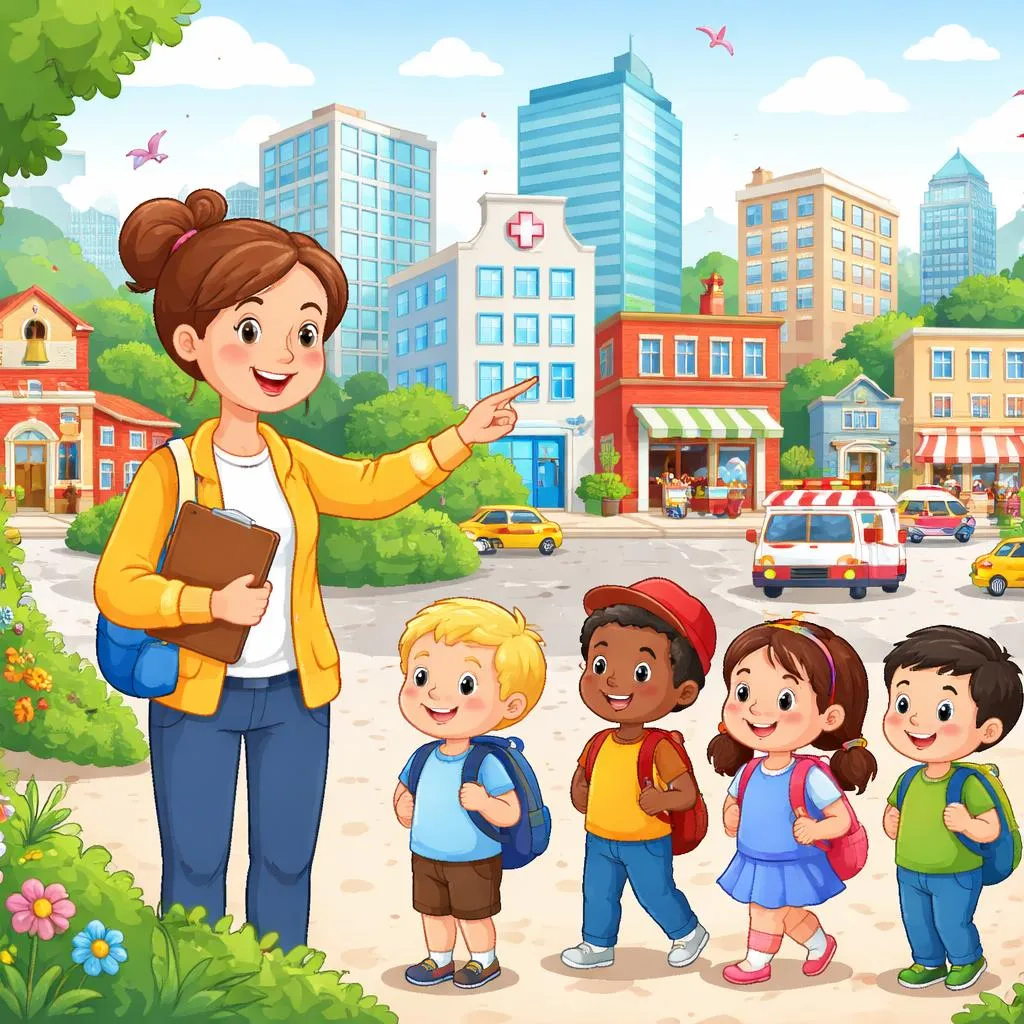

What Are City Buildings?
The topic of city buildings introduces places that appear in towns and big cities. Buildings shape daily life. They provide spaces for learning, living, working, and playing.
Learning these words builds strong vocabulary skills. This topic also supports geography and social studies. It connects language with the real world.
Meaning and Explanation of City Buildings
City buildings are structures built by people in urban areas. They can be tall or short. They can be old or modern.
Some buildings have one purpose. Some buildings have many purposes. Each building tells a story about the city.
Common city buildings include schools, hospitals, libraries, and skyscrapers. Each word describes a place and its function. Understanding these words helps describe cities in English.
Categories of City Buildings
City buildings fall into several groups. Public buildings serve the community. Private buildings serve homes and businesses.
Public buildings include city halls, museums, and police stations. These buildings help keep cities organized and safe.
Commercial buildings include shops, offices, and malls. These buildings support trade and services.
Residential buildings include apartments and houses. These buildings provide living spaces.
Cultural buildings include theaters and galleries. These buildings support art and culture.
Each category helps describe how a city works.
Key Vocabulary for City Buildings
Vocabulary instruction works best with clear examples. Important words include:
Skyscraper Office building Apartment building School Hospital Library Museum City hall Police station Fire station Mall Hotel Restaurant
Each word can appear in simple sentences. For example: The library is quiet. The hospital is big.
Short sentences help early learners understand meaning.
Pronunciation and Phonics Focus
City building words include many useful sounds. Skyscraper starts with the /sk/ sound. School starts with the /sk/ sound. Hospital starts with the /h/ sound. Library starts with the /l/ sound.
Some words have silent letters. In “library,” the middle sounds can feel tricky. Slow practice helps improve clarity.
Clapping syllables supports phonics learning. For example: ho-spi-tal li-bra-ry mu-se-um
Syllable practice builds reading confidence.
Grammar Patterns with City Buildings
City buildings appear often with the phrase “There is” or “There are.” For example: There is a school. There are many offices.
Prepositions also help describe location. Examples include: The bank is next to the mall. The park is behind the museum.
Adjectives add detail. A tall skyscraper. A small café.
These grammar patterns support descriptive language.
Daily Life Examples with City Buildings
Real-life examples make vocabulary meaningful. Cities include busy streets with tall buildings. Neighborhoods include shops and apartments. Town centers include libraries and city halls.
Daily routines often involve city buildings. A morning walk may pass a bakery. A school day happens in a classroom building. A weekend trip may include a museum or theater.
Discussing these routines helps connect language with experience.
Printable Flashcards for City Buildings
Flashcards support visual learners. Each card can show a building and its name. For example, a picture of a hospital with the word “hospital.”
Sentence examples can appear on the back of the card. “The hospital helps sick people.” “The school has many classrooms.”
Flashcards can be used for matching, reading, and speaking practice.
Learning Activities for City Buildings
Learning activities increase engagement. Drawing activities work well. A simple city map can be created with paper and crayons. Each building can be labeled in English.
Role-play activities also help. A pretend city can be built with blocks. Conversations can describe where places are.
Storytelling activities add creativity. A short story about a day in the city can be created. This approach integrates vocabulary with narrative skills.
Educational Games for City Buildings
Games provide repetition in a fun way. A matching game can pair building pictures with words. A guessing game can describe a building and ask for the name.
Board games can include city locations as spaces. Each space can prompt a sentence. For example: “You are at the museum. Say one fact about a museum.”
Digital games and apps also support practice. Interactive maps and quizzes provide instant feedback.
Teaching Strategies for Parents and Teachers
Consistent exposure supports retention. Use building names during walks or travel. Point to buildings and name them in English.
Books about cities support reading practice. Picture books provide context and visual cues. Videos about city tours provide listening practice.
Encourage speaking with simple prompts. “What is this building?” “Where is the school?”
Short daily practice builds strong vocabulary.
Integrating City Buildings into Reading and Writing
Reading tasks can include short descriptions of cities. Writing tasks can include simple sentences or short paragraphs.
Sentence frames help beginners: “There is a ____ in the city.” “The ____ is near the park.”
These frames support early writing development. They also reinforce grammar structures.
Connecting City Buildings with Geography and Social Studies
City buildings connect language with geography. Maps show where buildings are located. Landmarks teach about history and culture.
Learning about famous city buildings builds global awareness. Examples include famous towers, bridges, and palaces. These examples inspire curiosity and discussion.
Social studies lessons can discuss how cities function. Police stations, hospitals, and city halls show public services. This knowledge builds civic understanding.
Cultural Notes About City Buildings
Different countries have unique building styles. Some cities have ancient temples and castles. Some cities have modern glass skyscrapers.
Cultural differences appear in building design. Colors, shapes, and materials vary by region. Discussing these differences encourages global perspective.
Festivals and events often take place in city buildings. Theaters host shows. Stadiums host sports events. Community centers host celebrations.
Using Technology to Explore City Buildings
Virtual city tours offer rich visual content. Interactive maps show building names and locations. Educational apps include city vocabulary games.
Videos and animations support listening and comprehension. Digital flashcards and quizzes provide practice at home and school.
Technology also supports project-based learning. A digital city map project can combine language and creativity.
Assessment and Progress Monitoring
Assessment can be simple and informal. Picture identification checks vocabulary recognition. Oral questions check speaking skills.
Ordering tasks check understanding of city layouts. Writing tasks check sentence structure and spelling.
Progress monitoring helps adjust teaching strategies. It also shows growth in vocabulary and confidence.
Encouraging Curiosity About City Buildings
Curiosity drives learning. Encourage noticing buildings during travel or daily walks. Discuss what each building does.
Ask open-ended questions about cities. “What happens in this building?” “Who works here?”
These questions promote thinking and language use.
Extending Learning Beyond the Classroom
Family activities can include city exploration. A simple city scavenger hunt can identify building types. Photo projects can document city buildings and label them in English.
School projects can include building models or posters. Art and language integration increases engagement.
Books, documentaries, and online tours extend learning at home.
Cross-Curricular Connections with City Buildings
City buildings connect with math through counting floors and windows. They connect with science through materials and structures. They connect with art through design and architecture.
Integrating subjects deepens understanding. It also makes language learning more meaningful.
Developing Speaking Confidence with City Buildings
Speaking confidence grows with practice. Use clear models and repetition. Encourage short responses and gradual expansion.
Positive feedback supports motivation. A supportive environment encourages participation and risk-taking.
City vocabulary provides many opportunities for real conversation. Describing neighborhoods, trips, and landmarks builds communication skills.
City buildings represent a rich and practical topic in English learning. They connect vocabulary, grammar, culture, and daily life. Clear instruction, engaging activities, and consistent practice build strong understanding and lasting language skills.