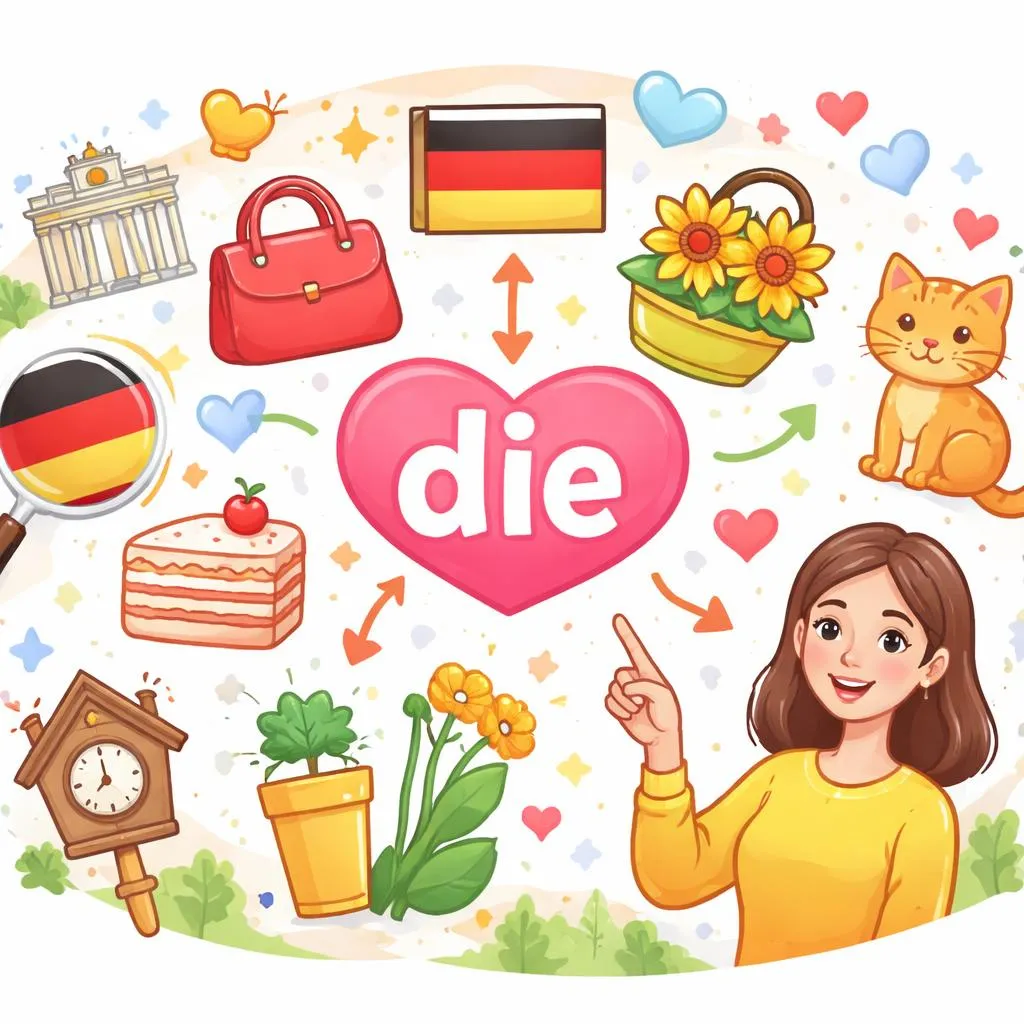

What is “Die” in German? “Die” is one of the definite articles in the German language. It is used with feminine nouns and plural nouns. For example, “die Frau” means “the woman,” and “die Katzen” means “the cats.”
“Die” means “the” for feminine and plural nouns.
Using “Die” with Feminine Nouns In German, “die” is used with feminine nouns. For example, “die Blume” means “the flower,” and “die Stadt” means “the city.” Feminine nouns in German always use “die” as the article.
“Die” is used with feminine nouns in German.
Using “Die” with Plural Nouns “Die” is also used with plural nouns, regardless of the noun’s gender. For example, “die Bücher” means “the books,” and “die Hunde” means “the dogs.” In plural, “die” is used for all genders: masculine, feminine, and neuter.
“Die” is used for all plural nouns.
Why “Die” is Important in German “Die” helps us understand if the noun is feminine or plural. It is an essential word to learn in German because it is used often. Knowing how to use “die” correctly is important for speaking and understanding German.
“Die” is an important article in German.
The Gender of Nouns in German In German, every noun has a gender: masculine, feminine, or neuter. “Die” is used with feminine nouns, like “die Lampe” (the lamp). It is also used with plural nouns, like “die Tische” (the tables).
German nouns have different genders.
Using “Die” in Sentences Here are some examples of how to use “die” in sentences: “Die Katze schläft” means “The cat is sleeping.” “Die Kinder spielen” means “The children are playing.”
“Die” is used in simple German sentences.
The Role of “Die” in German Grammar In German grammar, “die” is used to indicate the definite article for feminine and plural nouns. It is important to match “die” with the correct noun gender or plurality. Without the correct article, sentences may be unclear.
“Die” is key to German sentence structure.
Differences Between “Die” and Other Articles In German, there are other articles like “der” for masculine nouns and “das” for neuter nouns. For example, “der Hund” means “the dog” (masculine) and “das Auto” means “the car” (neuter). “Die” is only used with feminine and plural nouns.
“Die” is different from “der” and “das.”
How “Die” Helps with Pronouns “Die” can also be used with pronouns. For example, “Ich sehe die” means “I see them” (feminine or plural). It connects to the noun that is being replaced by the pronoun.
“Die” helps connect nouns with pronouns.
Using “Die” for Specific Things In German, “die” is used to refer to specific things. For example, “Die Bücher sind alt” means “The books are old.” “Die” makes it clear that we are talking about specific books, not any books in general.
“Die” is used for specific items or people.
When Not to Use “Die” “Die” is not used for masculine or neuter singular nouns. For example, “der Tisch” means “the table” (masculine) and “das Kind” means “the child” (neuter). In these cases, you use “der” for masculine and “das” for neuter nouns.
“Die” is only for feminine and plural nouns.
“Die” and Sentence Structure In German sentence structure, the article “die” comes before the noun. For example, “Die Lampe ist schön” means “The lamp is beautiful.” It follows the usual word order in German sentences.
“Die” follows the noun in German sentences.
Learning “Die” with Vocabulary It’s important to learn “die” with the noun to understand its gender. For example, always learn nouns like “die Blume” (the flower) and “die Schule” (the school) as part of your vocabulary. This helps you remember which article to use.
Learning articles with nouns is key in German.
Common Mistakes with “Die” A common mistake is using “die” with masculine nouns. For example, “der Hund” (the dog) is masculine, so “die Hund” is incorrect. Always remember to use “der” for masculine nouns and “die” only for feminine or plural nouns.
Avoid mixing up articles in German.
“Die” in Questions You can also use “die” in questions. For example, “Wo ist die Katze?” means “Where is the cat?” It helps ask about specific things or people.
“Die” is used in questions for specific nouns.
The Plural Form of “Die” In German, “die” is the same for all plural nouns, no matter the gender. For example, “die Autos” means “the cars” and “die Mädchen” means “the girls.” It shows that “die” is used for all plurals.
“Die” is used for all plural nouns.
: Mastering “Die” in German “Die” is an essential word to learn in German. It helps you talk about feminine nouns and plural nouns clearly. By mastering “die,” you will improve your German grammar and speaking skills.
Mastering “die” helps with understanding German.
Using “Die” for Specific Nouns In German, “die” helps specify which noun you are talking about. For example, “Die Uhr ist neu” means “The clock is new.” It makes it clear that you are talking about this particular clock.
“Die” specifies the noun you are referring to.
The Importance of Articles in German Articles like “die,” “der,” and “das” are important in German because they show the gender of a noun. In this case, “die” is used for feminine and plural nouns. Learning the right article is crucial to speaking and writing correctly in German.
Articles help you understand nouns in German.
Learning Nouns with “Die” When learning German nouns, it’s important to learn the correct article along with the noun. For example, “die Lampe” (the lamp) is feminine, and “die Katze” (the cat) is also feminine. Always pair the noun with its article to remember it correctly.
Learning nouns with their articles is helpful.
Using “Die” in Descriptions You can use “die” in sentences that describe something. For example, “Die alte Kirche ist wunderschön” means “The old church is beautiful.” Here, “die” shows that we are talking about a specific church.
“Die” is used to describe specific objects.
Plural Forms with “Die” In German, “die” is used for all plural nouns, no matter the gender. For example, “die Tische” means “the tables,” and “die Kinder” means “the children.” This rule makes it easier to use “die” for plurals.
“Die” works for all plural nouns in German.
Using “Die” for Groups of People “Die” is used when talking about groups of people. For example, “Die Schüler lernen” means “The students are learning.” “Die” is used to talk about more than one person.
“Die” can be used for groups of people.
“Die” in Formal Speech In formal speech, “die” is used to talk about people or things respectfully. For example, “Die Herrschaften” can be used to refer to a group of people in a respectful way. In formal situations, using “die” shows politeness.
“Die” can be formal in some contexts.
Distinguishing Between “Die” and “Der” It’s important to know when to use “die” and when to use “der.” “Der” is used with masculine singular nouns, while “die” is used with feminine and plural nouns. For example, “der Hund” (the dog) is masculine, while “die Katze” (the cat) is feminine.
“Die” is for feminine and plural nouns, while “der” is for masculine nouns.
Examples of “Die” with Adjectives When using “die” with adjectives, the adjective must agree in gender, case, and number. For example, “die große Katze” means “the big cat.” Here, “die” is paired with the adjective “große” to describe the feminine noun “Katze.”
Adjectives agree with “die” in gender and number.
Common Phrases with “Die” Here are some common phrases using “die”: “Die Sonne scheint” means “The sun is shining.” “Die Kinder spielen draußen” means “The children are playing outside.”
“Die” is part of common German phrases.
The Use of “Die” in Questions “Die” can also be used in questions. For example, “Wo ist die Lampe?” means “Where is the lamp?” Here, “die” refers to the specific lamp.
“Die” is used in questions about specific things.
“Die” in Imperative Sentences In German, “die” can be used in imperative sentences to give orders or requests. For example, “Die Tür öffnen!” means “Open the door!” It helps us express commands in a clear way.
“Die” is used in imperative sentences to make requests.
Practice with “Die” To get better at using “die,” practice with different nouns. For example, “die Blume” (the flower), “die Wand” (the wall), and “die Straße” (the street). Practice helps you remember which nouns need “die.”
Practice makes it easier to remember articles.
Using “Die” for Specific Events You can also use “die” when talking about specific events. For example, “Die Party war toll” means “The party was great.” “Die” helps refer to specific events or experiences.
“Die” is used to talk about specific occasions.
The Role of “Die” in Time Expressions In time expressions, “die” can be used to talk about particular times. For example, “Die Woche ist lang” means “The week is long.” “Die” helps us refer to specific periods of time.
“Die” can refer to time expressions.
Learning Articles in Context When learning “die,” it’s important to practice using it in context. For example, say “Ich sehe die Katze” (I see the cat) or “Die Blumen sind schön” (The flowers are beautiful). By using “die” in real sentences, you’ll get better at using it correctly.
Using “die” in sentences helps you learn it faster.
The Importance of Articles in German Grammar Articles like “die” are a key part of German grammar. They help us understand the gender and number of nouns. By learning how to use “die,” you can speak and write in German more clearly.
Articles are important for learning German grammar.
: Mastering “Die” “Die” is a basic but important part of German grammar. It is used with feminine and plural nouns to make sentences clearer. By mastering “die,” you will improve your German language skills and sound more natural.
Mastering “die” is essential for speaking German.