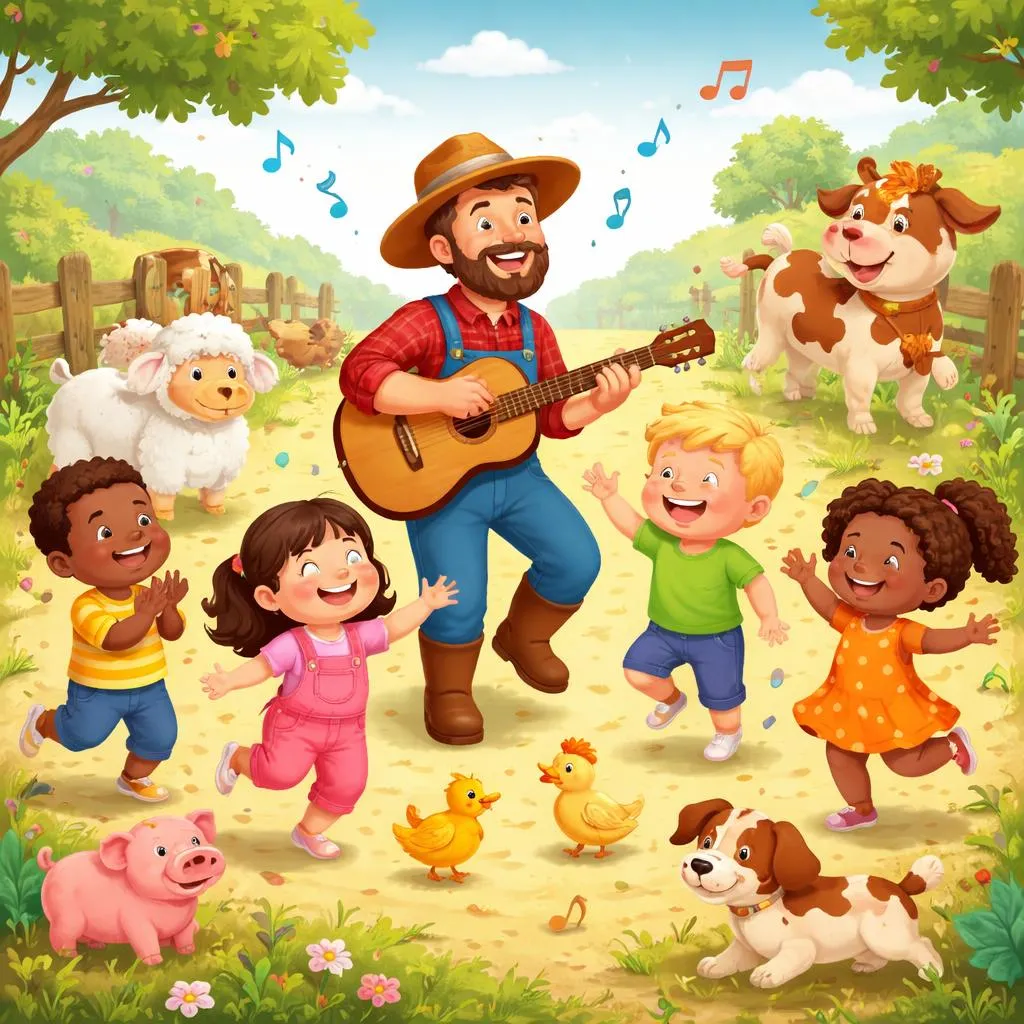

What is the “Farmer Had a Farm” song? “Farmer Had a Farm” is a classic nursery rhyme loved by children around the world. The song introduces farm animals, actions, and sounds through repetition and rhythm. It tells the story of a farmer who owns a farm with many animals. Children enjoy imitating animal sounds and acting out movements. The interactive nature makes it an ideal tool for language learning. Songs like this combine music, movement, and vocabulary practice.
The song uses a simple, predictable structure that is easy to follow. Repetition helps children remember words and phrases. Singing encourages pronunciation practice and listening skills. Movement activities increase coordination while supporting memory. The song provides opportunities for group participation and teamwork. It engages multiple senses, which strengthens learning outcomes.
Lyrics of the Song The main lyrics go: “Farmer had a farm, E-I-E-I-O And on that farm he had a cow, E-I-E-I-O With a moo-moo here and a moo-moo there Here a moo, there a moo, everywhere a moo-moo Farmer had a farm, E-I-E-I-O”
Other verses replace the cow with animals like a pig, sheep, or duck. Each animal verse includes its unique sound and motion. Children enjoy repeating the sounds and acting them out. The song’s structure introduces sequencing and pattern recognition. It also builds anticipation as children predict the next animal. This repetition enhances memory and strengthens language skills.
Vocabulary Learning The song introduces farm-related vocabulary. Words like “farmer,” “farm,” “cow,” “pig,” “sheep,” and “duck” are repeated. Each verse highlights animal names and sounds. Children associate words with actions and images. Visual aids, such as pictures or toy animals, reinforce understanding.
Singing and moving with the words makes vocabulary memorable. Children learn plural forms and simple nouns naturally. The song connects words to real-life concepts, like farms and animals. Vocabulary learning happens through repetition and playful interaction. Children internalize words quickly when combined with rhythm and movement. The song provides a fun and meaningful context for English words.
Phonics Points The song supports phonics by emphasizing initial sounds of words. Animal sounds like “moo,” “oink,” or “baa” reinforce phonemic awareness. Children notice letter-sound correspondence naturally through singing. Repetition of phrases strengthens listening and auditory discrimination. The song also introduces short vowel sounds in simple words like “cow” or “pig.”
Phonics skills are reinforced as children sing, clap, and move. They develop awareness of sounds, letters, and word patterns. The musical context helps children remember letter sounds. Phonics learning becomes engaging and interactive. Children learn to recognize sounds while enjoying play and music. Music-based phonics learning supports early reading skills in young learners.
Grammar Patterns The song demonstrates basic sentence structures. Lines like “And on that farm he had a cow” show subject-verb-object patterns. The repeated structure introduces simple past tense through “had.” Children hear grammar patterns in context without explicit explanation.
Repetition reinforces sentence structure naturally. Children understand word order while singing along. The song also uses possessive forms, such as “on that farm he had.” Grammar skills develop as children imitate phrases. Singing helps internalize language structures through rhythm and repetition. Children practice forming complete sentences in a playful way.
Daily Life Examples The song relates to daily life and children’s experiences. Visiting a farm or seeing animals in books connects to the song’s content. Children can act out feeding animals or walking around the farm. Clapping, stomping, or moving like animals develops motor skills. Role-play activities improve social interaction and collaboration.
Children explore cause and effect through animal sounds. They learn sequencing as each verse introduces a new animal. Movement and actions support memory and comprehension. Practical experiences make vocabulary and grammar meaningful. The song combines imagination, language, and physical activity. Children learn English while having fun and staying active.
Printable Flashcards Flashcards can feature farm animals, their names, and sounds. Children match words to images while singing the song. Visual aids reinforce vocabulary and phonics understanding.
Cards with farm scenes or animals support comprehension. Games with flashcards strengthen memory and word recognition. Teachers and parents can adapt cards for different learning levels. Combining visuals, music, and movement enhances retention. Flashcards encourage practice beyond singing. Children learn to associate words, sounds, and actions effectively.
Learning Activities and Games “Animal Sound Imitation” has children make sounds for each animal in the song. “Animal Parade” lets children move like the animals while singing. “Letter Match” uses flashcards to match animal names and sounds.
Games reinforce vocabulary, phonics, rhythm, and sentence patterns. Group activities develop listening, coordination, and social skills. Repeated singing and movement improve memory and fluency. Active participation engages multiple senses for holistic learning. Music-based learning strengthens cognitive, motor, and social skills. Children enjoy learning English while playing, singing, and moving together.
Singing “Farmer Had a Farm” combines music, movement, and language learning. Children develop vocabulary, phonics, grammar, and memory skills. The song encourages imagination, participation, and creativity. Music and play create an engaging, joyful, and educational environment. Repetition, melody, and action make language learning natural and fun. Songs like this help children enjoy English while building foundational skills.