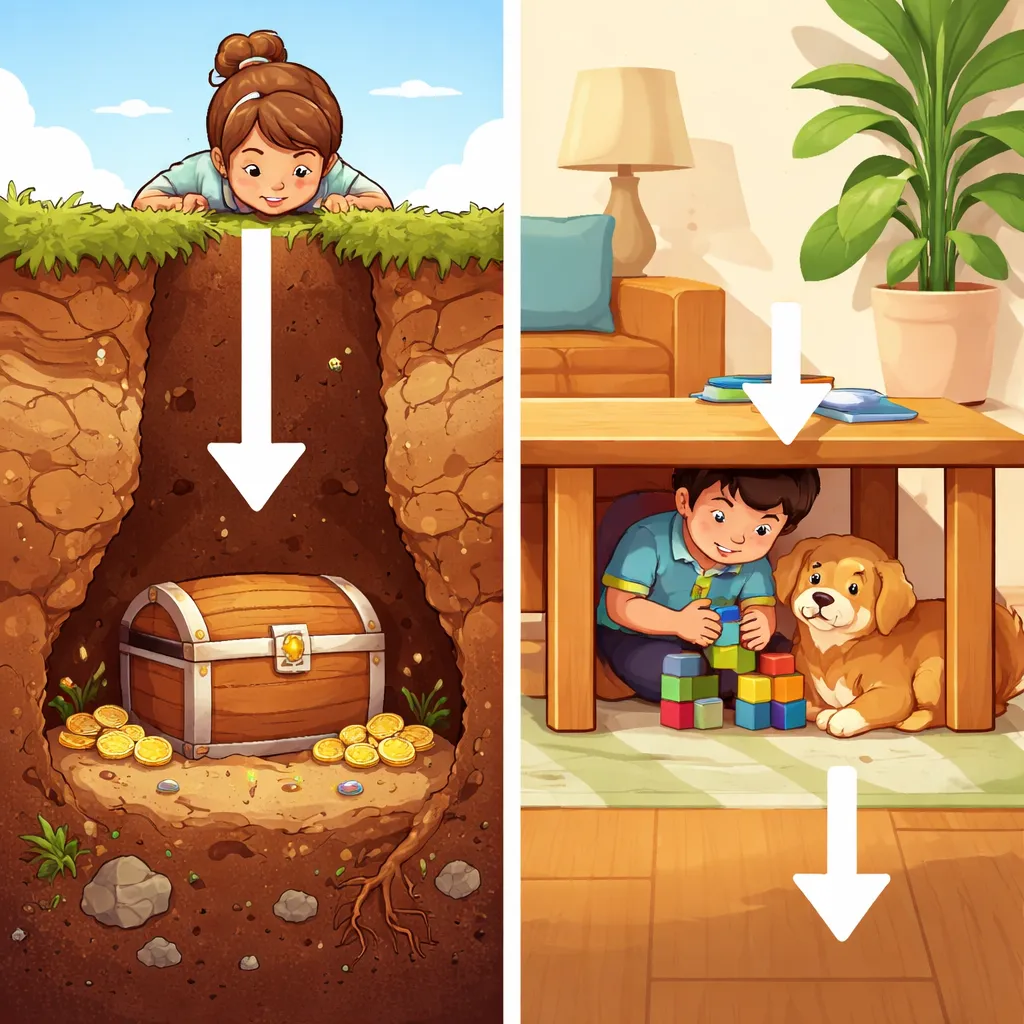

Children learn “down” early. Then they meet “below” and “under”. These words seem the same. Many parents ask if “below and under” are interchangeable. They are very similar but not identical. A fish below the surface is different from a cat under the table. Below freezing is different from under pressure. Kids need clear examples. Parents can help by pointing out everyday situations. This article gives you simple rules. You will find friendly explanations. Let’s explore “below and under” together.
Are Similar Words Really Interchangeable? Similar words often create confusion. “Below and under” seem like perfect twins. Both mean lower than something. But you cannot always swap them. A temperature below zero works. A temperature under zero also works but sounds less formal. A carpet under your feet works. A carpet below your feet sounds strange. Language gives each word a special job. Children benefit from knowing these jobs. Parents can help by using both words naturally. This article focuses only on “below and under”. We will compare them step by step.
Set 1: Below vs Under — Which One Is More Common? “Under” appears more often in daily conversation. We say under the bed. We say under pressure. We say under the weather. “Below” appears less often. We say below zero. We say below average. We say below the surface. For everyday talk, “under” wins easily. Children hear “under” for hiding, covering, and feelings. “Below” sounds more formal or precise. Under the table is normal. Below the table is also fine but feels more exact. Parents can teach this by using “under” for most situations. Save “below” for measurements, levels, and formal comparisons.
Set 2: Below vs Under — Same Meaning, Different Contexts Sometimes “below and under” describe the same position. A fish below the water. A fish under the water. The meaning is almost the same. But “under” often suggests something covering or hiding. “Below” suggests a lower level. Consider a number. Below ten means less than ten. Under ten also means less than ten. Both work. Consider a person in rank. A soldier below the captain. A soldier under the captain. “Under” suggests authority. “Below” suggests position. For children, explain it this way. “Below” is for exact lower position or level. “Under” is for covering, hiding, authority, and conditions. Use “below” for measurements. Use “under” for physical covering and control.
Set 3: Below vs Under — Which Word Is “Bigger” or More Emphatic? “Under” often feels more emphatic and active. It suggests being controlled or covered. Under attack. Under investigation. Under construction. “Below” feels calmer and more exact. Below sea level. Below the horizon. “Under” also suggests conditions. Under pressure. Under the weather. “Below” does not have these conditional uses. For children, this difference appears in descriptions. “The boat went under the water” suggests submersion. “The boat went below the water” suggests a level change. Parents can practice by describing a blanket. “The toy is under the blanket” (covered). “The toy is below the blanket” (sounds like the blanket is on a shelf above). Use “under” for covering. Use “below” for levels.
Set 4: Below vs Under — Concrete vs Abstract Both “below and under” work for concrete and abstract things. A room below another room (concrete). Below average (abstract). A tunnel under the road (concrete). Under stress (abstract). But “under” has more abstract uses. Under consideration. Under control. Under the influence. “Below” has fewer abstract uses. Below freezing (semi-abstract). Below the radar (abstract but less common). For children, this is a helpful guide. Use “below” for levels, numbers, and exact positions. Use “under” for covering, control, conditions, and authority. Below the line. Under the rules. Parents can make two columns. One column for below things (zero, sea level, average). One column for under things (table, blanket, pressure, age).
Set 5: Below vs Under — Verb or Noun? First Understand the Role Both “below and under” are prepositions. “Under” also works as an adjective and adverb. “The under layer” uses “under” as an adjective. “Go under” uses “under” as an adverb. “Below” works as an adverb too. “See below” uses “below” as an adverb. Children do not need these advanced uses. Focus on the preposition meanings. The basement is below the first floor. The cat is under the chair. A useful tip: use “below” for things that are lower but not necessarily covered. Use “under” for things that are covered or controlled. A valley below the mountain (not covered). A ball under the couch (covered). Teach your child to ask: Is it covered or controlled? If yes, use “under”. If just lower, use “below”.
Set 6: Below vs Under — American English vs British English American and British English treat “below and under” almost the same. One small difference: British English uses “under” more often for numbers. “Under ten pounds” is common in both, but British English uses “below ten pounds” less often. Another difference: authority. British English says “under the king” for authority. American English says “below the king” less often. For children, these differences do not matter. Teach international English. Say “below the window” and “under the bed”. Both dialects accept these. Parents only need to know that “under” is more versatile. Use it for covering, control, age, and conditions.
Set 7: Below vs Under — Which Fits Formal Situations? Formal English prefers “below” for exact measurements and standards. A scientific report says “below the threshold”. A geography text says “below sea level”. “Under” works in formal contexts too but sounds less precise. “Under the limit” is fine. “Below the limit” is more exact. For children, school writing benefits from “below” for comparisons. “The temperature dropped below zero” sounds clear. Use “under” for conditions and control. “The project is under review” is perfect. This builds precision.
Set 8: Below vs Under — Which One Is Easier for Kids to Remember? “Under” is easier for young children. It has five letters. It sounds like “wonder” without the W. Children use “under” for hiding and covering. Under the blanket. Under the table. Under the bed. “Below” has five letters too. But it sounds like “be” and “low”. The “low” part helps memory. Below means be low. Start with “under”. Use “under” for several weeks. Then introduce “below”. Connect “below” to “be low”. Something below is in a low position. That image helps memory. Also use hand gestures. Put your hand under a book (touching or covered). Then hold your hand below the book with space. Under touches or covers. Below has space. Parents can play a stacking game. Stack two blocks. The bottom block is below the top block (space? no, they touch). But we still say “below” for position. Use a toy under a blanket (covered). Use a fish below the water surface (level). This physical demonstration builds clear understanding.
Mini Exercise: Can You Spot the Differences Between These Similar Words? Let’s practice with ten sentences. Choose “below” or “under”. Answers are below.
The cat hid __________ the bed.
The temperature is __________ freezing.
The submarine went __________ the waves.
He is __________ a lot of pressure at work.
The basement is __________ the first floor.
The child is __________ the age limit for the ride.
The treasure is buried __________ the old tree.
Her test score was __________ the class average.
The dog slept __________ the table during dinner.
The ship sailed __________ the bridge.
Answers: 1 under, 2 below, 3 below or under (under suggests submersion, below suggests level), 4 under, 5 below, 6 under or below (under is more common for age), 7 under, 8 below, 9 under, 10 under (movement and crossing) or below (position).
Count the correct answers. For sentences where both work, accept either. 8-10 correct means your child understands “below and under” well. 5-7 correct means review the concrete vs abstract section. Below 5 correct means focus only on “under” for two weeks. Then add “below” for exact levels and measurements.
Parent Tips: How to Help Kids Learn and Remember Similar Words You do not need teaching tools. You just need daily noticing. Every day has chances to use “below and under”. At breakfast: “The plate is under the napkin. The temperature is below freezing outside.” At the park: “The tunnel goes under the road. The clouds are below the mountain top.” At bedtime: “Your pajamas are under the pillow. The moon is below the stars tonight.” Use a warm voice. Do not correct harshly. If your child says “The fish is under the water”, you say “Yes, or you can say below the surface. Both are fine.” Keep it kind. Another tip: create a level chart. Draw a line for sea level. Draw a submarine below the line. Draw a blanket on a bed. Draw a toy under the blanket. Hang the chart in the bedroom. Children learn from seeing different kinds of “lower”. Finally, play the “below vs under” hiding game. Hide a toy under a cup. Say “under”. Place a toy on a lower shelf below another shelf. Say “below”. Compare the two. You and your child will master “below and under” through playful observation. Keep exploring. Every word helps you describe exactly where things are and how they feel.