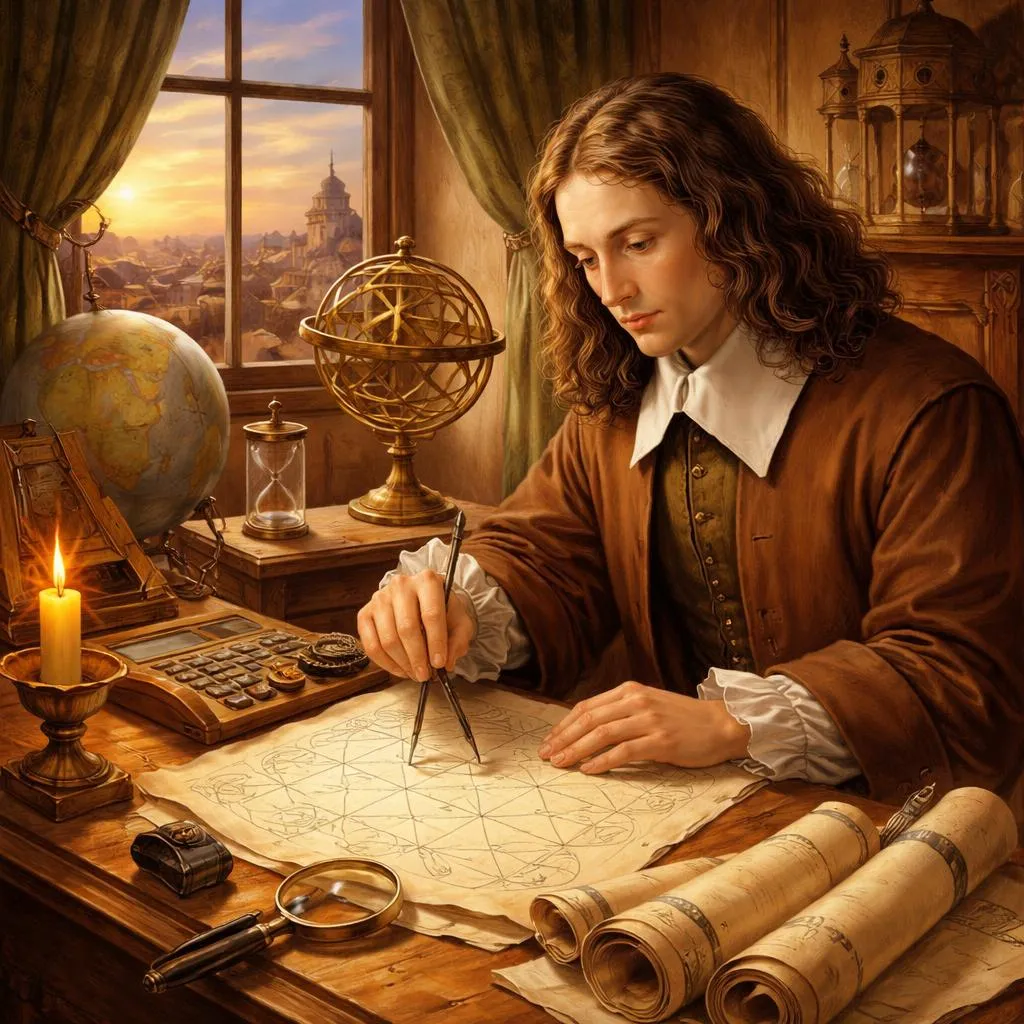

Among the contemporaries of Descartes none displayed greater natural genius than Pascal, but his mathematical reputation rests more on what he might have done than on what he actually effected, as during a considerable part of his life he deemed it his duty to devote his whole time to religious exercises.
Blaise Pascal was born at Clermont on June 19, 1623, and died at Paris on Aug. 19, 1662. His father, a local judge at Clermont, and himself of some scientific reputation, moved to Paris in 1631, partly to prosecute his own scientific studies, partly to carry on the education of his only son, who had already displayed exceptional ability. Pascal was kept at home in order to ensure his not being overworked, and with the same object it was directed that his education should be at first confined to the study of languages, and should not include any mathematics. This naturally excited the boy's curiosity, and one day, being then twelve years old, he asked in what geometry consisted. His tutor replied that it was the science of constructing exact figures and of determining the proportions between their different parts. Pascal, stimulated no doubt by the injunction against reading it, gave up his play-time to this new study, and in a few weeks had discovered for himself many properties of figures, and in particular the proposition that the sum of the angles of a triangle is equal to two right angles. I have read somewhere, but I cannot lay my hand on the authority, that his proof merely consisted in turning the angular points of a triangular piece of paper over so as to meet in the centre of the inscribed circle: a similar demonstration can be got by turning the angular points over so as to meet at the foot of the perpendicular drawn from the biggest angle to the opposite side. His father, struck by this display of ability, gave him a copy of Euclid's Elements , a book which Pascal read with avidity and soon mastered.
At the age of fourteen he was admitted to the weekly meetings of Roberval, Mersenne, Mydorge, and other French geometricians; from which, ultimately, the French Academy sprung. At sixteen Pascal wrote an essay on conic sections; and in 1641, at the age of eighteen, he constructed the first arithmetical machine, an instrument which, eight years later, he further improved. His correspondence with Fermat about this time shews that he was then turning his attention to analytical geometry and physics. He repeated Torricelli's experiments, by which the pressure of the atmosphere could be estimated as a weight, and he confirmed his theory of the cause of barometrical variations by obtaining at the same instant readings at different altitudes on the hill of Puy-de-Dôme.
In 1650, when in the midst of these researches, Pascal suddenly abandoned his favourite pursuits to study religion, or, as he says in his Pensées , "contemplate the greatness and the misery of man"; and about the same time he persuaded the younger of his two sisters to enter the Port Royal society.
In 1653 he had to administer his father's estate. He now took up his old life again, and made several experiments on the pressure exerted by gases and liquids; it was also about this period that he invented the arithmetical triangle, and together with Fermat created the calculus of probabilities. He was meditating marriage when an accident again turned the current of his thoughts to a religious life. He was driving a four-in-hand on November 23, 1654, when the horses ran away; the two leaders dashed over the parapet of the bridge at Neuilly, and Pascal was saved only by the traces breaking. Always somewhat of a mystic, he considered this a special summons to abandon the world. He wrote an account of the accident on a small piece of parchment, which for the rest of his life he wore next to his heart, to perpetually remind him of his covenant; and shortly moved to Port Royal, where he continued to live until his death in 1662. Constitutionally delicate, he had injured his health by his incessant study; from the age of seventeen or eighteen he suffered from insomnia and acute dyspepsia, and at the time of his death was physically worn out.
His famous Provincial Letters directed against the Jesuits, and his Pensées , were written towards the close of his life, and are the first example of that finished form which is characteristic of the best French literature. The only mathematical work that he produced after retiring to Port Royal was the essay on the cycloid in 1658. He was suffering from sleeplessness and toothache when the idea occurred to him, and to his surprise his teeth immediately ceased to ache. Regarding this as a divine intimation to proceed with the problem, he worked incessantly for eight days at it, and completed a tolerably full account of the geometry of the cycloid.
I now proceed to consider his mathematical works in rather greater detail.
His early essay on the geometry of conics, written in 1639, but not published till 1779, seems to have been founded on the teaching of Desargues. Two of the results are important as well as interesting. The first of these is the theorem known now as "Pascal's Theorem," namely, that if a hexagon be inscribed in a conic, the points of intersection of the opposite sides will lie in a straight line. The second, which is really due to Desargues, is that if a quadrilateral be inscribed in a conic, and a straight line be drawn cutting the sides taken in order in the points A , B , C , and D , and the conic in P and Q , then
PA . PC : PB . PD = QA . QC : QB . QD .
Pascal employed his arithmetical triangle in 1653, but no account of his method was printed till 1665. The triangle is constructed as in the figure below, each horizontal line being formed form the one above it by making every number in it equal to the sum of those above and to the left of it in the row immediately above it; ex. gr. the fourth number in the fourth line, namely, 20, is equal to 1 + 3 + 6 + 10.
The numbers in each line are what are now called figurate numbers. Those in the first line are called numbers of the first order; those in the second line, natural numbers or numbers of the second order; those in the third line, numbers of the third order, and so on. It is easily shewn that the mth number in the nth row is (m+n-2)! / (m-1)!(n-1)!
Pascal's arithmetical triangle, to any required order, is got by drawing a diagonal downwards from right to left as in the figure. The numbers in any diagonal give the coefficients of the expansion of a binomial; for example, the figures in the fifth diagonal, namely 1, 4, 6, 4, 1, are the coefficients of the expansion ( a + b ) 4 . Pascal used the triangle partly for this purpose, and partly to find the numbers of combinations of m things taken n at a time, which he stated, correctly, to be (n+1)(n+2)(n+3) ... m / (m-n)!
Perhaps as a mathematician Pascal is best known in connection with his correspondence with Fermat in 1654 in which he laid down the principles of the theory of probabilities. This correspondence arose from a problem proposed by a gamester, the Chevalier de Méré, to Pascal, who communicated it to Fermat. The problem was this. Two players of equal skill want to leave the table before finishing their game. Their scores and the number of points which constitute the game being given, it is desired to find in what proportion they should divide the stakes. Pascal and Fermat agreed on the answer, but gave different proofs. The following is a translation of Pascal's solution. That of Fermat is given later.
The following is my method for determining the share of each player when, for example, two players play a game of three points and each player has staked 32 pistoles.
Suppose that the first player has gained two points, and the second player one point; they have now to play for a point on this condition, that, if the first player gain, he takes all the money which is at stake, namely, 64 pistoles; while, if the second player gain, each player has two points, so that there are on terms of equality, and, if they leave off playing, each ought to take 32 pistoles. Thus if the first player gain, then 64 pistoles belong to him, and if he lose, then 32 pistoles belong to him. If therefore the players do not wish to play this game but to separate without playing it, the first player would say to the second, "I am certain of 32 pistoles even if I lose this game, and as for the other 32 pistoles perhaps I will have them and perhaps you will have them; the chances are equal. Let us then divide these 32 pistoles equally, and give me also the 32 pistoles of which I am certain." Thus the first player will have 48 pistoles and the second 16 pistoles.
Next, suppose that the first player has gained two points and the second player none, and that they are about to play for a point; the condition then is that, if the first player gain this point, he secures the game and takes the 64 pistoles, and, if the second player gain this point, then the players will be in the situation already examined, in which the first player is entitled to 48 pistoles and the second to 16 pistoles. Thus if they do not wish to play, the first player would say to the second, "If I gain the point I gain 64 pistoles; if I lose it, I am entitled to 48 pistoles. Give me then the 48 pistoles of which I am certain, and divide the other 16 equally, since our chances of gaining the point are equal." Thus the first player will have 56 pistoles and the second player 8 pistoles.
Finally, suppose that the first player has gained one point and the second player none. If they proceed to play for a point, the condition is that, if the first player gain it, the players will be in the situation first examined, in which the first player is entitled to 56 pistoles; if the first player lose the point, each player has then a point, and each is entitled to 32 pistoles. Thus, if they do not wish to play, the first player would say to the second, "Give me the 32 pistoles of which I am certain, and divide the remainder of the 56 pistoles equally, that is divide 24 pistoles equally." Thus the first player will have the sum of 32 and 12 pistoles, that is, 44 pistoles, and consequently the second will have 20 pistoles.
Pascal proceeds next to consider the similar problems when the game is won by whoever first obtains m + n points, and one player has m while the other has n points. The answer is obtained using the arithmetical triangle. The general solution (in which the skill of the players is unequal) is given in many modern text-books on algebra, and agrees with Pascal's result, though of course the notation of the latter is different and less convenient.
Pascal made an illegitimate use of the new theory in the seventh chapter of his Pensées . In effect, he puts his argument that, as the value of eternal happiness must be infinite, then, even if the probability of a religious life ensuring eternal happiness be very small, still the expectation (which is measured by the product of the two) must be of sufficient magnitude to make it worth while to be religious. The argument, if worth anything, would apply equally to any religion which promised eternal happiness to those who accepted its doctrines. If any conclusion may be drawn from the statement, it is the undersirability of applying mathematics to questions of morality of which some of the data are necessarily outside the range of an exact science. It is only fair to add that no one had more contempt than Pascal for those who changes their opinions according to the prospect of material benefit, and this isolated passage is at variance with the spirit of his writings.
The last mathematical work of Pascal was that on the cycloid in 1658. The cycloid is the curve traced out by a point on the circumference of a circular hoop which rolls along a straight line. Galileo, in 1630, had called attention to this curve, the shape of which is particularly graceful, and had suggested that the arches of bridges should be built in this form. Four years later, in 1634, Roberval found the area of the cycloid; Descartes thought little of this solution and defied him to find its tangents, the same challenge being also sent to Fermat who at once solved the problem. Several questions connected with the curve, and with the surface and volume generated by its revolution about its axis, base, or the tangent at its vertex, were then proposed by various mathematicians. These and some analogous question, as well as the positions of the centres of the mass of the solids formed, were solved by Pascal in 1658, and the results were issued as a challenge to the world, Wallis succeeded in solving all the questions except those connected with the centre of mass. Pascal's own solutions were effected by the method of indivisibles, and are similar to those which a modern mathematician would give by the aid of the integral calculus. He obtained by summation what are equivalent to the integrals of sin φ , sin 2 φ , and φ sin φ , one limit being either 0 or 1/2π. He also investigated the geometry of the Archimedean spiral. These researches, according to D'Alembert, form a connecting link between the geometry of Archimedes and the infinitesimal calculus of Newton.
Introducción a Blaise Pascal y su legado
Blaise Pascal fue un notable matemático, físico, inventor, escritor y filósofo francés que vivió en el siglo XVII. Nacido en 1623, Pascal demostró un talento extraordinario desde muy joven, especialmente en matemáticas y ciencias. A pesar de su temprana promesa y sus importantes contribuciones, gran parte de su vida la dedicó a la reflexión religiosa y la filosofía. Su trabajo ha tenido un impacto duradero en muchos campos, incluyendo la geometría, la teoría de la probabilidad e incluso la literatura.
Antecedentes y contexto histórico
Pascal vivió en una época en la que la ciencia y la religión a menudo se cruzaban y, a veces, entraban en conflicto. El siglo XVII fue un período de grandes descubrimientos científicos, con figuras como Descartes y Galileo desafiando las viejas ideas y sentando las bases de la ciencia moderna. Pascal fue parte de esta revolución intelectual, pero también estuvo profundamente involucrado con el pensamiento religioso, particularmente a través de su conexión con el movimiento jansenista en Port Royal, una comunidad religiosa que enfatizaba la piedad y el rigor moral.
Su padre, que también era juez y científico, jugó un papel crucial en la educación temprana de Pascal. Curiosamente, a Pascal inicialmente se le prohibió estudiar matemáticas, lo que solo alimentó su curiosidad y lo llevó a descubrir muchas verdades matemáticas por sí mismo. Este aprendizaje temprano autodirigido preparó el escenario para sus logros posteriores.
Principales contribuciones de Pascal
-
Matemáticas y geometría: Pascal hizo importantes descubrimientos en geometría proyectiva, incluido el teorema de Pascal sobre los hexágonos inscritos en secciones cónicas. También desarrolló el famoso triángulo de Pascal, una herramienta que ayuda a calcular combinaciones y expansiones binomiales, que todavía se enseña en las escuelas hoy en día.
-
Teoría de la probabilidad: Junto con Pierre de Fermat, Pascal sentó las bases de la teoría moderna de la probabilidad. Su correspondencia comenzó con un problema de juego y evolucionó hacia una teoría matemática formal que nos ayuda a comprender el azar y el riesgo, un campo esencial para la estadística, la economía y la toma de decisiones.
-
Física e inventos: Pascal realizó experimentos sobre la presión atmosférica, confirmando y ampliando el trabajo anterior de Torricelli. Inventó una de las primeras calculadoras mecánicas, un primer paso hacia la informática moderna.
-
Filosofía y literatura: Las "Pensées" (Pensamientos) de Pascal son una colección de reflexiones sobre la naturaleza humana, la religión y la filosofía. Su famoso argumento de la "apuesta" utiliza la probabilidad para razonar sobre la creencia en Dios, mostrando su combinación única de razonamiento científico y espiritualidad.
Significado e importancia para los estudiantes
La vida y obra de Pascal ofrecen ricas lecciones para estudiantes y jóvenes lectores:
-
Curiosidad y autoaprendizaje: La temprana desobediencia de Pascal a las restricciones y su estudio automotivado muestran el poder de la curiosidad y el aprendizaje independiente. Los estudiantes pueden aprender que a veces cuestionar las reglas y explorar por su cuenta conduce a grandes descubrimientos.
-
Pensamiento interdisciplinario: Pascal combinó las matemáticas, la ciencia y la filosofía, demostrando que el conocimiento está interconectado. Esto anima a los estudiantes a ser de mente abierta y a ver cómo diferentes materias pueden informarse y enriquecerse mutuamente.
-
Equilibrio entre pasión y reflexión: El cambio de Pascal de la ciencia a la contemplación religiosa nos recuerda la importancia de equilibrar las actividades intelectuales con los valores personales y la reflexión.
-
Resiliencia y propósito: A pesar de los problemas de salud y los desafíos personales, Pascal continuó trabajando y pensando profundamente en cuestiones importantes. Su perseverancia es inspiradora para cualquiera que enfrente dificultades.
Aplicaciones en la vida diaria y el aprendizaje
-
Matemáticas y resolución de problemas: Comprender el triángulo de Pascal y la probabilidad puede mejorar las habilidades de pensamiento lógico y toma de decisiones de los estudiantes, útiles en juegos, estudios y situaciones de la vida real que involucran riesgos.
-
Ética y pensamiento crítico: Las reflexiones filosóficas de Pascal animan a los estudiantes a pensar en grandes preguntas, sobre la felicidad, el propósito y la creencia, lo que puede ayudarles a desarrollar sus propios valores y razonamiento moral.
-
Investigación científica: Los experimentos de Pascal muestran la importancia de la observación, las pruebas y la curiosidad en la ciencia, animando a los estudiantes a explorar y cuestionar el mundo que les rodea.
-
Apreciación literaria: El estilo de escritura claro y elegante de Pascal en sus cartas y "Pensées" es un gran ejemplo de cómo expresar ideas complejas de forma sencilla y hermosa, una habilidad valiosa en toda comunicación.
Cómo cultivar el espíritu de Pascal
-
Mantente curioso: Como Pascal, no tengas miedo de explorar nuevos temas, incluso aquellos que parezcan difíciles o prohibidos.
-
Piensa en diferentes materias: Intenta conectar ideas de diferentes áreas (matemáticas, ciencias, literatura, filosofía) para obtener una comprensión más profunda.
-
Reflexiona sobre tus creencias: Tómate un tiempo para considerar lo que te importa, tal como lo hizo Pascal en sus últimos años.
-
Sé persistente: Los desafíos y los contratiempos son parte del aprendizaje; sigue trabajando para lograr tus objetivos con dedicación.
Conclusión
La historia de Blaise Pascal no se trata solo de matemáticas o ciencia; se trata del viaje de una mente joven a través de la curiosidad, el descubrimiento, la fe y la reflexión. Para los estudiantes de hoy, su vida enseña el valor de la pasión intelectual, el cuestionamiento moral y la resiliencia. Al estudiar a Pascal, los jóvenes estudiantes pueden desarrollar habilidades y actitudes que les ayuden a tener éxito académicamente y a crecer como individuos reflexivos e integrales.
