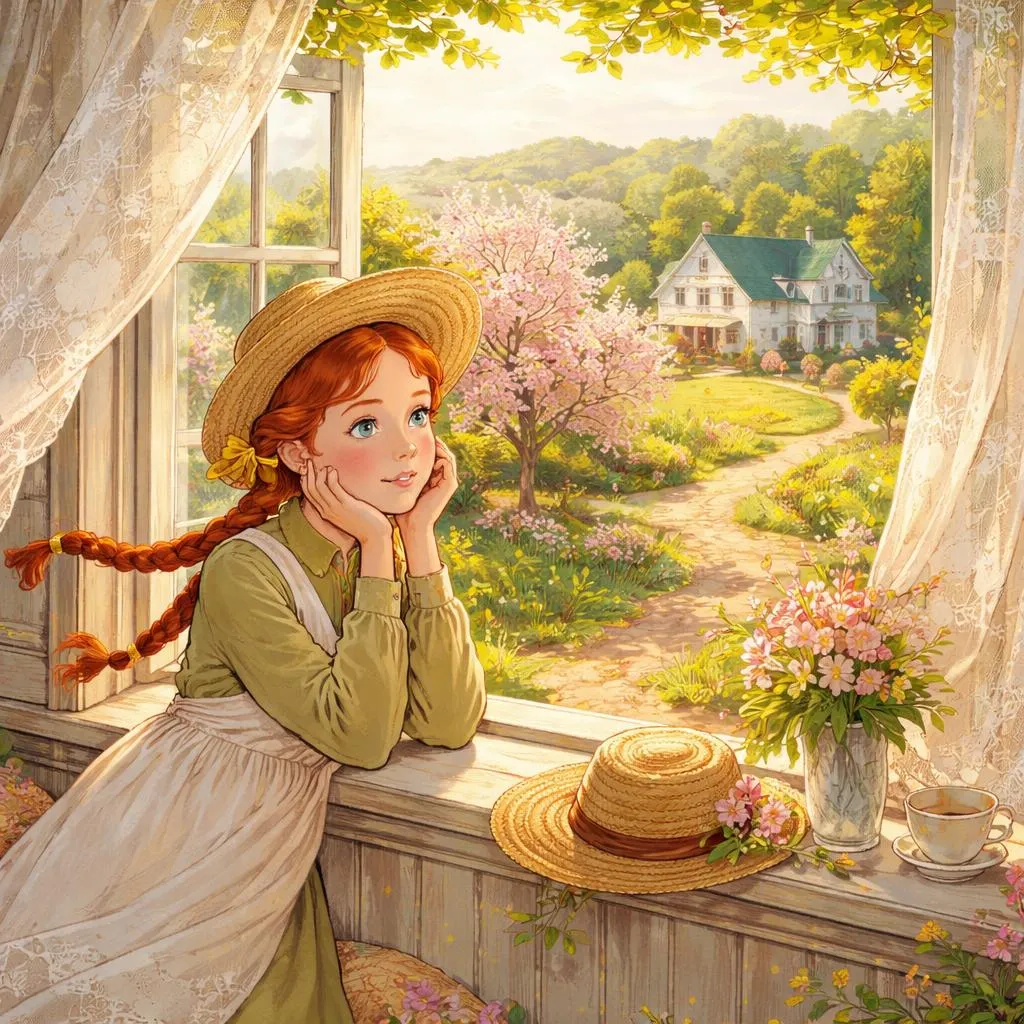

“It’s time Anne was in to do her sewing,” said Marilla, glancing at the clock and then out into the yellow August afternoon where everything drowsed in the heat. “She stayed playing with Diana more than half an hour more’n I gave her leave to; and now she’s perched out there on the woodpile talking to Matthew, nineteen to the dozen, when she knows perfectly well she ought to be at her work. And of course he’s listening to her like a perfect ninny. I never saw such an infatuated man. The more she talks and the odder the things she says, the more he’s delighted evidently. Anne Shirley, you come right in here this minute, do you hear me!”
A series of staccato taps on the west window brought Anne flying in from the yard, eyes shining, cheeks faintly flushed with pink, unbraided hair streaming behind her in a torrent of brightness.
“Oh, Marilla,” she exclaimed breathlessly, “there’s going to be a Sunday-school picnic next week—in Mr. Harmon Andrews’s field, right near the lake of Shining Waters. And Mrs. Superintendent Bell and Mrs. Rachel Lynde are going to make ice cream—think of it, Marilla—ICE CREAM! And, oh, Marilla, can I go to it?”
“Just look at the clock, if you please, Anne. What time did I tell you to come in?”
“Two o’clock—but isn’t it splendid about the picnic, Marilla? Please can I go? Oh, I’ve never been to a picnic—I’ve dreamed of picnics, but I’ve never—”
“Yes, I told you to come at two o’clock. And it’s a quarter to three. I’d like to know why you didn’t obey me, Anne.”
“Why, I meant to, Marilla, as much as could be. But you have no idea how fascinating Idlewild is. And then, of course, I had to tell Matthew about the picnic. Matthew is such a sympathetic listener. Please can I go?”
“You’ll have to learn to resist the fascination of Idle-whatever-you-call-it. When I tell you to come in at a certain time I mean that time and not half an hour later. And you needn’t stop to discourse with sympathetic listeners on your way, either. As for the picnic, of course you can go. You’re a Sunday-school scholar, and it’s not likely I’d refuse to let you go when all the other little girls are going.”
“But—but,” faltered Anne, “Diana says that everybody must take a basket of things to eat. I can’t cook, as you know, Marilla, and—and—I don’t mind going to a picnic without puffed sleeves so much, but I’d feel terribly humiliated if I had to go without a basket. It’s been preying on my mind ever since Diana told me.”
“Well, it needn’t prey any longer. I’ll bake you a basket.”
“Oh, you dear good Marilla. Oh, you are so kind to me. Oh, I’m so much obliged to you.”
Getting through with her “ohs” Anne cast herself into Marilla’s arms and rapturously kissed her sallow cheek. It was the first time in her whole life that childish lips had voluntarily touched Marilla’s face. Again that sudden sensation of startling sweetness thrilled her. She was secretly vastly pleased at Anne’s impulsive caress, which was probably the reason why she said brusquely:
“There, there, never mind your kissing nonsense. I’d sooner see you doing strictly as you’re told. As for cooking, I mean to begin giving you lessons in that some of these days. But you’re so featherbrained, Anne, I’ve been waiting to see if you’d sober down a little and learn to be steady before I begin. You’ve got to keep your wits about you in cooking and not stop in the middle of things to let your thoughts rove all over creation. Now, get out your patchwork and have your square done before teatime.”
“I do NOT like patchwork,” said Anne dolefully, hunting out her workbasket and sitting down before a little heap of red and white diamonds with a sigh. “I think some kinds of sewing would be nice; but there’s no scope for imagination in patchwork. It’s just one little seam after another and you never seem to be getting anywhere. But of course I’d rather be Anne of Green Gables sewing patchwork than Anne of any other place with nothing to do but play. I wish time went as quick sewing patches as it does when I’m playing with Diana, though. Oh, we do have such elegant times, Marilla. I have to furnish most of the imagination, but I’m well able to do that. Diana is simply perfect in every other way. You know that little piece of land across the brook that runs up between our farm and Mr. Barry’s. It belongs to Mr. William Bell, and right in the corner there is a little ring of white birch trees—the most romantic spot, Marilla. Diana and I have our playhouse there. We call it Idlewild. Isn’t that a poetical name? I assure you it took me some time to think it out. I stayed awake nearly a whole night before I invented it. Then, just as I was dropping off to sleep, it came like an inspiration. Diana was ENRAPTURED when she heard it. We have got our house fixed up elegantly. You must come and see it, Marilla—won’t you? We have great big stones, all covered with moss, for seats, and boards from tree to tree for shelves. And we have all our dishes on them. Of course, they’re all broken but it’s the easiest thing in the world to imagine that they are whole. There’s a piece of a plate with a spray of red and yellow ivy on it that is especially beautiful. We keep it in the parlor and we have the fairy glass there, too. The fairy glass is as lovely as a dream. Diana found it out in the woods behind their chicken house. It’s all full of rainbows—just little young rainbows that haven’t grown big yet—and Diana’s mother told her it was broken off a hanging lamp they once had. But it’s nice to imagine the fairies lost it one night when they had a ball, so we call it the fairy glass. Matthew is going to make us a table. Oh, we have named that little round pool over in Mr. Barry’s field Willowmere. I got that name out of the book Diana lent me. That was a thrilling book, Marilla. The heroine had five lovers. I’d be satisfied with one, wouldn’t you? She was very handsome and she went through great tribulations. She could faint as easy as anything. I’d love to be able to faint, wouldn’t you, Marilla? It’s so romantic. But I’m really very healthy for all I’m so thin. I believe I’m getting fatter, though. Don’t you think I am? I look at my elbows every morning when I get up to see if any dimples are coming. Diana is having a new dress made with elbow sleeves. She is going to wear it to the picnic. Oh, I do hope it will be fine next Wednesday. I don’t feel that I could endure the disappointment if anything happened to prevent me from getting to the picnic. I suppose I’d live through it, but I’m certain it would be a lifelong sorrow. It wouldn’t matter if I got to a hundred picnics in after years; they wouldn’t make up for missing this one. They’re going to have boats on the Lake of Shining Waters—and ice cream, as I told you. I have never tasted ice cream. Diana tried to explain what it was like, but I guess ice cream is one of those things that are beyond imagination.”
“Anne, you have talked even on for ten minutes by the clock,” said Marilla. “Now, just for curiosity’s sake, see if you can hold your tongue for the same length of time.”
Anne held her tongue as desired. But for the rest of the week she talked picnic and thought picnic and dreamed picnic. On Saturday it rained and she worked herself up into such a frantic state lest it should keep on raining until and over Wednesday that Marilla made her sew an extra patchwork square by way of steadying her nerves.
On Sunday Anne confided to Marilla on the way home from church that she grew actually cold all over with excitement when the minister announced the picnic from the pulpit.
“Such a thrill as went up and down my back, Marilla! I don’t think I’d ever really believed until then that there was honestly going to be a picnic. I couldn’t help fearing I’d only imagined it. But when a minister says a thing in the pulpit you just have to believe it.”
“You set your heart too much on things, Anne,” said Marilla, with a sigh. “I’m afraid there’ll be a great many disappointments in store for you through life.”
“Oh, Marilla, looking forward to things is half the pleasure of them,” exclaimed Anne. “You mayn’t get the things themselves; but nothing can prevent you from having the fun of looking forward to them. Mrs. Lynde says, ‘Blessed are they who expect nothing for they shall not be disappointed.’ But I think it would be worse to expect nothing than to be disappointed.”
Marilla wore her amethyst brooch to church that day as usual. Marilla always wore her amethyst brooch to church. She would have thought it rather sacrilegious to leave it off—as bad as forgetting her Bible or her collection dime. That amethyst brooch was Marilla’s most treasured possession. A seafaring uncle had given it to her mother who in turn had bequeathed it to Marilla. It was an old-fashioned oval, containing a braid of her mother’s hair, surrounded by a border of very fine amethysts. Marilla knew too little about precious stones to realize how fine the amethysts actually were; but she thought them very beautiful and was always pleasantly conscious of their violet shimmer at her throat, above her good brown satin dress, even although she could not see it.
Anne had been smitten with delighted admiration when she first saw that brooch.
“Oh, Marilla, it’s a perfectly elegant brooch. I don’t know how you can pay attention to the sermon or the prayers when you have it on. I couldn’t, I know. I think amethysts are just sweet. They are what I used to think diamonds were like. Long ago, before I had ever seen a diamond, I read about them and I tried to imagine what they would be like. I thought they would be lovely glimmering purple stones. When I saw a real diamond in a lady’s ring one day I was so disappointed I cried. Of course, it was very lovely but it wasn’t my idea of a diamond. Will you let me hold the brooch for one minute, Marilla? Do you think amethysts can be the souls of good violets?”
Trasfondo e Introducción a la Autora
Este extracto es de Ana de las Tejas Verdes, una querida novela clásica escrita por la autora canadiense Lucy Maud Montgomery. Publicada en 1908, la historia sigue a Ana Shirley, una niña huérfana imaginativa y enérgica que es enviada por error a vivir con Marilla y Matthew Cuthbert, un hermano y una hermana que pretendían adoptar a un niño para ayudar con su granja. Ambientada en el pueblo ficticio de Avonlea en la Isla del Príncipe Eduardo, la novela captura bellamente la vida rural y las aventuras de la infancia.
Lucy Maud Montgomery se inspiró en su propia vida y entorno, infundiendo la historia con vívidas descripciones de la naturaleza y un rico desarrollo de los personajes. Ana de las Tejas Verdes se ha convertido desde entonces en una obra muy apreciada en todo el mundo, celebrada por su calidez, humor y temas atemporales.
Interpretación Detallada y Significado
Este pasaje destaca la viva imaginación de Ana y su anhelo de pertenencia y alegría. Su entusiasmo por el picnic de la escuela dominical y sus vívidas descripciones de "Idlewild", la casa de juegos que comparte con su amiga Diana, muestran su espíritu creativo y su deseo de amistad. El papel de Marilla como tutora introduce el tema de la disciplina y la responsabilidad, contrastando con la naturaleza impulsiva de Ana.
Las reflexiones de Ana sobre el picnic, sus preocupaciones por encajar y su deleite por los placeres sencillos como el helado y el cristal de hadas revelan la experiencia universal de crecer: equilibrar los sueños con la realidad. La historia también toca temas de aceptación, crecimiento personal y la importancia de la comunidad.
Lecciones y Perspectivas para los Estudiantes
-
Imaginación y Creatividad: La capacidad de Ana para convertir lugares ordinarios en mundos mágicos anima a los estudiantes a cultivar su creatividad. La imaginación puede enriquecer la vida cotidiana y ayudar a resolver problemas de forma innovadora.
-
Responsabilidad y Disciplina: La insistencia de Marilla en la puntualidad y en terminar las tareas de costura enseña el valor de la disciplina y de seguir las reglas, esenciales para el éxito en la escuela y en la vida.
-
Amistad y Empatía: La relación de Ana con Diana y Matthew muestra la importancia de la amabilidad, la escucha y el apoyo a los demás, que son habilidades vitales para la interacción social.
-
Manejo de la Decepción: El entusiasmo de Ana por el picnic y su miedo a la decepción reflejan los altibajos emocionales que todos enfrentan. Aprender a gestionar las expectativas y encontrar alegría en la anticipación es una valiosa lección emocional.
-
Apreciar las Alegrías Simples: La historia recuerda a los lectores que deben encontrar la felicidad en las pequeñas cosas: un picnic, una cesta hecha en casa o un broche preciado, lo que puede fomentar la gratitud y el contentamiento.
Aplicación en la Vida Diaria
-
En la Escuela: Los estudiantes pueden aprender de la curiosidad y el entusiasmo de Ana por explorar nuevas experiencias, a la vez que comprenden la importancia de equilibrar la diversión con responsabilidades como los deberes y las tareas.
-
En Entornos Sociales: La apertura y calidez de Ana animan a los jóvenes lectores a ser amables e inclusivos, a hacer nuevos amigos y a apreciar las diferentes personalidades.
-
Crecimiento Personal: La historia inspira la autorreflexión, animando a los estudiantes a abrazar sus cualidades únicas mientras se esfuerzan por alcanzar la madurez y la estabilidad, como aconseja Marilla.
Cultivar Rasgos Positivos de la Historia
-
Imaginación: Participar en actividades creativas como escribir, dibujar o jugar a roles para desarrollar la imaginación como la de Ana.
-
Paciencia y Concentración: Practicar la finalización de tareas sin distracciones, como espera Marilla que aprenda Ana, para desarrollar la concentración y la fiabilidad.
-
Amabilidad y Escucha: Ser atento y solidario con los amigos y la familia, reflejando la escucha comprensiva de Matthew.
-
Resiliencia: Comprender que la decepción es parte de la vida, pero esperar con ansias los acontecimientos y mantener la esperanza aporta alegría y fuerza.
Reflexión y Apreciación
Ana de las Tejas Verdes ofrece una exploración atemporal de las alegrías y los desafíos de la infancia. La vibrante personalidad de Ana y sus interacciones con Marilla y otros invitan a los lectores a apreciar la belleza de la vida cotidiana, el poder de la imaginación y la importancia de crecer con amabilidad y coraje. Los estudiantes pueden encontrar inspiración en la historia de Ana para abrazar su propia singularidad y afrontar las aventuras de la vida con optimismo y corazón.
