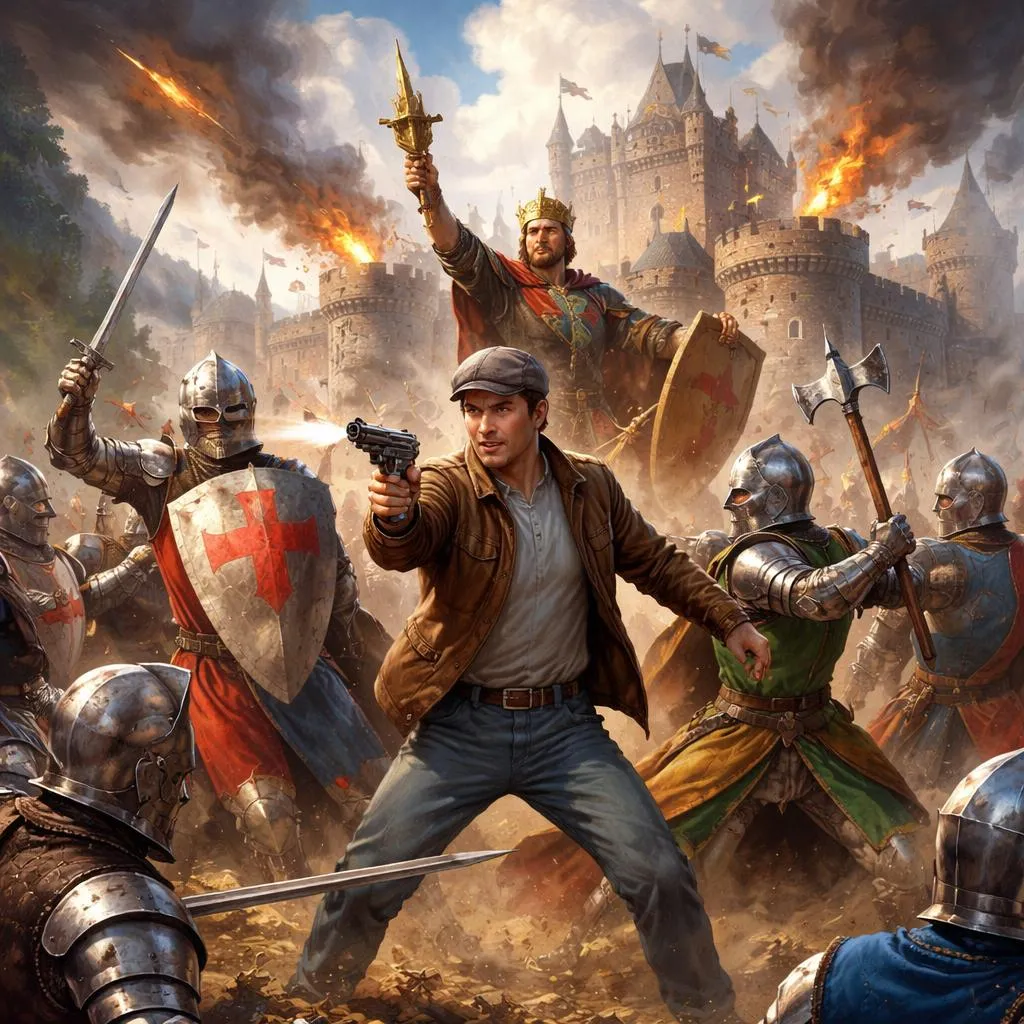

I paid three pennies for my breakfast, and a most extravagant price it was, too, seeing that one could have breakfasted a dozen persons for that money; but I was feeling good by this time, and I had always been a kind of spendthrift anyway; and then these people had wanted to give me the food for nothing, scant as their provision was, and so it was a grateful pleasure to emphasize my appreciation and sincere thankfulness with a good big financial lift where the money would do so much more good than it would in my helmet, where, these pennies being made of iron and not stinted in weight, my half-dollar’s worth was a good deal of a burden to me. I spent money rather too freely in those days, it is true; but one reason for it was that I hadn’t got the proportions of things entirely adjusted, even yet, after so long a sojourn in Britain—hadn’t got along to where I was able to absolutely realize that a penny in Arthur’s land and a couple of dollars in Connecticut were about one and the same thing: just twins, as you may say, in purchasing power. If my start from Camelot could have been delayed a very few days I could have paid these people in beautiful new coins from our own mint, and that would have pleased me; and them, too, not less. I had adopted the American values exclusively. In a week or two now, cents, nickels, dimes, quarters, and half-dollars, and also a trifle of gold, would be trickling in thin but steady streams all through the commercial veins of the kingdom, and I looked to see this new blood freshen up its life.
The farmers were bound to throw in something, to sort of offset my liberality, whether I would or no; so I let them give me a flint and steel; and as soon as they had comfortably bestowed Sandy and me on our horse, I lit my pipe. When the first blast of smoke shot out through the bars of my helmet, all those people broke for the woods, and Sandy went over backwards and struck the ground with a dull thud. They thought I was one of those fire-belching dragons they had heard so much about from knights and other professional liars. I had infinite trouble to persuade those people to venture back within explaining distance. Then I told them that this was only a bit of enchantment which would work harm to none but my enemies. And I promised, with my hand on my heart, that if all who felt no enmity toward me would come forward and pass before me they should see that only those who remained behind would be struck dead. The procession moved with a good deal of promptness. There were no casualties to report, for nobody had curiosity enough to remain behind to see what would happen.
I lost some time, now, for these big children, their fears gone, became so ravished with wonder over my awe-compelling fireworks that I had to stay there and smoke a couple of pipes out before they would let me go. Still the delay was not wholly unproductive, for it took all that time to get Sandy thoroughly wonted to the new thing, she being so close to it, you know. It plugged up her conversation mill, too, for a considerable while, and that was a gain. But above all other benefits accruing, I had learned something. I was ready for any giant or any ogre that might come along, now.
We tarried with a holy hermit, that night, and my opportunity came about the middle of the next afternoon. We were crossing a vast meadow by way of short-cut, and I was musing absently, hearing nothing, seeing nothing, when Sandy suddenly interrupted a remark which she had begun that morning, with the cry:
“Defend thee, lord!—peril of life is toward!”
And she slipped down from the horse and ran a little way and stood. I looked up and saw, far off in the shade of a tree, half a dozen armed knights and their squires; and straightway there was bustle among them and tightening of saddle-girths for the mount. My pipe was ready and would have been lit, if I had not been lost in thinking about how to banish oppression from this land and restore to all its people their stolen rights and manhood without disobliging anybody. I lit up at once, and by the time I had got a good head of reserved steam on, here they came. All together, too; none of those chivalrous magnanimities which one reads so much about —one courtly rascal at a time, and the rest standing by to see fair play. No, they came in a body, they came with a whirr and a rush, they came like a volley from a battery; came with heads low down, plumes streaming out behind, lances advanced at a level. It was a handsome sight, a beautiful sight—for a man up a tree. I laid my lance in rest and waited, with my heart beating, till the iron wave was just ready to break over me, then spouted a column of white smoke through the bars of my helmet. You should have seen the wave go to pieces and scatter! This was a finer sight than the other one.
But these people stopped, two or three hundred yards away, and this troubled me. My satisfaction collapsed, and fear came; I judged I was a lost man. But Sandy was radiant; and was going to be eloquent—but I stopped her, and told her my magic had miscarried, somehow or other, and she must mount, with all despatch, and we must ride for life. No, she wouldn’t. She said that my enchantment had disabled those knights; they were not riding on, because they couldn’t; wait, they would drop out of their saddles presently, and we would get their horses and harness. I could not deceive such trusting simplicity, so I said it was a mistake; that when my fireworks killed at all, they killed instantly; no, the men would not die, there was something wrong about my apparatus, I couldn’t tell what; but we must hurry and get away, for those people would attack us again, in a minute. Sandy laughed, and said:
“Lack-a-day, sir, they be not of that breed! Sir Launcelot will give battle to dragons, and will abide by them, and will assail them again, and yet again, and still again, until he do conquer and destroy them; and so likewise will Sir Pellinore and Sir Aglovale and Sir Carados, and mayhap others, but there be none else that will venture it, let the idle say what the idle will. And, la, as to yonder base rufflers, think ye they have not their fill, but yet desire more?”
“Well, then, what are they waiting for? Why don’t they leave? Nobody’s hindering. Good land, I’m willing to let bygones be bygones, I’m sure.”
“Leave, is it? Oh, give thyself easement as to that. They dream not of it, no, not they. They wait to yield them.”
“Come—really, is that ‘sooth’—as you people say? If they want to, why don’t they?”
“It would like them much; but an ye wot how dragons are esteemed, ye would not hold them blamable. They fear to come.”
“Well, then, suppose I go to them instead, and—”
“Ah, wit ye well they would not abide your coming. I will go.”
And she did. She was a handy person to have along on a raid. I would have considered this a doubtful errand, myself. I presently saw the knights riding away, and Sandy coming back. That was a relief. I judged she had somehow failed to get the first innings —I mean in the conversation; otherwise the interview wouldn’t have been so short. But it turned out that she had managed the business well; in fact, admirably. She said that when she told those people I was The Boss, it hit them where they lived: “smote them sore with fear and dread” was her word; and then they were ready to put up with anything she might require. So she swore them to appear at Arthur’s court within two days and yield them, with horse and harness, and be my knights henceforth, and subject to my command. How much better she managed that thing than I should have done it myself! She was a daisy.
Antecedentes e Introducción del Autor
Este extracto es de una historia que mezcla elementos de la leyenda artúrica con un giro único e imaginativo. El narrador se encuentra en un entorno medieval, interactuando con caballeros, granjeros y criaturas míticas, mientras aporta una perspectiva y unos valores modernos a este mundo antiguo. La historia recuerda a "Un yanqui de Connecticut en la corte del Rey Arturo" de Mark Twain, una novela clásica que explora el choque entre la tecnología moderna y la superstición medieval.
Mark Twain, cuyo nombre real era Samuel Langhorne Clemens, fue un famoso escritor estadounidense conocido por su ingenio, humor y crítica social. Escribiendo a finales del siglo XIX, Twain a menudo usaba la sátira para desafiar las normas sociales y resaltar las locuras humanas. "Un yanqui de Connecticut en la corte del Rey Arturo" es una de sus obras más célebres, que mezcla la fantasía y la sátira para cuestionar las visiones románticas de la caballería y la monarquía.
Interpretación Detallada y Significado
El pasaje describe las experiencias del narrador mientras navega por el mundo medieval, utilizando sus conocimientos y recursos de la era moderna. Su compra del desayuno a un precio extravagante simboliza las diferencias culturales y económicas entre su mundo y el medieval. La generosidad del narrador contrasta con la escasez que le rodea, y sus interacciones revelan un comentario humorístico pero reflexivo sobre el valor, la moneda y la bondad humana.
El episodio con los caballeros cargando y siendo repelidos por los "fuegos artificiales" de humo del narrador muestra el poder del conocimiento y el ingenio sobre la fuerza bruta. También destaca el tema de los malentendidos entre diferentes culturas y épocas. La compañera del narrador, Sandy, juega un papel vital como mediadora y negociadora, demostrando coraje y diplomacia.
Esta historia invita a los lectores a reflexionar sobre la justicia, el poder y el progreso. Desafía la idea de que la fuerza es el derecho y sugiere que la inteligencia, la bondad y la justicia son fuerzas más fuertes para el cambio. También explora cómo se puede lograr un cambio positivo sin causar daño ni falta de respeto.
Lecciones e Inspiraciones para Estudiantes
-
Apreciación de Diferentes Culturas y Épocas
La historia anima a los jóvenes lectores a respetar y comprender culturas e historias diferentes a las suyas. Muestra que valores como la bondad y la justicia son universales, incluso si las costumbres y las apariencias cambian. -
El Poder del Ingenio y el Conocimiento
El uso del humo y las tácticas inteligentes del narrador para defenderse enseña a los estudiantes la importancia de pensar de forma creativa y utilizar el conocimiento para resolver problemas en lugar de recurrir a la violencia. -
Coraje y Liderazgo
La valentía y las habilidades diplomáticas de Sandy resaltan el valor de defender lo que es correcto y liderar con sabiduría y empatía. Los estudiantes pueden aprender cómo el liderazgo no se trata solo de fuerza, sino de comunicación y confianza. -
Generosidad y Gratitud
A pesar de las diferencias de riqueza y moneda, el narrador muestra generosidad y gratitud, recordando a los lectores que la amabilidad y el aprecio son importantes en todas las circunstancias.
Aplicando Estas Lecciones en la Vida Diaria
-
En la Escuela: Los estudiantes pueden usar el pensamiento creativo para abordar desafíos, ya sea en la resolución de problemas o en proyectos grupales. También pueden practicar el liderazgo escuchando a los demás y fomentando el trabajo en equipo.
-
En Entornos Sociales: Comprender y respetar diferentes orígenes ayuda a construir amistades y comunidades pacíficas. Mostrar gratitud y generosidad fortalece las relaciones.
-
En el Crecimiento Personal: El coraje para enfrentar los miedos y defender la justicia ayuda a construir el carácter. Aprender de la historia y las historias puede inspirar mejores decisiones y empatía.
Cultivando Valores Positivos de la Historia
Para desarrollar los rasgos positivos que se muestran en la historia, los estudiantes pueden:
- Practicar la bondad diariamente, incluso en pequeños actos.
- Leer mucho para comprender diferentes perspectivas e historias.
- Pensar de forma crítica y creativa cuando se enfrentan a problemas.
- Comunicarse de forma clara y respetuosa con los demás.
- Reflexionar sobre sus acciones y esforzarse por ser justos.
Esta historia, con su mezcla de fantasía, humor y lecciones morales, ofrece a los jóvenes lectores una rica experiencia que entretiene a la vez que enseña importantes habilidades y valores para la vida. Nos recuerda que el coraje, la bondad y la inteligencia son cualidades atemporales que pueden cambiar el mundo para mejor.
