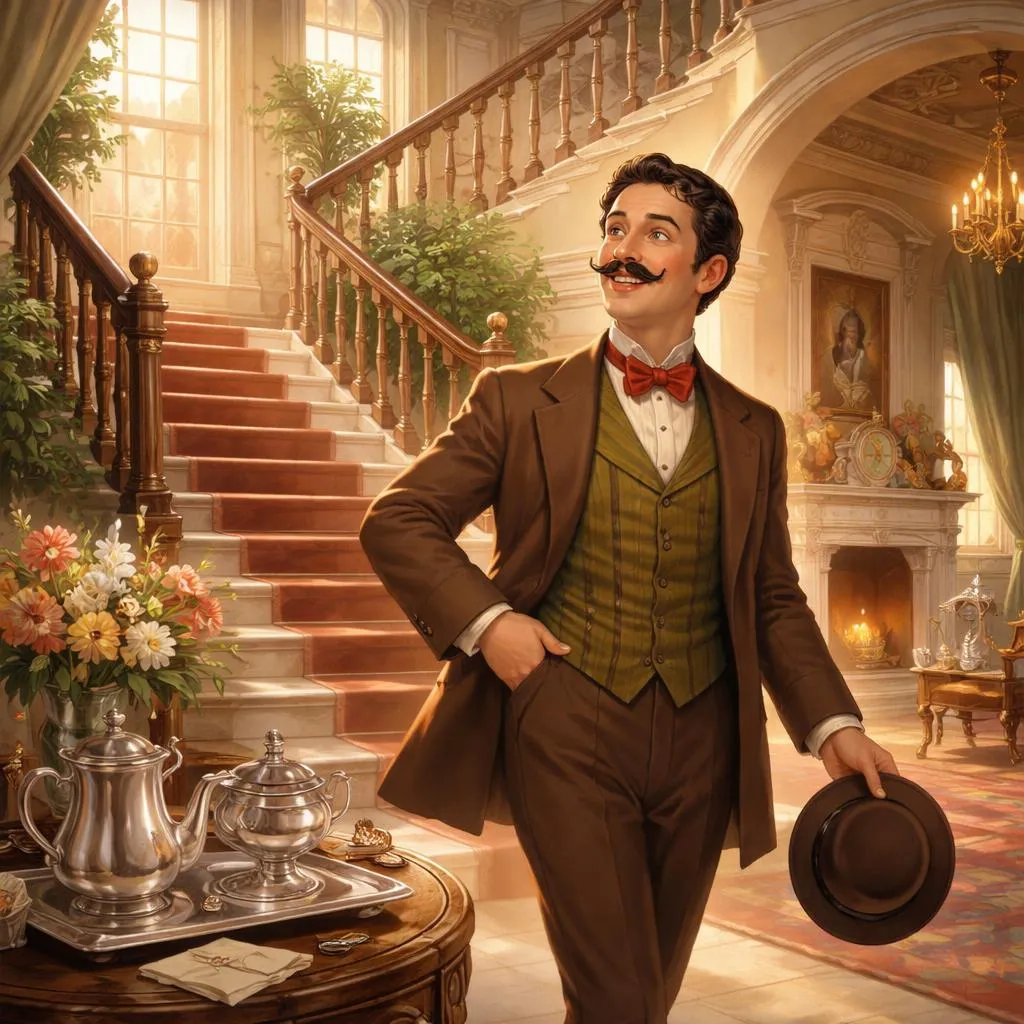

"Faith," muttered Passepartout, somewhat flurried, "I've seen people at Madame Tussaud's as lively as my new master!"
Madame Tussaud's "people," let it be said, are of wax, and are much visited in London; speech is all that is wanting to make them human.
During his brief interview with Mr. Fogg, Passepartout had been carefully observing him. He appeared to be a man about forty years of age, with fine, handsome features, and a tall, well-shaped figure; his hair and whiskers were light, his forehead compact and unwrinkled, his face rather pale, his teeth magnificent. His countenance possessed in the highest degree what physiognomists call "repose in action," a quality of those who act rather than talk. Calm and phlegmatic, with a clear eye, Mr. Fogg seemed a perfect type of that English composure which Angelica Kauffmann has so skilfully represented on canvas. Seen in the various phases of his daily life, he gave the idea of being perfectly well-balanced, as exactly regulated as a Leroy chronometer. Phileas Fogg was, indeed, exactitude personified, and this was betrayed even in the expression of his very hands and feet; for in men, as well as in animals, the limbs themselves are expressive of the passions.
He was so exact that he was never in a hurry, was always ready, and was economical alike of his steps and his motions. He never took one step too many, and always went to his destination by the shortest cut; he made no superfluous gestures, and was never seen to be moved or agitated. He was the most deliberate person in the world, yet always reached his destination at the exact moment.
He lived alone, and, so to speak, outside of every social relation; and as he knew that in this world account must be taken of friction, and that friction retards, he never rubbed against anybody.
As for Passepartout, he was a true Parisian of Paris. Since he had abandoned his own country for England, taking service as a valet, he had in vain searched for a master after his own heart. Passepartout was by no means one of those pert dunces depicted by Moliere with a bold gaze and a nose held high in the air; he was an honest fellow, with a pleasant face, lips a trifle protruding, soft-mannered and serviceable, with a good round head, such as one likes to see on the shoulders of a friend. His eyes were blue, his complexion rubicund, his figure almost portly and well-built, his body muscular, and his physical powers fully developed by the exercises of his younger days. His brown hair was somewhat tumbled; for, while the ancient sculptors are said to have known eighteen methods of arranging Minerva's tresses, Passepartout was familiar with but one of dressing his own: three strokes of a large-tooth comb completed his toilet.
It would be rash to predict how Passepartout's lively nature would agree with Mr. Fogg. It was impossible to tell whether the new servant would turn out as absolutely methodical as his master required; experience alone could solve the question. Passepartout had been a sort of vagrant in his early years, and now yearned for repose; but so far he had failed to find it, though he had already served in ten English houses. But he could not take root in any of these; with chagrin, he found his masters invariably whimsical and irregular, constantly running about the country, or on the look-out for adventure. His last master, young Lord Longferry, Member of Parliament, after passing his nights in the Haymarket taverns, was too often brought home in the morning on policemen's shoulders. Passepartout, desirous of respecting the gentleman whom he served, ventured a mild remonstrance on such conduct; which, being ill-received, he took his leave. Hearing that Mr. Phileas Fogg was looking for a servant, and that his life was one of unbroken regularity, that he neither travelled nor stayed from home overnight, he felt sure that this would be the place he was after. He presented himself, and was accepted, as has been seen.
At half-past eleven, then, Passepartout found himself alone in the house in Saville Row. He begun its inspection without delay, scouring it from cellar to garret. So clean, well-arranged, solemn a mansion pleased him; it seemed to him like a snail's shell, lighted and warmed by gas, which sufficed for both these purposes. When Passepartout reached the second story he recognised at once the room which he was to inhabit, and he was well satisfied with it. Electric bells and speaking-tubes afforded communication with the lower stories; while on the mantel stood an electric clock, precisely like that in Mr. Fogg's bedchamber, both beating the same second at the same instant. "That's good, that'll do," said Passepartout to himself.
He suddenly observed, hung over the clock, a card which, upon inspection, proved to be a programme of the daily routine of the house. It comprised all that was required of the servant, from eight in the morning, exactly at which hour Phileas Fogg rose, till half-past eleven, when he left the house for the Reform Club—all the details of service, the tea and toast at twenty-three minutes past eight, the shaving-water at thirty-seven minutes past nine, and the toilet at twenty minutes before ten. Everything was regulated and foreseen that was to be done from half-past eleven a.m. till midnight, the hour at which the methodical gentleman retired.
Mr. Fogg's wardrobe was amply supplied and in the best taste. Each pair of trousers, coat, and vest bore a number, indicating the time of year and season at which they were in turn to be laid out for wearing; and the same system was applied to the master's shoes. In short, the house in Saville Row, which must have been a very temple of disorder and unrest under the illustrious but dissipated Sheridan, was cosiness, comfort, and method idealised. There was no study, nor were there books, which would have been quite useless to Mr. Fogg; for at the Reform two libraries, one of general literature and the other of law and politics, were at his service. A moderate-sized safe stood in his bedroom, constructed so as to defy fire as well as burglars; but Passepartout found neither arms nor hunting weapons anywhere; everything betrayed the most tranquil and peaceable habits.
Having scrutinised the house from top to bottom, he rubbed his hands, a broad smile overspread his features, and he said joyfully, "This is just what I wanted! Ah, we shall get on together, Mr. Fogg and I! What a domestic and regular gentleman! A real machine; well, I don't mind serving a machine."
Introducción y antecedentes del autor
Este pasaje es de la novela clásica La vuelta al mundo en ochenta días de Julio Verne, un célebre autor francés conocido por sus obras de aventuras y ciencia ficción. Escrita en 1873, esta novela captura el espíritu de la Revolución Industrial y la fascinación por las nuevas tecnologías y los viajes globales. La vívida imaginación y las detalladas descripciones de Verne dan vida a la emoción y los desafíos de un viaje alrededor del mundo en una época en la que tales viajes eran aún una hazaña notable.
Interpretación detallada de la historia
El extracto presenta a dos personajes principales: Phileas Fogg, un hombre de estricta rutina y precisión, y su recién contratado sirviente, Passepartout, cuya naturaleza vivaz y flexible contrasta con la regularidad mecánica de Fogg. Fogg es retratado como un modelo de compostura y exactitud inglesa, que vive una vida tan ordenada que cada minuto y movimiento están planificados y ejecutados con cuidado. Passepartout, por otro lado, es un personaje humano y cálido con un pasado colorido y un deseo de estabilidad.
Esta apertura prepara el escenario para la aventura central de la novela: la apuesta de Fogg para circunnavegar el globo en ochenta días. El contraste entre la naturaleza metódica de Fogg y el mundo impredecible al que está a punto de enfrentarse crea tensión y humor a lo largo de la historia.
Qué pueden aprender los estudiantes
-
El valor de la disciplina y la rutina: El personaje de Phileas Fogg ejemplifica el poder de la disciplina. Su puntualidad, cuidadosa planificación y comportamiento tranquilo muestran cómo la estructura puede ayudar a lograr objetivos ambiciosos. Los estudiantes pueden aprender la importancia de la gestión del tiempo y la organización en sus estudios y en la vida diaria.
-
Adaptabilidad y apertura de mente: El personaje de Passepartout nos recuerda que, si bien la rutina es valiosa, la flexibilidad y la amabilidad son igualmente importantes. Sus experiencias pasadas y su naturaleza tranquila equilibran la rigidez de Fogg, enseñando a los estudiantes a apreciar las diferentes personalidades y a adaptarse a las nuevas situaciones.
-
Coraje y aventura: La novela anima a los lectores a aceptar los desafíos y a salir de su zona de confort. El viaje de Fogg es una metáfora de la perseverancia y la valentía, que inspira a los jóvenes lectores a perseguir sus sueños a pesar de los obstáculos.
-
Conciencia cultural: A medida que la historia viaja por diferentes países y culturas, ofrece una ventana a la diversidad del mundo. Esto amplía los horizontes de los estudiantes y fomenta el respeto por los diferentes pueblos y tradiciones.
Aplicación de estas lecciones en la vida
- En el aprendizaje: Los estudiantes pueden adoptar la dedicación de Fogg estableciendo objetivos claros y siguiendo un horario de estudio, al tiempo que recuerdan la flexibilidad de Passepartout para manejar los cambios inesperados o las dificultades con gracia.
- En entornos sociales: Reconocer el valor de las diferentes personalidades ayuda a construir la empatía y el trabajo en equipo. Así como Fogg y Passepartout se complementan, los estudiantes pueden aprender a trabajar bien con compañeros de clase que tienen diferentes fortalezas.
- En el crecimiento personal: El espíritu de aventura fomenta la curiosidad y la resiliencia. Los estudiantes pueden desafiarse a sí mismos a probar nuevas actividades, viajar o explorar nuevas ideas, aumentando su confianza y visión del mundo.
Cultivar rasgos positivos de la historia
- Precisión y responsabilidad: Al igual que Fogg, los estudiantes pueden practicar ser responsables de sus tareas y puntuales en sus compromisos.
- Amabilidad y apoyo: Inspirándose en Passepartout, mostrar amabilidad y apoyo a los demás crea fuertes amistades y un ambiente positivo.
- Resolución de problemas: La historia muestra que surgen problemas inesperados, pero el pensamiento tranquilo y la determinación conducen al éxito. Los estudiantes pueden desarrollar habilidades para la resolución de problemas manteniéndose tranquilos y pensando creativamente.
Conclusión
La vuelta al mundo en ochenta días es más que una simple aventura emocionante; es una rica fuente de lecciones sobre el carácter, la cultura y el coraje. Al leer y reflexionar sobre esta historia, los estudiantes pueden obtener conocimientos que les ayuden en la escuela, en las relaciones y en los muchos viajes de la vida. Aceptar tanto la disciplina como la flexibilidad, respetar la diversidad y atreverse a explorar lo desconocido son valores intemporales que esta novela clásica imparte maravillosamente.
