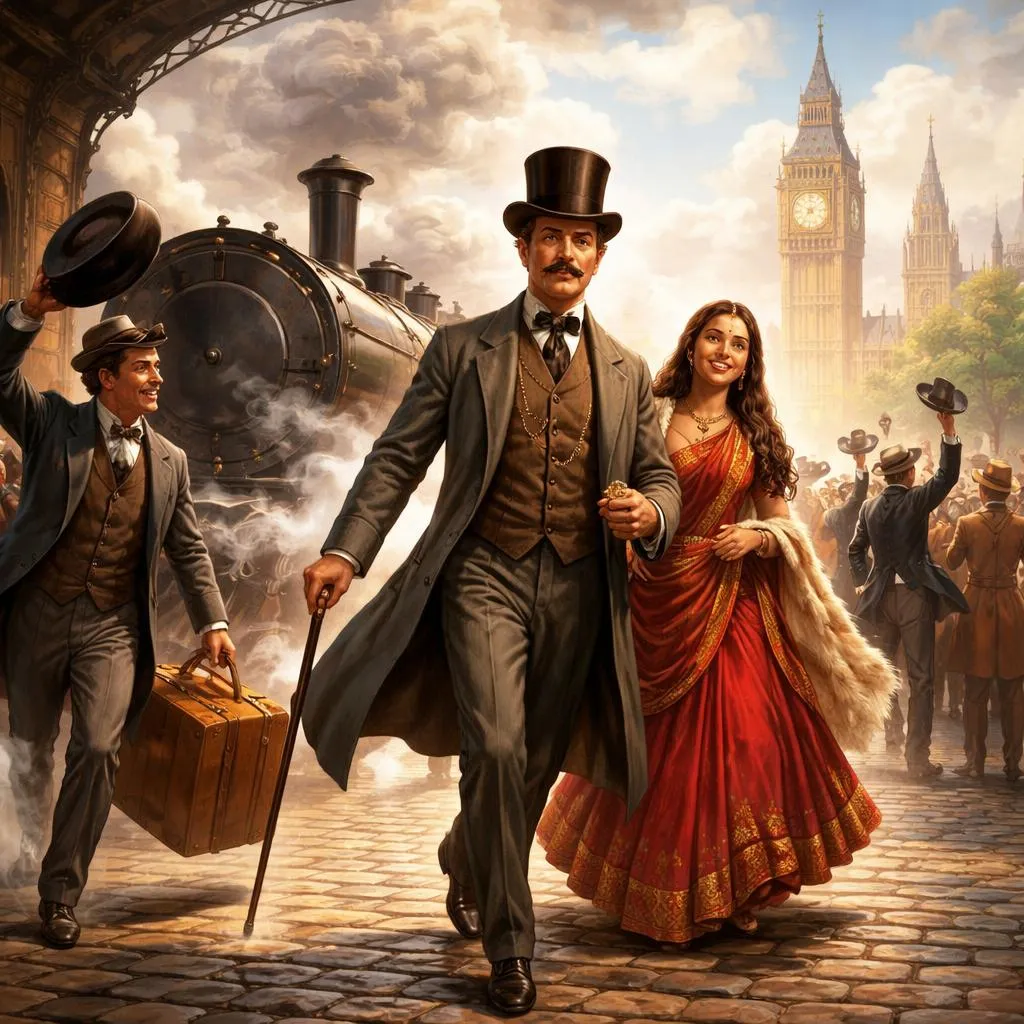

Phileas Fogg was in prison. He had been shut up in the Custom House, and he was to be transferred to London the next day.
Passepartout, when he saw his master arrested, would have fallen upon Fix had he not been held back by some policemen. Aouda was thunderstruck at the suddenness of an event which she could not understand. Passepartout explained to her how it was that the honest and courageous Fogg was arrested as a robber. The young woman's heart revolted against so heinous a charge, and when she saw that she could attempt to do nothing to save her protector, she wept bitterly.
As for Fix, he had arrested Mr. Fogg because it was his duty, whether Mr. Fogg were guilty or not.
The thought then struck Passepartout, that he was the cause of this new misfortune! Had he not concealed Fix's errand from his master? When Fix revealed his true character and purpose, why had he not told Mr. Fogg? If the latter had been warned, he would no doubt have given Fix proof of his innocence, and satisfied him of his mistake; at least, Fix would not have continued his journey at the expense and on the heels of his master, only to arrest him the moment he set foot on English soil. Passepartout wept till he was blind, and felt like blowing his brains out.
Aouda and he had remained, despite the cold, under the portico of the Custom House. Neither wished to leave the place; both were anxious to see Mr. Fogg again.
That gentleman was really ruined, and that at the moment when he was about to attain his end. This arrest was fatal. Having arrived at Liverpool at twenty minutes before twelve on the 21st of December, he had till a quarter before nine that evening to reach the Reform Club, that is, nine hours and a quarter; the journey from Liverpool to London was six hours.
If anyone, at this moment, had entered the Custom House, he would have found Mr. Fogg seated, motionless, calm, and without apparent anger, upon a wooden bench. He was not, it is true, resigned; but this last blow failed to force him into an outward betrayal of any emotion. Was he being devoured by one of those secret rages, all the more terrible because contained, and which only burst forth, with an irresistible force, at the last moment? No one could tell. There he sat, calmly waiting—for what? Did he still cherish hope? Did he still believe, now that the door of this prison was closed upon him, that he would succeed?
However that may have been, Mr. Fogg carefully put his watch upon the table, and observed its advancing hands. Not a word escaped his lips, but his look was singularly set and stern. The situation, in any event, was a terrible one, and might be thus stated: if Phileas Fogg was honest he was ruined; if he was a knave, he was caught.
Did escape occur to him? Did he examine to see if there were any practicable outlet from his prison? Did he think of escaping from it? Possibly; for once he walked slowly around the room. But the door was locked, and the window heavily barred with iron rods. He sat down again, and drew his journal from his pocket. On the line where these words were written, "21st December, Saturday, Liverpool," he added, "80th day, 11.40 a.m.," and waited.
The Custom House clock struck one. Mr. Fogg observed that his watch was two hours too fast.
Two hours! Admitting that he was at this moment taking an express train, he could reach London and the Reform Club by a quarter before nine, p.m. His forehead slightly wrinkled.
At thirty–three minutes past two he heard a singular noise outside, then a hasty opening of doors. Passepartout's voice was audible, and immediately after that of Fix. Phileas Fogg's eyes brightened for an instant.
The door swung open, and he saw Passepartout, Aouda, and Fix, who hurried towards him.
Fix was out of breath, and his hair was in disorder. He could not speak. "Sir," he stammered, "sir—forgive me—most—unfortunate resemblance—robber arrested three days ago—you are free!"
Phileas Fogg was free! He walked to the detective, looked him steadily in the face, and with the only rapid motion he had ever made in his life, or which he ever would make, drew back his arms, and with the precision of a machine knocked Fix down.
"Well hit!" cried Passepartout, "Parbleu! that's what you might call a good application of English fists!"
Fix, who found himself on the floor, did not utter a word. He had only received his deserts. Mr. Fogg, Aouda, and Passepartout left the Custom House without delay, got into a cab, and in a few moments descended at the station.
Phileas Fogg asked if there was an express train about to leave for London. It was forty minutes past two. The express train had left thirty–five minutes before. Phileas Fogg then ordered a special train.
There were several rapid locomotives on hand; but the railway arrangements did not permit the special train to leave until three o'clock.
At that hour Phileas Fogg, having stimulated the engineer by the offer of a generous reward, at last set out towards London with Aouda and his faithful servant.
It was necessary to make the journey in five hours and a half; and this would have been easy on a clear road throughout. But there were forced delays, and when Mr. Fogg stepped from the train at the terminus, all the clocks in London were striking ten minutes before nine.
Having made the tour of the world, he was behind–hand five minutes. He had lost the wager!
Introducción y antecedentes del autor
Esta historia es un extracto de La vuelta al mundo en ochenta días, una novela de aventuras clásica escrita por el autor francés Julio Verne en 1873. A Verne se le suele llamar el "Padre de la ciencia ficción" por sus historias imaginativas y con visión de futuro que combinan la aventura con el conocimiento científico y geográfico. Esta novela en particular captura el espíritu del siglo XIX, una época en la que el mundo se estaba volviendo más conectado a través de los ferrocarriles y los barcos de vapor, y los viajes comenzaban a reducir las vastas distancias entre los continentes.
Análisis detallado de la historia y su significado
La historia sigue a Phileas Fogg, un caballero inglés tranquilo y metódico que apuesta a que puede dar la vuelta al mundo en solo ochenta días. El pasaje que lees describe un momento crítico en el que Fogg es arrestado injustamente justo cuando está a punto de completar su viaje. A pesar de este contratiempo, su comportamiento tranquilo y su determinación brillan, mostrando su resistencia ante la adversidad.
El arresto de Fogg es un punto de inflexión que pone a prueba su paciencia, coraje y confianza en sus amigos. Su sirviente, Passepartout, se siente culpable por no haberle advertido sobre las sospechas del detective Fix, y Aouda, una joven a la que rescataron durante sus viajes, muestra una profunda lealtad y preocupación por Fogg. La historia destaca temas como la justicia, la perseverancia y la importancia de la amistad y la confianza.
Lecciones e ideas para estudiantes y jóvenes lectores
-
Perseverancia en tiempos difíciles: La calma y la resolución de Fogg, incluso cuando es acusado y encarcelado injustamente, nos enseñan la importancia de mantener la compostura y la concentración cuando nos enfrentamos a desafíos. La vida a menudo presenta obstáculos inesperados, pero mantener la mente clara nos ayuda a encontrar soluciones.
-
El valor de la lealtad y la amistad: La devoción de Passepartout y Aouda por Fogg nos recuerda que tener amigos que nos apoyen y estar ahí el uno para el otro en momentos difíciles es invaluable. Su preocupación y sus acciones demuestran cómo el trabajo en equipo y el cuidado pueden ayudar a superar las dificultades.
-
Honestidad e integridad: El carácter de Fogg se basa en la honestidad y la integridad. Incluso cuando es acusado injustamente, no pierde la dignidad ni recurre a la deshonestidad. Esto muestra a los jóvenes lectores la importancia de mantenerse fiel a los propios valores.
-
El poder de la gestión del tiempo y la planificación: Toda la novela gira en torno al horario y la planificación precisos de Fogg. Enseña a los estudiantes lo importante que es administrar el tiempo sabiamente y prepararse para los retrasos inesperados, una habilidad útil en los estudios y la vida diaria.
Cómo aplicar estas lecciones en la vida
-
En la escuela: Al enfrentarse a exámenes o proyectos, los estudiantes pueden aprender del enfoque disciplinado de Fogg para la planificación y la perseverancia. Incluso si ocurren contratiempos, mantener la calma y la concentración les ayudará a tener éxito.
-
En situaciones sociales: Al igual que Passepartout y Aouda apoyan a Fogg, construir amistades sólidas basadas en la confianza y la lealtad es esencial. Estar ahí para los amigos y pedir ayuda cuando sea necesario fortalece las relaciones.
-
En el crecimiento personal: La integridad de Fogg anima a los jóvenes lectores a actuar con honestidad y responsabilidad, incluso cuando podría ser más fácil tomar atajos. Esto construye el carácter y se gana el respeto.
Cultivar rasgos positivos de la historia
-
Resiliencia: Practica mantener la calma y pensar con claridad cuando las cosas no salen según lo planeado. Intenta ver los obstáculos como desafíos a superar en lugar de razones para rendirte.
-
Empatía y apoyo: Aprende a notar cuándo los amigos o compañeros de clase necesitan ayuda y ofrece tu apoyo. Los pequeños actos de bondad pueden marcar una gran diferencia.
-
Responsabilidad: Asume la responsabilidad de tus acciones, como Passepartout se da cuenta de su error. Admitir los errores y aprender de ellos es una señal de madurez.
Conclusión
La vuelta al mundo en ochenta días es más que una simple aventura emocionante; es una historia llena de valiosas lecciones de vida sobre el coraje, la amistad, la honestidad y la perseverancia. Al leer y reflexionar sobre personajes como Phileas Fogg, los estudiantes y los jóvenes lectores pueden inspirarse para afrontar sus propios desafíos con confianza e integridad, preparándolos para el éxito en la escuela, las relaciones y más allá.
