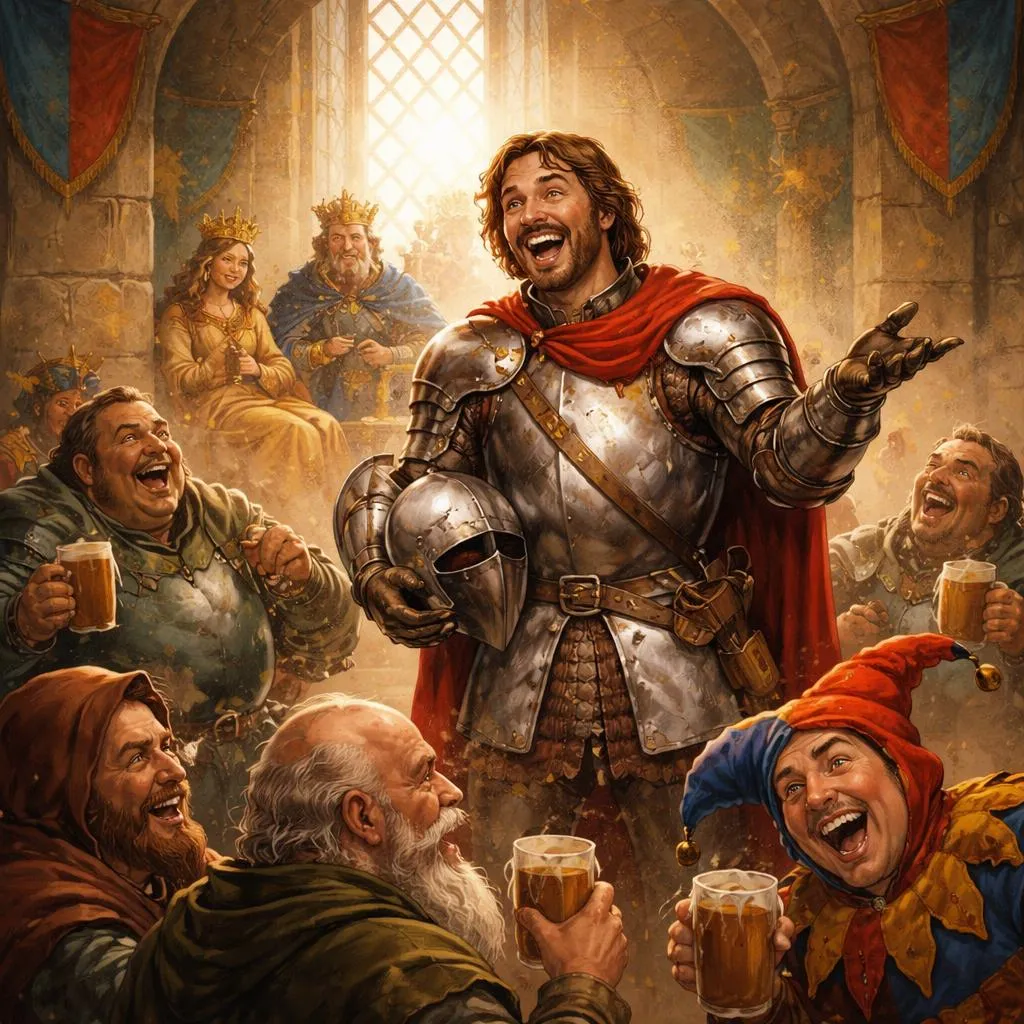

It seemed to me that this quaint lie was most simply and beautifully told; but then I had heard it only once, and that makes a difference; it was pleasant to the others when it was fresh, no doubt.
Sir Dinadan the Humorist was the first to awake, and he soon roused the rest with a practical joke of a sufficiently poor quality. He tied some metal mugs to a dog’s tail and turned him loose, and he tore around and around the place in a frenzy of fright, with all the other dogs bellowing after him and battering and crashing against everything that came in their way and making altogether a chaos of confusion and a most deafening din and turmoil; at which every man and woman of the multitude laughed till the tears flowed, and some fell out of their chairs and wallowed on the floor in ecstasy. It was just like so many children. Sir Dinadan was so proud of his exploit that he could not keep from telling over and over again, to weariness, how the immortal idea happened to occur to him; and as is the way with humorists of his breed, he was still laughing at it after everybody else had got through. He was so set up that he concluded to make a speech —of course a humorous speech. I think I never heard so many old played-out jokes strung together in my life. He was worse than the minstrels, worse than the clown in the circus. It seemed peculiarly sad to sit here, thirteen hundred years before I was born, and listen again to poor, flat, worm-eaten jokes that had given me the dry gripes when I was a boy thirteen hundred years afterwards. It about convinced me that there isn’t any such thing as a new joke possible. Everybody laughed at these antiquities —but then they always do; I had noticed that, centuries later. However, of course the scoffer didn’t laugh—I mean the boy. No, he scoffed; there wasn’t anything he wouldn’t scoff at. He said the most of Sir Dinadan’s jokes were rotten and the rest were petrified. I said “petrified” was good; as I believed, myself, that the only right way to classify the majestic ages of some of those jokes was by geologic periods. But that neat idea hit the boy in a blank place, for geology hadn’t been invented yet. However, I made a note of the remark, and calculated to educate the commonwealth up to it if I pulled through. It is no use to throw a good thing away merely because the market isn’t ripe yet.
Now Sir Kay arose and began to fire up on his history-mill with me for fuel. It was time for me to feel serious, and I did. Sir Kay told how he had encountered me in a far land of barbarians, who all wore the same ridiculous garb that I did—a garb that was a work of enchantment, and intended to make the wearer secure from hurt by human hands. However he had nullified the force of the enchantment by prayer, and had killed my thirteen knights in a three hours’ battle, and taken me prisoner, sparing my life in order that so strange a curiosity as I was might be exhibited to the wonder and admiration of the king and the court. He spoke of me all the time, in the blandest way, as “this prodigious giant,” and “this horrible sky-towering monster,” and “this tusked and taloned man-devouring ogre”, and everybody took in all this bosh in the naivest way, and never smiled or seemed to notice that there was any discrepancy between these watered statistics and me. He said that in trying to escape from him I sprang into the top of a tree two hundred cubits high at a single bound, but he dislodged me with a stone the size of a cow, which “all-to brast” the most of my bones, and then swore me to appear at Arthur’s court for sentence. He ended by condemning me to die at noon on the 21st; and was so little concerned about it that he stopped to yawn before he named the date.
I was in a dismal state by this time; indeed, I was hardly enough in my right mind to keep the run of a dispute that sprung up as to how I had better be killed, the possibility of the killing being doubted by some, because of the enchantment in my clothes. And yet it was nothing but an ordinary suit of fifteen-dollar slop-shops. Still, I was sane enough to notice this detail, to wit: many of the terms used in the most matter-of-fact way by this great assemblage of the first ladies and gentlemen in the land would have made a Comanche blush. Indelicacy is too mild a term to convey the idea. However, I had read “Tom Jones,” and “Roderick Random,” and other books of that kind, and knew that the highest and first ladies and gentlemen in England had remained little or no cleaner in their talk, and in the morals and conduct which such talk implies, clear up to a hundred years ago; in fact clear into our own nineteenth century—in which century, broadly speaking, the earliest samples of the real lady and real gentleman discoverable in English history—or in European history, for that matter—may be said to have made their appearance. Suppose Sir Walter, instead of putting the conversations into the mouths of his characters, had allowed the characters to speak for themselves? We should have had talk from Rebecca and Ivanhoe and the soft lady Rowena which would embarrass a tramp in our day. However, to the unconsciously indelicate all things are delicate. King Arthur’s people were not aware that they were indecent and I had presence of mind enough not to mention it.
They were so troubled about my enchanted clothes that they were mightily relieved, at last, when old Merlin swept the difficulty away for them with a common-sense hint. He asked them why they were so dull—why didn’t it occur to them to strip me. In half a minute I was as naked as a pair of tongs! And dear, dear, to think of it: I was the only embarrassed person there. Everybody discussed me; and did it as unconcernedly as if I had been a cabbage. Queen Guenever was as naively interested as the rest, and said she had never seen anybody with legs just like mine before. It was the only compliment I got—if it was a compliment.
Finally I was carried off in one direction, and my perilous clothes in another. I was shoved into a dark and narrow cell in a dungeon, with some scant remnants for dinner, some moldy straw for a bed, and no end of rats for company.
Antecedentes e Introducción al Autor
Este pasaje es de la novela de Mark Twain, Un yanqui en la corte del Rey Arturo, publicada por primera vez en 1889. Twain, uno de los más grandes humoristas y críticos sociales de Estados Unidos, utiliza esta historia para mezclar fantasía, sátira y ficción histórica. La novela cuenta la historia de un ingeniero estadounidense del siglo XIX que es transportado misteriosamente en el tiempo a la época del Rey Arturo. Twain utiliza esta imaginativa configuración para explorar temas de progreso, tecnología, justicia social y naturaleza humana.
Interpretación Detallada y Significado
El extracto captura el choque humorístico y a menudo absurdo entre los mundos moderno y medieval. El protagonista, un hombre del futuro, observa a los caballeros y nobles de la leyenda artúrica con una mezcla de ironía e incredulidad. La broma de Sir Dinadan y los cuentos exagerados contados por Sir Kay resaltan el contraste entre los ideales caballerescos y la realidad a menudo ridícula que hay detrás.
El estilo narrativo de Twain combina un tono juguetón con una aguda crítica social. La “mentira pintoresca” y las “viejas bromas gastadas” simbolizan cómo las historias y las tradiciones pueden distorsionarse o perder significado con el tiempo. Las reflexiones del protagonista sobre el lenguaje y las costumbres del pasado revelan la crítica de Twain a las pretensiones sociales y la hipocresía, tanto en el entorno medieval como en su propia época.
La ropa encantada y el encarcelamiento del protagonista ilustran la tensión entre la superstición y la razón, un tema recurrente en la novela. El consejo práctico de Merlín de desnudar al protagonista para romper el encantamiento representa el triunfo del sentido común sobre la creencia ciega.
Lecciones y Perspectivas para Estudiantes
-
Pensamiento Crítico y Escepticismo: La historia anima a los lectores a cuestionar las verdades y tradiciones aceptadas. Así como el protagonista duda de los cuentos de los caballeros y el poder de los encantamientos, los estudiantes deben aprender a pensar críticamente sobre la información y no aceptar todo al pie de la letra.
-
El Humor como Herramienta para la Reflexión: El uso del humor por parte de Twain ayuda a exponer las locuras humanas y los defectos sociales. Los estudiantes pueden apreciar cómo la risa y la sátira pueden ser formas poderosas de comprender y criticar el mundo que les rodea.
-
Comprensión del Contexto Histórico: La novela mezcla la leyenda histórica con ideas modernas, mostrando cómo cambian las perspectivas con el tiempo. Esto anima a los estudiantes a explorar la historia con una mente abierta y a reconocer la influencia de la cultura y el tiempo en las historias y las creencias.
-
Respeto por el Conocimiento y el Progreso: Los antecedentes del protagonista como ingeniero simbolizan la importancia de la ciencia y la tecnología para el avance de la sociedad. Los estudiantes pueden inspirarse para valorar la educación y la innovación, respetando al mismo tiempo las lecciones del pasado.
-
Empatía y Mentalidad Abierta: La experiencia del protagonista como forastero en un mundo extraño enseña la importancia de la empatía y la adaptabilidad. Los estudiantes pueden aprender a apreciar las diferentes culturas y puntos de vista, lo cual es vital en la sociedad diversa actual.
Aplicando el Espíritu de la Historia en la Vida Diaria
-
En el Aprendizaje: Abrace la curiosidad y cuestione los supuestos. Aborde los estudios con un equilibrio de escepticismo y apertura, como el protagonista que navega por un mundo desconocido.
-
En las Interacciones Sociales: Use el humor con amabilidad para aliviar las tensiones y construir conexiones, pero sea consciente de los sentimientos de los demás. Al igual que las bromas de Sir Dinadan, el humor puede unir a las personas cuando se usa con sensatez.
-
Al Enfrentar Desafíos: Aplique la razón y el sentido común para resolver problemas, como aconseja Merlín. No tenga miedo de eliminar complicaciones innecesarias para encontrar soluciones claras.
-
En el Desarrollo del Carácter: Cultive la resiliencia y la adaptabilidad. El viaje del protagonista muestra que las situaciones inesperadas requieren coraje y flexibilidad.
Fomentando los Valores Positivos
Los estudiantes pueden aprender de la experiencia del protagonista a desarrollar virtudes como la honestidad, la valentía y la humildad. Reconocer los defectos en los demás y en uno mismo con humor y gracia ayuda a construir un carácter fuerte. La novela también promueve el valor de defender lo que es correcto, cuestionar la injusticia y usar el conocimiento de manera responsable.
Al leer y reflexionar sobre Un yanqui en la corte del Rey Arturo, los jóvenes lectores no solo obtienen entretenimiento, sino también una comprensión más profunda de la historia, la sociedad y la naturaleza humana. Se les invita a pensar de forma independiente, a apreciar el poder de la narración y a llevar adelante el espíritu de investigación y bondad en sus propias vidas.
