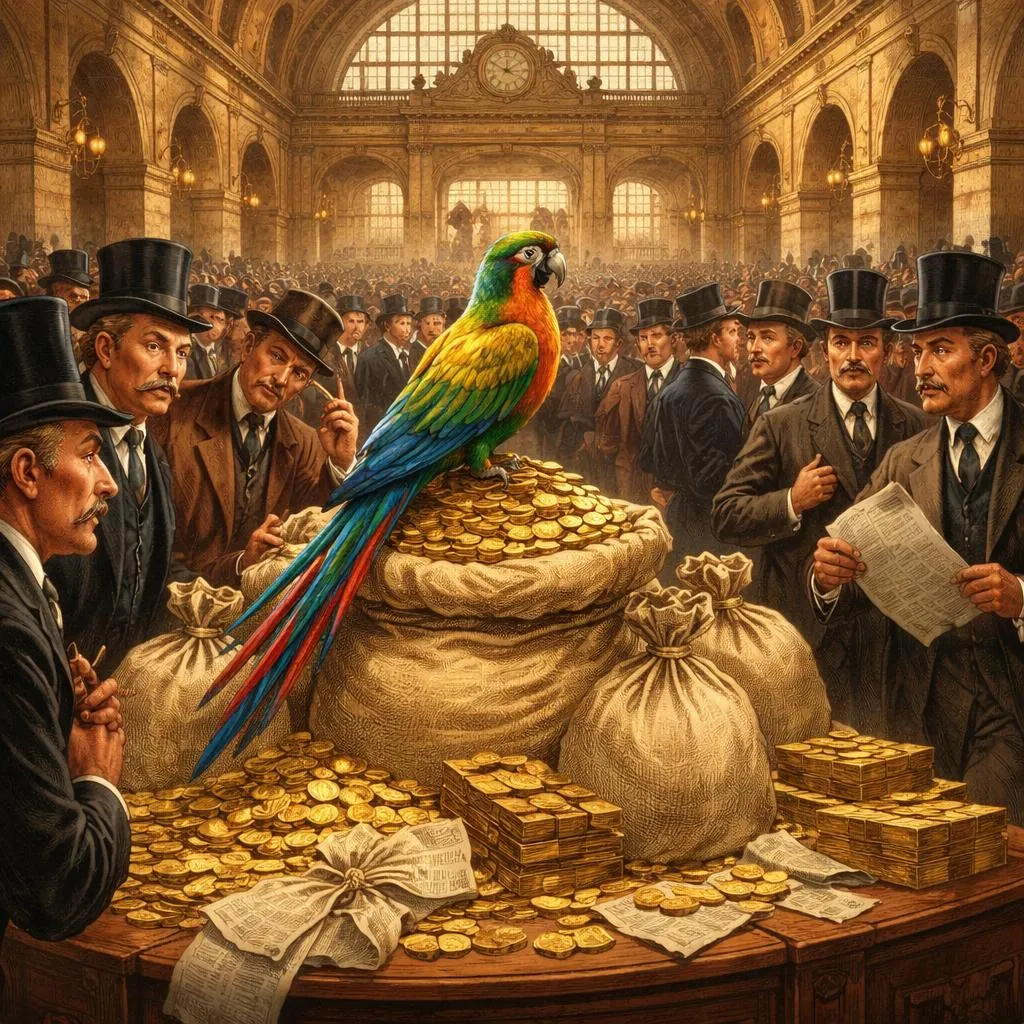

Phileas Fogg rightly suspected that his departure from London would create a lively sensation at the West End. The news of the bet spread through the Reform Club, and afforded an exciting topic of conversation to its members. From the club it soon got into the papers throughout England. The boasted "tour of the world" was talked about, disputed, argued with as much warmth as if the subject were another Alabama claim. Some took sides with Phileas Fogg, but the large majority shook their heads and declared against him; it was absurd, impossible, they declared, that the tour of the world could be made, except theoretically and on paper, in this minimum of time, and with the existing means of travelling. The Times, Standard, Morning Post, and Daily News, and twenty other highly respectable newspapers scouted Mr. Fogg's project as madness; the Daily Telegraph alone hesitatingly supported him. People in general thought him a lunatic, and blamed his Reform Club friends for having accepted a wager which betrayed the mental aberration of its proposer.
Articles no less passionate than logical appeared on the question, for geography is one of the pet subjects of the English; and the columns devoted to Phileas Fogg's venture were eagerly devoured by all classes of readers. At first some rash individuals, principally of the gentler sex, espoused his cause, which became still more popular when the Illustrated London News came out with his portrait, copied from a photograph in the Reform Club. A few readers of the Daily Telegraph even dared to say, "Why not, after all? Stranger things have come to pass."
At last a long article appeared, on the 7th of October, in the bulletin of the Royal Geographical Society, which treated the question from every point of view, and demonstrated the utter folly of the enterprise.
Everything, it said, was against the travellers, every obstacle imposed alike by man and by nature. A miraculous agreement of the times of departure and arrival, which was impossible, was absolutely necessary to his success. He might, perhaps, reckon on the arrival of trains at the designated hours, in Europe, where the distances were relatively moderate; but when he calculated upon crossing India in three days, and the United States in seven, could he rely beyond misgiving upon accomplishing his task? There were accidents to machinery, the liability of trains to run off the line, collisions, bad weather, the blocking up by snow—were not all these against Phileas Fogg? Would he not find himself, when travelling by steamer in winter, at the mercy of the winds and fogs? Is it uncommon for the best ocean steamers to be two or three days behind time? But a single delay would suffice to fatally break the chain of communication; should Phileas Fogg once miss, even by an hour; a steamer, he would have to wait for the next, and that would irrevocably render his attempt vain.
This article made a great deal of noise, and, being copied into all the papers, seriously depressed the advocates of the rash tourist.
Everybody knows that England is the world of betting men, who are of a higher class than mere gamblers; to bet is in the English temperament. Not only the members of the Reform, but the general public, made heavy wagers for or against Phileas Fogg, who was set down in the betting books as if he were a race–horse. Bonds were issued, and made their appearance on 'Change; "Phileas Fogg bonds" were offered at par or at a premium, and a great business was done in them. But five days after the article in the bulletin of the Geographical Society appeared, the demand began to subside: "Phileas Fogg" declined. They were offered by packages, at first of five, then of ten, until at last nobody would take less than twenty, fifty, a hundred!
Lord Albemarle, an elderly paralytic gentleman, was now the only advocate of Phileas Fogg left. This noble lord, who was fastened to his chair, would have given his fortune to be able to make the tour of the world, if it took ten years; and he bet five thousand pounds on Phileas Fogg. When the folly as well as the uselessness of the adventure was pointed out to him, he contented himself with replying, "If the thing is feasible, the first to do it ought to be an Englishman."
The Fogg party dwindled more and more, everybody was going against him, and the bets stood a hundred and fifty and two hundred to one; and a week after his departure an incident occurred which deprived him of backers at any price.
The commissioner of police was sitting in his office at nine o'clock one evening, when the following telegraphic dispatch was put into his hands:
Suez to London.
Rowan, Commissioner of Police, Scotland Yard:
I've found the bank robber, Phileas Fogg. Send with out delay warrant of arrest to Bombay.
Fix, Detective.
The effect of this dispatch was instantaneous. The polished gentleman disappeared to give place to the bank robber. His photograph, which was hung with those of the rest of the members at the Reform Club, was minutely examined, and it betrayed, feature by feature, the description of the robber which had been provided to the police. The mysterious habits of Phileas Fogg were recalled; his solitary ways, his sudden departure; and it seemed clear that, in undertaking a tour round the world on the pretext of a wager, he had had no other end in view than to elude the detectives, and throw them off his track.
Antecedentes e introducción al autor
Este extracto es de la novela clásica La vuelta al mundo en ochenta días de Julio Verne, un autor francés conocido por sus obras pioneras en la ciencia ficción y la literatura de aventuras. Escrita en 1873, la historia captura el espíritu de la fascinación del siglo XIX por la exploración, la tecnología y la reducción del mundo a través de los avances en el transporte. La vívida imaginación y la detallada investigación de Verne hicieron que sus novelas fueran entretenidas y educativas, inspirando a generaciones de lectores a soñar con lugares lejanos y audaces aventuras.
Resumen de la historia y su importancia
La historia sigue a Phileas Fogg, un caballero inglés preciso y adinerado, que apuesta a que puede dar la vuelta al mundo en solo ochenta días. Esta audaz apuesta prepara el escenario para un emocionante viaje lleno de desafíos, encuentros culturales y momentos de suspense. El pasaje describe la reacción pública inicial al plan de Fogg, destacando el escepticismo y la incredulidad de los periódicos y el público, así como la dinámica social en torno a las apuestas y la reputación en la Inglaterra victoriana.
El viaje de Fogg no es solo una aventura física, sino también una prueba de la determinación humana, el ingenio y el poder de la tecnología moderna. La historia explora temas como el tiempo, el progreso y el choque entre la tradición y la innovación. También reflexiona sobre la naturaleza humana: cómo reacciona la sociedad ante lo poco convencional y lo desconocido, a menudo con dudas o miedo.
Lecciones e ideas para los estudiantes
-
Coraje y determinación: La disposición de Phileas Fogg a asumir un desafío casi imposible enseña a los estudiantes el valor del coraje y la persistencia. Incluso cuando se enfrentan a dudas y obstáculos generalizados, es crucial mantenerse comprometido con los propios objetivos.
-
Pensamiento crítico y escepticismo: La reacción del público muestra cómo las personas a menudo juzgan las ideas basándose en sus propias experiencias y prejuicios. Los estudiantes pueden aprender a evaluar las nuevas ideas con cuidado, pero también a mantener una mente abierta a las posibilidades más allá de las limitaciones actuales.
-
La importancia de la planificación y la adaptabilidad: El viaje de Fogg depende de la sincronización y la coordinación precisas, pero los eventos inesperados amenazan su éxito. Esto destaca la necesidad de una planificación cuidadosa y la capacidad de adaptarse cuando las cosas no salen como se esperaba.
-
Conciencia cultural: A medida que Fogg viaja por el mundo, se encuentra con diversas culturas y entornos. Esto anima a los estudiantes a apreciar la diversidad global y a desarrollar empatía y curiosidad por otras formas de vida.
-
El papel de la tecnología: La historia muestra cómo los avances tecnológicos (como los ferrocarriles y los barcos de vapor) pueden transformar la sociedad. Los estudiantes pueden reflexionar sobre cómo la innovación impacta la vida diaria y la importancia de abrazar el cambio.
Aplicación de estas lecciones en la vida y el aprendizaje
-
En la escuela: Los estudiantes pueden aplicar el ejemplo de Fogg estableciendo metas desafiantes pero alcanzables, administrando bien su tiempo y perseverando a través de las dificultades en sus estudios.
-
En situaciones sociales: El comportamiento tranquilo y respetuoso de Fogg, a pesar de las críticas, enseña la importancia de la confianza y la integridad al enfrentarse a la presión de los compañeros o al escepticismo.
-
En el crecimiento personal: Abrazar nuevas experiencias y aprender de diferentes culturas puede ampliar la perspectiva de uno y fomentar la apertura mental.
Cultivar cualidades positivas de la historia
-
Resiliencia: Al igual que Fogg, los estudiantes deben aprender a recuperarse de los contratiempos y seguir adelante.
-
Curiosidad y exploración: Fomentar un espíritu de aventura en el aprendizaje, ya sea a través de la lectura, los viajes o los nuevos pasatiempos, puede enriquecer la vida.
-
Respeto por los demás: Comprender y valorar la diversidad, como hace Fogg durante sus viajes, ayuda a construir mejores relaciones.
Reflexión y apreciación
Leer La vuelta al mundo en ochenta días invita a los estudiantes a imaginar la emoción de la aventura mientras piensan críticamente sobre los desafíos del cambio y el progreso. Es una historia que celebra el ingenio humano y el deseo de superar los límites, inspirando a los lectores a soñar en grande y actuar con valentía. A través del viaje de Fogg, los jóvenes lectores obtienen no solo entretenimiento, sino también valiosas lecciones de vida que los animan a ser valientes, reflexivos y de corazón abierto en sus propias vidas.
