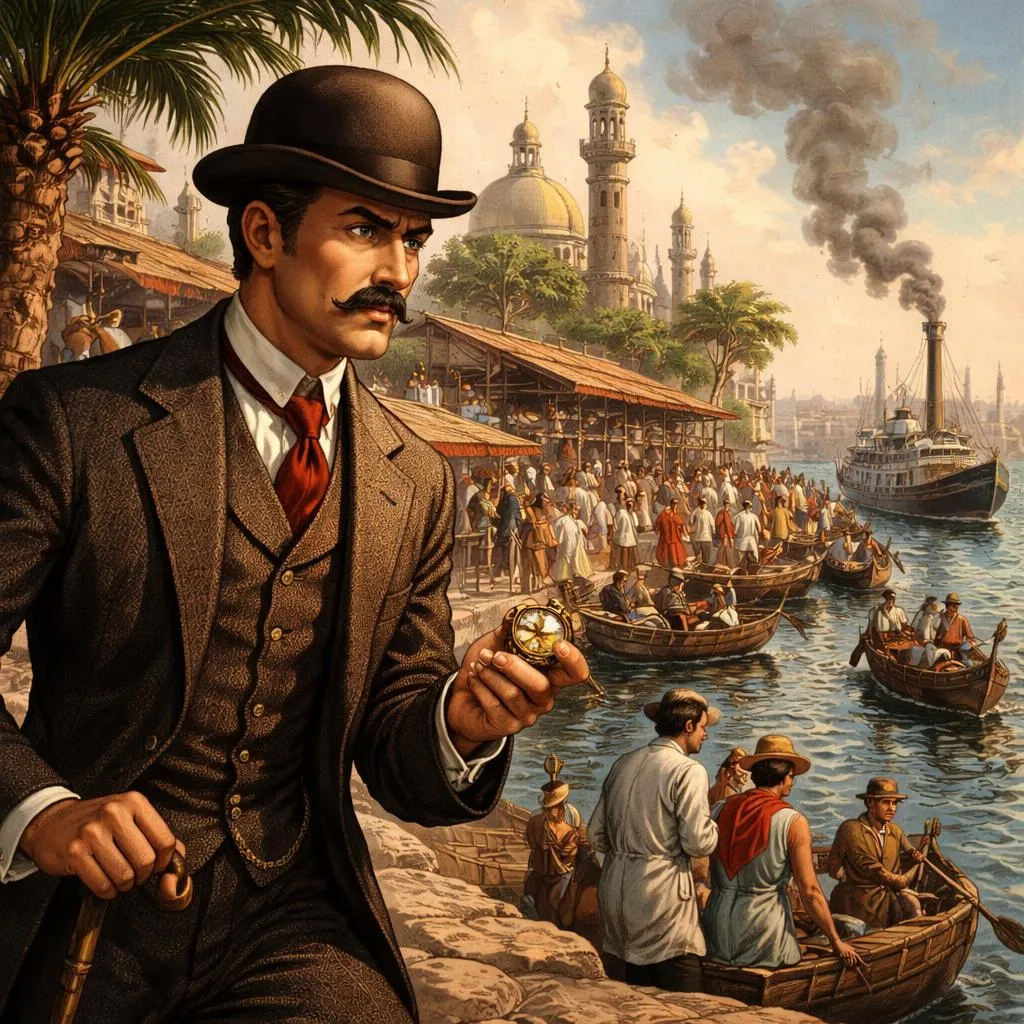

The circumstances under which this telegraphic dispatch about Phileas Fogg was sent were as follows:
The steamer Mongolia, belonging to the Peninsular and Oriental Company, built of iron, of two thousand eight hundred tons burden, and five hundred horse–power, was due at eleven o'clock a.m. on Wednesday, the 9th of October, at Suez. The Mongolia plied regularly between Brindisi and Bombay via the Suez Canal, and was one of the fastest steamers belonging to the company, always making more than ten knots an hour between Brindisi and Suez, and nine and a half between Suez and Bombay.
Two men were promenading up and down the wharves, among the crowd of natives and strangers who were sojourning at this once straggling village—now, thanks to the enterprise of M. Lesseps, a fast–growing town. One was the British consul at Suez, who, despite the prophecies of the English Government, and the unfavourable predictions of Stephenson, was in the habit of seeing, from his office window, English ships daily passing to and fro on the great canal, by which the old roundabout route from England to India by the Cape of Good Hope was abridged by at least a half. The other was a small, slight–built personage, with a nervous, intelligent face, and bright eyes peering out from under eyebrows which he was incessantly twitching. He was just now manifesting unmistakable signs of impatience, nervously pacing up and down, and unable to stand still for a moment. This was Fix, one of the detectives who had been dispatched from England in search of the bank robber; it was his task to narrowly watch every passenger who arrived at Suez, and to follow up all who seemed to be suspicious characters, or bore a resemblance to the description of the criminal, which he had received two days before from the police headquarters at London. The detective was evidently inspired by the hope of obtaining the splendid reward which would be the prize of success, and awaited with a feverish impatience, easy to understand, the arrival of the steamer Mongolia.
"So you say, consul," asked he for the twentieth time, "that this steamer is never behind time?"
"No, Mr. Fix," replied the consul. "She was bespoken yesterday at Port Said, and the rest of the way is of no account to such a craft. I repeat that the Mongolia has been in advance of the time required by the company's regulations, and gained the prize awarded for excess of speed."
"Does she come directly from Brindisi?"
"Directly from Brindisi; she takes on the Indian mails there, and she left there Saturday at five p.m. Have patience, Mr. Fix; she will not be late. But really, I don't see how, from the description you have, you will be able to recognise your man, even if he is on board the Mongolia."
"A man rather feels the presence of these fellows, consul, than recognises them. You must have a scent for them, and a scent is like a sixth sense which combines hearing, seeing, and smelling. I've arrested more than one of these gentlemen in my time, and, if my thief is on board, I'll answer for it; he'll not slip through my fingers."
"I hope so, Mr. Fix, for it was a heavy robbery."
"A magnificent robbery, consul; fifty–five thousand pounds! We don't often have such windfalls. Burglars are getting to be so contemptible nowadays! A fellow gets hung for a handful of shillings!"
"Mr. Fix," said the consul, "I like your way of talking, and hope you'll succeed; but I fear you will find it far from easy. Don't you see, the description which you have there has a singular resemblance to an honest man?"
"Consul," remarked the detective, dogmatically, "great robbers always resemble honest folks. Fellows who have rascally faces have only one course to take, and that is to remain honest; otherwise they would be arrested off–hand. The artistic thing is, to unmask honest countenances; it's no light task, I admit, but a real art."
Mr. Fix evidently was not wanting in a tinge of self–conceit.
Little by little the scene on the quay became more animated; sailors of various nations, merchants, ship–brokers, porters, fellahs, bustled to and fro as if the steamer were immediately expected. The weather was clear, and slightly chilly. The minarets of the town loomed above the houses in the pale rays of the sun. A jetty pier, some two thousand yards along, extended into the roadstead. A number of fishing–smacks and coasting boats, some retaining the fantastic fashion of ancient galleys, were discernible on the Red Sea.
As he passed among the busy crowd, Fix, according to habit, scrutinised the passers–by with a keen, rapid glance.
It was now half–past ten.
"The steamer doesn't come!" he exclaimed, as the port clock struck.
"She can't be far off now," returned his companion.
"How long will she stop at Suez?"
"Four hours; long enough to get in her coal. It is thirteen hundred and ten miles from Suez to Aden, at the other end of the Red Sea, and she has to take in a fresh coal supply."
"And does she go from Suez directly to Bombay?"
"Without putting in anywhere."
"Good!" said Fix. "If the robber is on board he will no doubt get off at Suez, so as to reach the Dutch or French colonies in Asia by some other route. He ought to know that he would not be safe an hour in India, which is English soil."
"Unless," objected the consul, "he is exceptionally shrewd. An English criminal, you know, is always better concealed in London than anywhere else."
This observation furnished the detective food for thought, and meanwhile the consul went away to his office. Fix, left alone, was more impatient than ever, having a presentiment that the robber was on board the Mongolia. If he had indeed left London intending to reach the New World, he would naturally take the route via India, which was less watched and more difficult to watch than that of the Atlantic. But Fix's reflections were soon interrupted by a succession of sharp whistles, which announced the arrival of the Mongolia. The porters and fellahs rushed down the quay, and a dozen boats pushed off from the shore to go and meet the steamer. Soon her gigantic hull appeared passing along between the banks, and eleven o'clock struck as she anchored in the road. She brought an unusual number of passengers, some of whom remained on deck to scan the picturesque panorama of the town, while the greater part disembarked in the boats, and landed on the quay.
Fix took up a position, and carefully examined each face and figure which made its appearance. Presently one of the passengers, after vigorously pushing his way through the importunate crowd of porters, came up to him and politely asked if he could point out the English consulate, at the same time showing a passport which he wished to have visaed. Fix instinctively took the passport, and with a rapid glance read the description of its bearer. An involuntary motion of surprise nearly escaped him, for the description in the passport was identical with that of the bank robber which he had received from Scotland Yard.
"Is this your passport?" asked he.
"No, it's my master's."
"And your master is—"
"He stayed on board."
"But he must go to the consul's in person, so as to establish his identity."
"Oh, is that necessary?"
"Quite indispensable."
"And where is the consulate?"
"There, on the corner of the square," said Fix, pointing to a house two hundred steps off.
"I'll go and fetch my master, who won't be much pleased, however, to be disturbed."
The passenger bowed to Fix, and returned to the steamer.
Contexto e introducción del autor
Este extracto es de la novela de aventuras clásica La vuelta al mundo en ochenta días, escrita por el autor francés Julio Verne en 1873. Verne es conocido como uno de los pioneros de la ciencia ficción y la literatura de aventuras. Sus obras a menudo combinan conocimientos científicos detallados con una narración emocionante, inspirando a generaciones de lectores a explorar el mundo e imaginar nuevas posibilidades. La vuelta al mundo en ochenta días captura el espíritu de la fascinación del siglo XIX por los viajes, la tecnología y la exploración, centrado en el audaz viaje de Phileas Fogg, un meticuloso caballero inglés que apuesta a que puede circunnavegar el globo en solo ochenta días.
Interpretación detallada de la historia y su significado
En este pasaje, vemos al detective Fix esperando ansiosamente la llegada del vapor Mongolia en el Canal de Suez, con la esperanza de atrapar a un ladrón de bancos que se cree que está a bordo. La escena es vívida y bulliciosa, mostrando la importancia del Canal de Suez como un punto estratégico que conecta Europa y Asia. El diálogo entre Fix y el cónsul británico destaca temas de sospecha, identidad y el desafío de distinguir la verdad de las apariencias. La creencia de Fix de que los grandes criminales a menudo parecen hombres honestos agrega una capa de ironía y complejidad a la historia, recordando a los lectores que las apariencias pueden ser engañosas.
Esta parte de la historia prepara el escenario para el suspense y la intriga que seguirán a medida que se desarrolla el viaje de Phileas Fogg. También refleja los avances tecnológicos de la época: barcos de vapor, telégrafos y comunicación global, que hicieron posible tal viaje y capturaron la imaginación de los lectores de todo el mundo.
Lecciones y conocimientos para los estudiantes
-
Pensamiento crítico y percepción: La dificultad de Fix para identificar al criminal basándose en la apariencia nos enseña que no debemos juzgar a las personas únicamente por su apariencia. En cambio, debemos desarrollar habilidades de pensamiento crítico y profundizar en los hechos y comportamientos antes de formar opiniones.
-
Paciencia y observación: La espera de Fix y su cuidadoso escrutinio de los pasajeros muestran la importancia de la paciencia y la atención al detalle, habilidades valiosas tanto en el estudio académico como en la vida cotidiana.
-
Coraje y determinación: El viaje de Phileas Fogg, insinuado en este pasaje, es un testimonio del coraje y la determinación humanos. Los estudiantes pueden aprender a establecer metas ambiciosas y perseguirlas con perseverancia, incluso cuando se enfrentan a la incertidumbre.
-
El valor de la tecnología y la innovación: La novela celebra el poder de las nuevas tecnologías como los barcos de vapor y los telégrafos, animando a los estudiantes a apreciar el progreso científico y su impacto en la sociedad.
Aplicaciones en la vida, el aprendizaje y las situaciones sociales
-
En el aprendizaje: Así como Fix analiza cuidadosamente las pistas, los estudiantes deben desarrollar sólidas habilidades de observación y análisis para resolver problemas y comprender temas complejos.
-
En las interacciones sociales: La historia advierte contra hacer juicios rápidos sobre los demás. Los estudiantes pueden practicar la empatía y la apertura mental al conocer a las personas más allá de las primeras impresiones.
-
En el crecimiento personal: El espíritu de aventura y resiliencia mostrado por Fogg anima a los estudiantes a aceptar los desafíos y mantener la calma bajo presión, cualidades que les ayudarán en los exámenes, proyectos y futuras carreras.
Cultivando valores positivos de la historia
-
Honestidad e integridad: A pesar de la sospecha del detective, la novela finalmente celebra la honestidad. Los estudiantes deben esforzarse por ser confiables y sinceros en sus acciones.
-
Curiosidad y apertura mental: La obra de Verne inspira curiosidad por el mundo. Los estudiantes pueden cultivar el amor por el aprendizaje explorando nuevas culturas, ciencias e ideas.
-
Perseverancia: El compromiso inquebrantable de Fogg con su objetivo enseña la importancia de la persistencia, incluso cuando surgen obstáculos.
Conclusión
La vuelta al mundo en ochenta días es más que una simple aventura emocionante; es una rica fuente de lecciones sobre la naturaleza humana, la tecnología y el espíritu de exploración. Al leer y reflexionar sobre esta historia, los estudiantes pueden desarrollar valiosas habilidades y actitudes que les servirán bien en la escuela y en la vida. Abrazar la curiosidad, la paciencia y la determinación ejemplificadas en la novela puede ayudar a los jóvenes lectores a convertirse en individuos reflexivos, valientes y de mente abierta, listos para navegar por sus propios viajes en el mundo.
