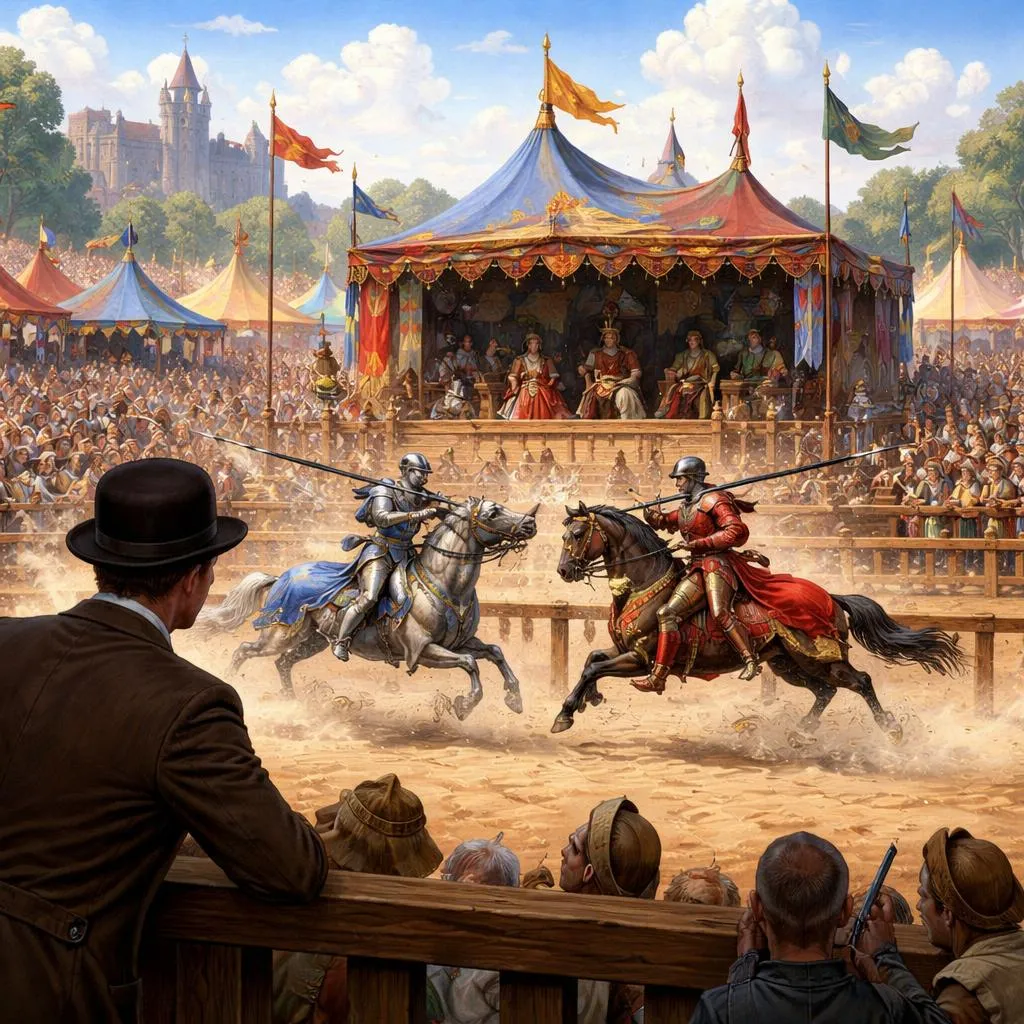

They were always having grand tournaments there at Camelot; and very stirring and picturesque and ridiculous human bull-fights they were, too, but just a little wearisome to the practical mind. However, I was generally on hand—for two reasons: a man must not hold himself aloof from the things which his friends and his community have at heart if he would be liked—especially as a statesman; and both as business man and statesman I wanted to study the tournament and see if I couldn’t invent an improvement on it. That reminds me to remark, in passing, that the very first official thing I did, in my administration—and it was on the very first day of it, too—was to start a patent office; for I knew that a country without a patent office and good patent laws was just a crab, and couldn’t travel any way but sideways or backways.
Things ran along, a tournament nearly every week; and now and then the boys used to want me to take a hand—I mean Sir Launcelot and the rest—but I said I would by and by; no hurry yet, and too much government machinery to oil up and set to rights and start a-going.
We had one tournament which was continued from day to day during more than a week, and as many as five hundred knights took part in it, from first to last. They were weeks gathering. They came on horseback from everywhere; from the very ends of the country, and even from beyond the sea; and many brought ladies, and all brought squires and troops of servants. It was a most gaudy and gorgeous crowd, as to costumery, and very characteristic of the country and the time, in the way of high animal spirits, innocent indecencies of language, and happy-hearted indifference to morals. It was fight or look on, all day and every day; and sing, gamble, dance, carouse half the night every night. They had a most noble good time. You never saw such people. Those banks of beautiful ladies, shining in their barbaric splendors, would see a knight sprawl from his horse in the lists with a lanceshaft the thickness of your ankle clean through him and the blood spouting, and instead of fainting they would clap their hands and crowd each other for a better view; only sometimes one would dive into her handkerchief, and look ostentatiously broken-hearted, and then you could lay two to one that there was a scandal there somewhere and she was afraid the public hadn’t found it out.
The noise at night would have been annoying to me ordinarily, but I didn’t mind it in the present circumstances, because it kept me from hearing the quacks detaching legs and arms from the day’s cripples. They ruined an uncommon good old cross-cut saw for me, and broke the saw-buck, too, but I let it pass. And as for my axe—well, I made up my mind that the next time I lent an axe to a surgeon I would pick my century.
I not only watched this tournament from day to day, but detailed an intelligent priest from my Department of Public Morals and Agriculture, and ordered him to report it; for it was my purpose by and by, when I should have gotten the people along far enough, to start a newspaper. The first thing you want in a new country, is a patent office; then work up your school system; and after that, out with your paper. A newspaper has its faults, and plenty of them, but no matter, it’s hark from the tomb for a dead nation, and don’t you forget it. You can’t resurrect a dead nation without it; there isn’t any way. So I wanted to sample things, and be finding out what sort of reporter-material I might be able to rake together out of the sixth century when I should come to need it.
Well, the priest did very well, considering. He got in all the details, and that is a good thing in a local item: you see, he had kept books for the undertaker-department of his church when he was younger, and there, you know, the money’s in the details; the more details, the more swag: bearers, mutes, candles, prayers —everything counts; and if the bereaved don’t buy prayers enough you mark up your candles with a forked pencil, and your bill shows up all right. And he had a good knack at getting in the complimentary thing here and there about a knight that was likely to advertise—no, I mean a knight that had influence; and he also had a neat gift of exaggeration, for in his time he had kept door for a pious hermit who lived in a sty and worked miracles.
Of course this novice’s report lacked whoop and crash and lurid description, and therefore wanted the true ring; but its antique wording was quaint and sweet and simple, and full of the fragrances and flavors of the time, and these little merits made up in a measure for its more important lacks. Here is an extract from it:
Then Sir Brian de les Isles and Grummore Grummorsum, knights of the castle, encountered with Sir Aglovale and Sir Tor, and Sir Tor smote down Sir Grummore Grummorsum to the earth. Then came Sir Carados of the dolorous tower, and Sir Turquine, knights of the castle, and there encountered with them Sir Percivale de Galis and Sir Lamorak de Galis, that were two brethren, and there encountered Sir Percivale with Sir Carados, and either brake their spears unto their hands, and then Sir Turquine with Sir Lamorak, and either of them smote down other, horse and all, to the earth, and either parties rescued other and horsed them again. And Sir Arnold, and Sir Gauter, knights of the castle, encountered with Sir Brandiles and Sir Kay, and these four knights encountered mightily, and brake their spears to their hands. Then came Sir Pertolope from the castle, and there encountered with him Sir Lionel, and there Sir Pertolope the green knight smote down Sir Lionel, brother to Sir Launcelot. All this was marked by noble heralds, who bare him best, and their names. Then Sir Bleobaris brake his spear upon Sir Gareth, but of that stroke Sir Bleobaris fell to the earth. When Sir Galihodin saw that, he bad Sir Gareth keep him, and Sir Gareth smote him to the earth. Then Sir Galihud gat a spear to avenge his brother, and in the same wise Sir Gareth served him, and Sir Dinadan and his brother La Cote Male Taile, and Sir Sagramore le Disirous, and Sir Dodinas le Savage; all these he bare down with one spear. When King Aswisance of Ireland saw Sir Gareth fare so he marveled what he might be, that one time seemed green, and another time, at his again coming, he seemed blue. And thus at every course that he rode to and fro he changed his color, so that there might neither king nor knight have ready cognizance of him. Then Sir Agwisance the King of Ireland encountered with Sir Gareth, and there Sir Gareth smote him from his horse, saddle and all. And then came King Carados of Scotland, and Sir Gareth smote him down horse and man. And in the same wise he served King Uriens of the land of Gore. And then there came in Sir Bagdemagus, and Sir Gareth smote him down horse and man to the earth. And Bagdemagus’s son Meliganus brake a spear upon Sir Gareth mightily and knightly. And then Sir Galahault the noble prince cried on high, Knight with the many colors, well hast thou justed; now make thee ready that I may just with thee. Sir Gareth heard him, and he gat a great spear, and so they encountered together, and there the prince brake his spear; but Sir Gareth smote him upon the left side of the helm, that he reeled here and there, and he had fallen down had not his men recovered him. Truly, said King Arthur, that knight with the many colors is a good knight. Wherefore the king called unto him Sir Launcelot, and prayed him to encounter with that knight. Sir, said Launcelot, I may as well find in my heart for to forbear him at this time, for he hath had travail enough this day, and when a good knight doth so well upon some day, it is no good knight’s part to let him of his worship, and, namely, when he seeth a knight hath done so great labour; for peradventure, said Sir Launcelot, his quarrel is here this day, and peradventure he is best beloved with this lady of all that be here, for I see well he paineth himself and enforceth him to do great deeds, and therefore, said Sir Launcelot, as for me, this day he shall have the honour; though it lay in my power to put him from it, I would not. There was an unpleasant little episode that day, which for reasons of state I struck out of my priest’s report. You will have noticed that Garry was doing some great fighting in the engagement. When I say Garry I mean Sir Gareth. Garry was my private pet name for him; it suggests that I had a deep affection for him, and that was the case. But it was a private pet name only, and never spoken aloud to any one, much less to him; being a noble, he would not have endured a familiarity like that from me. Well, to proceed: I sat in the private box set apart for me as the king’s minister. While Sir Dinadan was waiting for his turn to enter the lists, he came in there and sat down and began to talk; for he was always making up to me, because I was a stranger and he liked to have a fresh market for his jokes, the most of them having reached that stage of wear where the teller has to do the laughing himself while the other person looks sick. I had always responded to his efforts as well as I could, and felt a very deep and real kindness for him, too, for the reason that if by malice of fate he knew the one particular anecdote which I had heard oftenest and had most hated and most loathed all my life, he had at least spared it me. It was one which I had heard attributed to every humorous person who had ever stood on American soil, from Columbus down to Artemus Ward. It was about a humorous lecturer who flooded an ignorant audience with the killingest jokes for an hour and never got a laugh; and then when he was leaving, some gray simpletons wrung him gratefully by the hand and said it had been the funniest thing they had ever heard, and “it was all they could do to keep from laughin’ right out in meetin’.” That anecdote never saw the day that it was worth the telling; and yet I had sat under the telling of it hundreds and thousands and millions and billions of times, and cried and cursed all the way through. Then who can hope to know what my feelings were, to hear this armor-plated ass start in on it again, in the murky twilight of tradition, before the dawn of history, while even Lactantius might be referred to as “the late Lactantius,” and the Crusades wouldn’t be born for five hundred years yet? Just as he finished, the call-boy came; so, haw-hawing like a demon, he went rattling and clanking out like a crate of loose castings, and I knew nothing more. It was some minutes before I came to, and then I opened my eyes just in time to see Sir Gareth fetch him an awful welt, and I unconsciously out with the prayer, “I hope to gracious he’s killed!” But by ill-luck, before I had got half through with the words, Sir Gareth crashed into Sir Sagramor le Desirous and sent him thundering over his horse’s crupper, and Sir Sagramor caught my remark and thought I meant it for him .
Well, whenever one of those people got a thing into his head, there was no getting it out again. I knew that, so I saved my breath, and offered no explanations. As soon as Sir Sagramor got well, he notified me that there was a little account to settle between us, and he named a day three or four years in the future; place of settlement, the lists where the offense had been given. I said I would be ready when he got back. You see, he was going for the Holy Grail. The boys all took a flier at the Holy Grail now and then. It was a several years’ cruise. They always put in the long absence snooping around, in the most conscientious way, though none of them had any idea where the Holy Grail really was, and I don’t think any of them actually expected to find it, or would have known what to do with it if he had run across it. You see, it was just the Northwest Passage of that day, as you may say; that was all. Every year expeditions went out holy grailing, and next year relief expeditions went out to hunt for them . There was worlds of reputation in it, but no money. Why, they actually wanted me to put in! Well, I should smile.
Trasfondo e Introducción del Autor
Este pasaje es una vívida descripción de los torneos celebrados en Camelot, un castillo y corte legendarios asociados con el legendario Rey Arturo. La historia se basa en la rica tradición de las leyendas artúricas, que se han contado y recontado durante siglos. Estos cuentos a menudo exploran temas de caballería, honor, valentía y la búsqueda de ideales nobles. Las historias originales se transmitieron a través de la literatura medieval, con contribuyentes famosos como Sir Thomas Malory, cuyo trabajo "Le Morte d'Arthur" es una de las colecciones más conocidas de leyendas artúricas.
El narrador en este pasaje parece ser un observador reflexivo, posiblemente un estadista o funcionario, que está interesado no solo en el espectáculo de los torneos, sino también en las implicaciones sociales y políticas que tienen. El informe detallado del sacerdote añade un sabor histórico, enfatizando la importancia de registrar los eventos con precisión para las generaciones futuras.
Interpretación Detallada y Significado
Los torneos en Camelot se presentan como eventos grandiosos y coloridos llenos de emoción, competencia e interacción social. Caballeros de todas partes se reúnen para demostrar su valor y habilidad en combate, mientras que las damas de la corte observan con entusiasmo, a veces con reacciones sorprendentes a la violencia. Este escenario refleja la cultura medieval de la caballería, donde se esperaba que los caballeros defendieran el honor, protegieran a los débiles y participaran en concursos de fuerza y coraje.
Sin embargo, el pasaje también insinúa las contradicciones de este mundo: las "indecencias inocentes del lenguaje" y la "feliz indiferencia a la moral" sugieren una sociedad que es a la vez vibrante y defectuosa. La visión pragmática del narrador, preocupada por el gobierno, la invención y el orden social, añade una capa de realismo a la imagen romantizada de Camelot.
El relato detallado de las batallas de Sir Gareth ilustra el ideal heroico del caballero que lucha con valentía y se gana el respeto a través de sus acciones en lugar de sus títulos. La interacción entre los caballeros, los desafíos que enfrentan y el respeto que inspiran resaltan los valores de la perseverancia, la lealtad y el coraje.
Lecciones y Perspectivas para Estudiantes
-
Coraje y Perseverancia: La disposición de los caballeros a enfrentar el peligro repetidamente enseña la importancia de la valentía y la persistencia para superar los desafíos. Los estudiantes pueden aprender a enfrentar sus propias dificultades con una determinación similar.
-
Respeto y Honor: El código de caballería, aunque idealizado, enfatiza el respeto por los demás, la justicia en la competencia y el honor en las acciones. Estos valores son esenciales en la escuela, las amistades y las futuras carreras.
-
Comunidad y Participación: La decisión del narrador de asistir a los torneos a pesar de sus reservas personales muestra la importancia de participar en la comunidad y apoyar los intereses compartidos.
-
Pensamiento Crítico: El interés del narrador en mejorar el torneo y comenzar instituciones como una oficina de patentes anima a los estudiantes a pensar críticamente sobre las tradiciones y buscar formas de innovar y mejorar la sociedad.
-
Registro y Reflexión: El informe detallado del sacerdote nos recuerda el valor de documentar las experiencias y aprender de ellas, un hábito útil para los estudiantes en sus estudios y crecimiento personal.
Aplicando Estas Lecciones en la Vida Diaria
-
En la Escuela: Los estudiantes pueden aplicar el coraje abordando temas o proyectos difíciles sin temor al fracaso. Pueden practicar el honor siendo honestos en su trabajo y respetuosos con los profesores y compañeros de clase.
-
En Entornos Sociales: Mostrar respeto y justicia en las interacciones ayuda a construir amistades sólidas y a resolver conflictos pacíficamente.
-
En el Desarrollo Personal: Abrazar la perseverancia ayuda a los estudiantes a seguir adelante incluso cuando las tareas parecen difíciles, ya sea en deportes, artes o académicos.
-
En la Creatividad y la Innovación: Al igual que el interés del narrador en la invención, se debe alentar a los estudiantes a pensar creativamente y sugerir mejoras en su entorno.
Cultivando Rasgos Positivos de la Historia
-
Valentía: Anime a los estudiantes a asumir nuevos desafíos, entendiendo que el fracaso es parte del crecimiento.
-
Respeto: Enseñar la importancia de tratar a los demás con amabilidad y justicia, independientemente de las diferencias.
-
Espíritu Comunitario: Promover la participación en actividades grupales, clubes o trabajo voluntario para desarrollar un sentido de pertenencia.
-
Indagación Crítica: Fomentar la curiosidad y el cuestionamiento, ayudando a los estudiantes a no aceptar las cosas al pie de la letra, sino a explorar significados y posibilidades más profundas.
Conclusión
La historia de los torneos en Camelot ofrece más que solo cuentos emocionantes de caballeros y batallas. Proporciona una ventana a un mundo donde ideales como el coraje, el honor y la comunidad cobran vida. Para los estudiantes y los jóvenes lectores, estas historias inspiran no solo la imaginación, sino también valiosas lecciones de vida. Al aprender de las virtudes de los caballeros y la perspectiva reflexiva del narrador, los jóvenes pueden desarrollar cualidades que les ayudarán a tener éxito y a contribuir positivamente a sus comunidades.
